The Five Platonic Solids, Explained
After reading this you can name all five Platonic solids, count their vertices, edges and faces, check Euler's formula on each, and explain why no sixth solid exists.
What a Platonic solid is
A Platonic solid is a convex polyhedron built from one kind of regular polygon, with the same number of polygons meeting at every vertex. That single rule is strict. It rules out shapes that look regular but are not, and it leaves exactly five survivors.
Here is the whole family. The tetrahedron uses 4 triangles. The cube uses 6 squares. The octahedron uses 8 triangles. The dodecahedron uses 12 pentagons. The icosahedron uses 20 triangles. Nothing else qualifies. Not four, not six, but exactly five.
The hook: take a cube and mark the centre of each of its 6 faces. Connect centres that share an edge. You get an octahedron with 6 vertices, one per cube face. Do the same to the octahedron and you get the cube back. The two solids trade the roles of vertex and face. That relationship is called duality, and the explorer highlights it directly.
The count for each solid
Every Platonic solid is fixed by three numbers: V vertices, E edges and F faces. You can derive E and F from the faces alone. Suppose each face is a regular p-gon and q faces meet at each vertex.
Each face contributes p edge-sides, and every edge is shared by exactly 2 faces, so the edge count is pF/2. Each face contributes p corners, and every vertex is shared by exactly q faces, so the vertex count is pF/q. For the cube, p = 4, q = 3, F = 6: edges are 4 \cdot 6 / 2 = 12 and vertices are 4 \cdot 6 / 3 = 8. Those match the cube you can spin in the tool.
| Solid | Face | V | E | F | V − E + F |
|---|---|---|---|---|---|
| Tetrahedron | triangle | 4 | 6 | 4 | 2 |
| Cube | square | 8 | 12 | 6 | 2 |
| Octahedron | triangle | 6 | 12 | 8 | 2 |
| Dodecahedron | pentagon | 20 | 30 | 12 | 2 |
| Icosahedron | triangle | 12 | 30 | 20 | 2 |
Read the last column. Every solid gives 2. That is Euler's formula, and it is the next section.
Euler's formula and why it holds
For any convex polyhedron, the three counts obey a fixed relation.
Here V is the number of vertices, E the number of edges, and F the number of faces. The right side is always 2, not just for the Platonic five but for any convex polyhedron. A soccer ball made of 12 pentagons and 20 hexagons has V = 60, E = 90, F = 32, and 60 - 90 + 32 = 2.
One way to see why: imagine deflating the polyhedron onto a flat plane, so its edges become a connected graph drawn without crossings. One face becomes the unbounded outer region. Now build the graph up edge by edge from a single vertex. Adding a vertex with one new edge changes V - E + F by +1 - 1 + 0 = 0. Adding an edge that closes a loop creates one new face and changes it by 0 - 1 + 1 = 0. The quantity never moves. A single point starts at 1 - 0 + 1 = 2 when you count the outer region, and it stays 2 forever.
Euler's formula fails on shapes that are not topologically a sphere. A picture-frame solid with one hole through it gives V - E + F = 0. The general rule is V - E + F = 2 - 2g, where g counts holes. All five Platonic solids have g = 0.
Why there are exactly five
The proof is short and uses only the angle at a vertex. At any vertex of a convex solid, the face angles meeting there must sum to less than 360^\circ. If they summed to exactly 360^\circ the surface would lie flat, and above that it could not close into a solid. You also need at least 3 faces at each vertex.
Now test each regular polygon. An equilateral triangle has a corner angle of 60^\circ. Three of them give 180^\circ (tetrahedron), four give 240^\circ (octahedron), five give 300^\circ (icosahedron). Six triangles give exactly 360^\circ, which is flat, so it fails. That is three triangle solids and no more.
A square has a corner angle of 90^\circ. Three squares give 270^\circ (cube). Four give 360^\circ, flat, so it fails. One square solid.
A regular pentagon has a corner angle of 108^\circ. Three give 324^\circ (dodecahedron). Four give 432^\circ, over the limit, so it fails. One pentagon solid.
A regular hexagon has a corner angle of 120^\circ. Three already give 360^\circ, flat, so no hexagon solid exists, and larger polygons only make the angle bigger. The count stops at 3 + 1 + 1 = 5.
Reproducing the explorer, face by face
Open the tool with its default view and step through the dodecahedron. Confirm the counts by hand.
- The dodecahedron has F = 12 pentagonal faces, so p = 5.
- Edges: E = pF/2 = 5 \cdot 12 / 2 = 30.
- Three faces meet at each vertex, so q = 3, giving V = pF/q = 5 \cdot 12 / 3 = 20.
- Check Euler: V - E + F = 20 - 30 + 12 = 2.
- Now the dual. Swap V and F: a solid with 12 vertices, 30 edges, 20 faces. That is the icosahedron. The edge count stays 30, which is why the tool draws them as a linked pair.
Reading duality in the explorer
The five solids fall into two dual pairs and one self-dual loner. The cube and octahedron are dual: put a vertex at the centre of each face of one, and you build the other. Their counts confirm it. The cube has (V,E,F) = (8,12,6), the octahedron has (6,12,8). Swap the first and last numbers and keep the middle one.
The dodecahedron and icosahedron are the other pair, with (20,30,12) and (12,30,20). Same swap, same shared edge count of 30. The tetrahedron is its own dual: putting a vertex at each face centre produces another tetrahedron, since it has (4,6,4) and swapping V with F changes nothing.
Common mistakes
The first error is counting shared edges twice. Each face of a cube has 4 sides, and 6 faces give 6 \times 4 = 24 face-sides, but every edge is shared by two faces, so the true edge count is 24 / 2 = 12. Forget the division and you get 24, and Euler's formula breaks with 8 - 24 + 6 = -10.
The second is calling a shape Platonic when its vertices are not all identical. Cut the corners off a cube and you get a truncated cube with regular faces of two kinds (triangles and octagons). It is an Archimedean solid, not a Platonic one, because the rule demands one face type and one vertex type. Euler's formula still holds for it: 24 - 36 + 14 = 2.
Do not read the angle-sum bound as a claim about the real world. It is a statement in Euclidean geometry. On a sphere, three triangles with three 120^\circ angles fit fine, and hyperbolic space lets even more faces meet at a vertex. The five-solid count is exact only for flat space.
Related tools
To rotate a four-dimensional cube and watch its shadow, see the Tesseract projection. To understand the 3D rotations that spin these solids, try the Quaternion rotation visualizer. For tilings that break the flat-space rules on purpose, the Hyperbolic tiling explorer packs polygons that no flat plane allows. If you want another famous face-and-region count, the Four color map uses the same planar-graph reasoning as Euler's proof, and the Penrose tiling generator shows five-fold symmetry appearing where periodic tiles cannot.
Frequently asked questions
Why are there only five Platonic solids?
Because the face angles at any vertex of a convex solid must sum to less than 360^\circ, and you need at least 3 faces per vertex. Only five polygon-and-vertex combinations satisfy both: three, four or five triangles, three squares, and three pentagons. Six triangles, four squares, four pentagons, and any hexagon arrangement all reach or exceed 360^\circ.
Does Euler's formula work for shapes with curved faces?
The formula counts vertices, edges and faces on any surface that is topologically a sphere, curved or not. A cube and a beach ball with 8 dots, 12 arcs and 6 patches drawn on it give the same 8 - 12 + 6 = 2. What matters is the topology, not the straightness.
What does it mean for two solids to be dual?
Place a new vertex at the centre of each face, then join new vertices whose faces shared an edge. The result is the dual solid. Vertices and faces trade places while the edge count stays fixed. The cube's 6 faces become the octahedron's 6 vertices.
Is the tetrahedron really its own dual?
Yes. It has 4 vertices and 4 faces, so swapping those counts leaves the same numbers. Building the dual gives a smaller tetrahedron in the opposite orientation, the same shape scaled and turned.
Where do these shapes actually show up?
Fluorite crystals form octahedra, pyrite forms cubes, and many viruses pack their protein shells into icosahedra because 20 identical triangular faces give an efficient near-spherical cage. Dice sets use all five so that each face has an equal chance of landing up.
Related tools
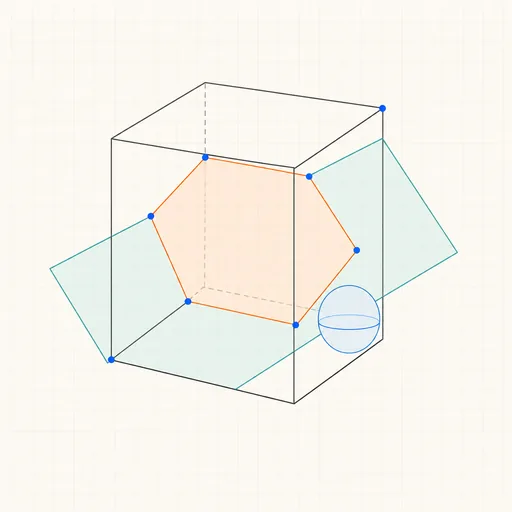
3D Geometry Board
Points, lines, planes, spheres and polyhedra on an orbiting camera — slice solids with planes, unfold nets, drop the Dandelin spheres into a cone and drag everything.
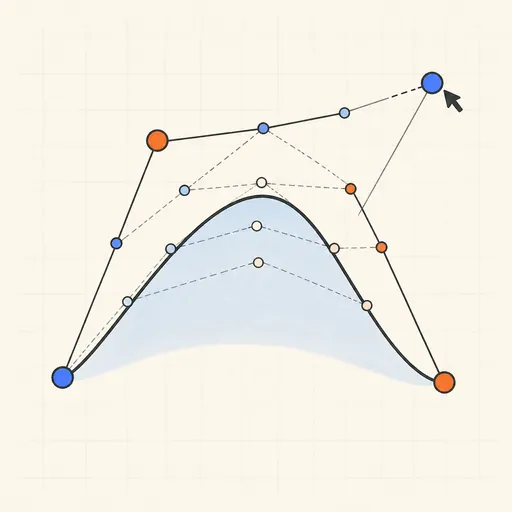
Bézier Curve Playground
Drag control points and watch De Casteljau’s algorithm construct a Bézier curve step by step.
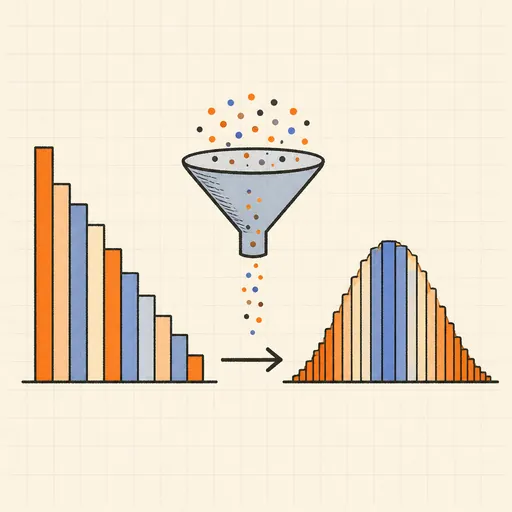
Central Limit Theorem Demo
Sample from any lopsided distribution and watch the averages pile up into a bell curve.
Conway’s Game of Life
Paint cells and watch Conway’s cellular automaton breed gliders, guns and oscillators.
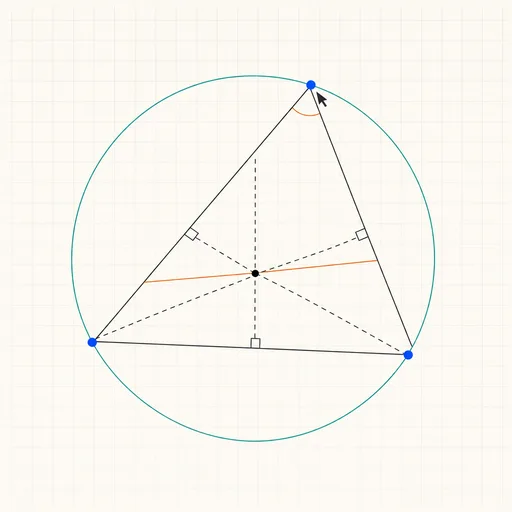
Dynamic Geometry Board
Construct with points, lines, circles and transformations, then drag anything — the construction stays true, and a checker tells you which relations are theorems.
Fantasy Map Generator
Roll a seed and get a continent: coastlines, mountains, rivers, biomes and named towns, ready for your campaign.