Phyllotaxis and the Golden Angle
After reading this you will know why a single fixed turning angle packs seeds into a sunflower head, why that angle is about 137.5 degrees, and why the spiral arms you count always come in consecutive Fibonacci numbers.
What phyllotaxis is
Phyllotaxis is the arrangement of repeated parts around a growing plant: seeds in a sunflower head, scales on a pinecone, florets in a daisy. The striking fact is that a whole family of these patterns follows one rule. Each new part appears at a fixed angle around the center from the previous one, while stepping a little farther out.
Pick up a sunflower and count the spiral arms. Counting the clockwise arms often gives 34; counting the counterclockwise arms gives 55. On a smaller head you might find 21 and 34, or 13 and 21. These are neighbors in the Fibonacci sequence 1, 1, 2, 3, 5, 8, 13, 21, 34, 55, 89. No one glued the seeds down in spirals. The spirals are what your eye extracts from points dropped one at a time by a single angle.
This tool drops those points for you. You set the turning angle, and the seeds accumulate. Keep the angle at the golden value and the packing stays even from center to rim. Move it a fraction of a degree and the evenness collapses into visible spokes.
The Vogel model
H. Vogel proposed a compact model for the sunflower head in 1979. Number the seeds n = 0, 1, 2, \dots. Seed n sits at polar angle \theta_n and radius r_n given by two rules.
Here \phi is the fixed turning angle (the divergence angle), c is a scale constant that sets the overall size, and \sqrt{n} is the ordinary square root of the seed number. The square root is the important half of the model. If each seed added the same area of packing, then the seed count inside radius r grows like the area, which is proportional to r^2. Inverting that relationship gives r \propto \sqrt{n}, so successive rings sit closer together as you move out and the density stays constant.
Converting to screen coordinates is direct:
Every symbol you need is already defined: n is the seed index, \phi the turning angle in radians, and c the scale. That is the entire simulation.
Why the golden angle
The turning angle decides everything about how the seeds pack. Think about the angle as a fraction of a full turn. If \phi is a rational fraction of 360 degrees, say exactly 1/5 of a turn (72 degrees), then seed 5 lands at the same direction as seed 0, seed 6 lines up with seed 1, and so on. You get 5 straight spokes and huge empty wedges between them. Rational angles waste space.
To avoid every alignment you want an angle whose fraction of a turn is as far from any simple fraction as possible. That is the "most irrational" number, the golden ratio:
Split a full turn in the golden ratio. The smaller of the two pieces is the golden angle:
Because 1/\varphi \approx 0.618034, the larger arc is about 222.49 degrees and the smaller is about 137.51 degrees. The golden ratio has the slowest-converging continued fraction of any number, which is a precise way of saying its best rational approximations are always poor. Those approximations are ratios of Fibonacci numbers: 2/3, 3/5, 5/8, 8/13, 13/21, 21/34, and so on. Each ratio nearly, but never exactly, closes a set of spirals, and that near-miss is exactly what your eye reads as a Fibonacci pair of arms.
The Fibonacci arm counts are not put in by hand. They fall out of the continued-fraction expansion of the golden ratio. Any angle equal to a Fibonacci ratio of a turn produces that many spokes, and the golden angle sits between all of them at once, so several spiral families coexist.
A worked example with the demo defaults
Load the tool with its default angle of 137.5077 degrees and let it place seeds. The table below places the first six seeds using scale c = 10 pixels. Convert the angle to radians first: 137.5077^\circ = 2.399963 radians.
First six seeds by hand
- Seed
n = 0: angle0, radius 10\sqrt{0} = 0. It sits at the center,(0, 0). - Seed
n = 1: angle 1 \times 137.51^\circ = 137.51^\circ, radius 10\sqrt{1} = 10. Then x = 10\cos(137.51^\circ) = -7.375, y = 10\sin(137.51^\circ) = 6.754. - Seed
n = 2: angle 275.02^\circ, radius 10\sqrt{2} = 14.14. So x = 1.234, y = -14.09. - Seed
n = 3: angle 412.52^\circ, which is 52.52^\circ after subtracting 360, radius 17.32. So x = 10.53, y = 13.74. - Seed
n = 4: angle reduces to 190.03^\circ, radius 20.0. So x = -19.69, y = -3.489. - Seed
n = 5: angle reduces to 327.54^\circ, radius 22.36. So x = 18.86, y = -11.99.
Notice how the six directions spread all around the circle instead of clustering. That even spread continues forever. The chart below plots these six seeds so you can check the numbers against the tool.
Watch the angle break the pattern
The widget below grows a full head and lets you turn the angle knob. The lesson is how narrow the sweet spot is. At exactly the golden angle the head is uniform. At 137.6 degrees, only one tenth of a degree off, you start to see the arms curve and gaps open. At a rational angle like 137.14 degrees (which is 960/7) the seeds collapse onto 7 spokes.
Reading and interpreting the result
When you look at a finished head, three things are worth measuring.
- Arm counts
- Trace the clockwise and counterclockwise spiral families and count each. At the golden angle these come out as adjacent Fibonacci numbers. A head of 800 seeds usually shows 21 arms one way and 34 the other, since 21 and 34 straddle the region where 800 seeds live.
- Radial density
- Count seeds in a thin ring at radius r. Because r = c\sqrt{n}, the number of seeds inside radius r is n = (r/c)^2, so the count in a ring of fixed width grows linearly with r, matching the ring's growing circumference. The per-area density is flat.
- Nearest-neighbor gaps
- At the golden angle the distance to the closest other seed stays nearly constant across the whole head. That constant gap is the visual signature of good packing. At a nearby angle it varies wildly.
The bar chart makes the arm counting concrete. It compares how many distinct radial spokes appear at three angles for a head of 800 seeds.
Common mistakes
Do not confuse the two ways to state the angle. Some references quote the golden angle as 137.5 degrees and others as 222.5 degrees. They describe the same turning: 137.5 clockwise is 222.5 counterclockwise. What you must not do is round to 137 or 138. At 137.0 degrees the pattern already shows faint arms, and the whole point is that the good value is irrational, so no short decimal is exact.
A second mistake is expecting the model to prove that real sunflowers optimize anything. Vogel's rule reproduces the geometry, but it is a description, not an explanation of the biology. Real growth is driven by hormone diffusion and mechanical buckling at the growing tip. Those processes happen to favor the golden angle, and models of them do converge on it, but the tool here only assumes the angle. It cannot tell you why the plant chose it.
A third trap is the square root. If you place seeds at radius proportional to n instead of \sqrt{n}, the seeds crowd the center and spray thin at the rim. The even head depends on the \sqrt{n} spacing as much as on the angle.
Related tools
Phyllotaxis lives next to several other pattern generators on this site. If you like watching order emerge from a simple repeated rule, the Chaos Game builds the Sierpinski triangle from random jumps, and Conway's Game of Life breeds moving structures from a grid of on-off cells. For more spirals, the Ulam Prime Spiral lays the whole numbers on a square spiral and finds diagonal streaks, while the Spirograph traces looping curves from rolling gears. The golden ratio and Fibonacci numbers show up again in the branching of Collatz Orbits. If continued fractions and irrationality caught your interest, the frequency ratios in Fourier Epicycles reward the same kind of attention.
Frequently asked questions
Why is 137.5 degrees called the golden angle?
Divide a full 360-degree turn into two arcs whose lengths are in the golden ratio \varphi \approx 1.618. The smaller arc is 360 \cdot (1 - 1/\varphi) \approx 137.5077 degrees. That is the golden angle.
Do the spirals really always follow Fibonacci numbers?
At the golden angle, yes, and it is a mathematical consequence, not a coincidence. The best rational approximations to the golden ratio are ratios of consecutive Fibonacci numbers, and each approximation controls one visible spiral family. A head with a few hundred seeds shows 21 and 34; a larger one shows 34 and 55.
What happens exactly at 137.5 degrees versus 137.5077?
The difference is small but visible in a large head. The true value is irrational and cannot be written as any finite decimal, so 137.5 is a rounding. At 800 seeds the two look nearly identical; at 5000 seeds the crude rounding starts to show slow drift in the arms.
Is the sunflower actually solving a packing problem?
The golden angle does produce the most even packing among fixed-angle rules, and that is a real geometric fact you can check with the widget. Whether the plant is optimizing packing, or simply following growth mechanics that land on the same angle, is a biology question this toy model does not settle.
Can I use any irrational angle instead of golden?
Any irrational fraction of a turn avoids exact spokes, but not equally well. Numbers close to a simple fraction (like a turn times 1/\pi \approx 0.3183, near 1/3) still show near-spokes for a long time. The golden ratio is the single worst-approximated number, so it gives the cleanest head.
Related tools
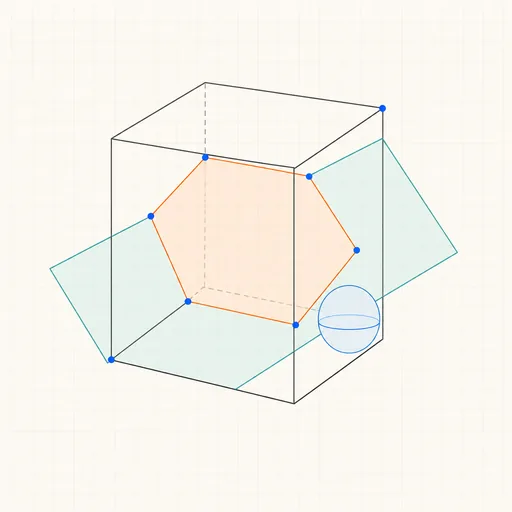
3D Geometry Board
Points, lines, planes, spheres and polyhedra on an orbiting camera — slice solids with planes, unfold nets, drop the Dandelin spheres into a cone and drag everything.
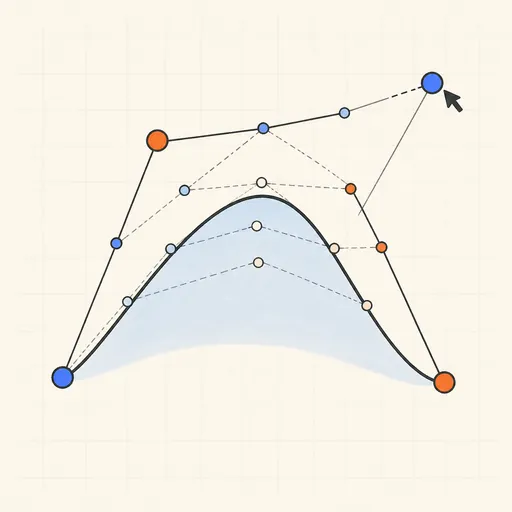
Bézier Curve Playground
Drag control points and watch De Casteljau’s algorithm construct a Bézier curve step by step.
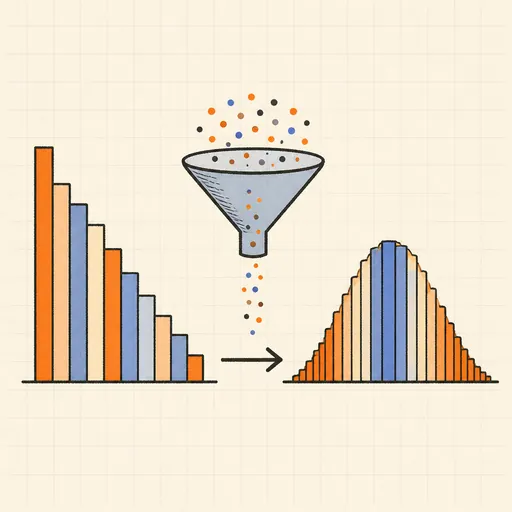
Central Limit Theorem Demo
Sample from any lopsided distribution and watch the averages pile up into a bell curve.
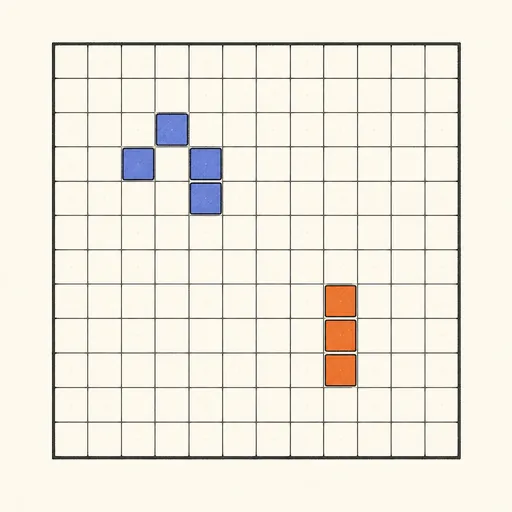
Conway’s Game of Life
Paint cells and watch Conway’s cellular automaton breed gliders, guns and oscillators.
Dynamic Geometry Board
Construct with points, lines, circles and transformations, then drag anything — the construction stays true, and a checker tells you which relations are theorems.
Fantasy Map Generator
Roll a seed and get a continent: coastlines, mountains, rivers, biomes and named towns, ready for your campaign.