Forest Fire Model
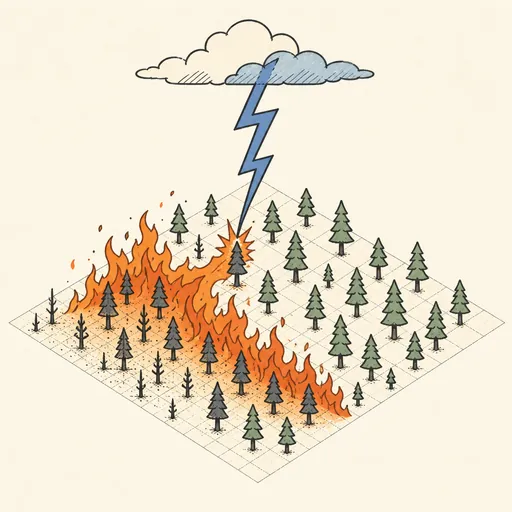
The forest-fire model is a cellular automaton with three states per cell: empty, tree or burning. Each step, empty cells grow trees with a small probability, burning trees ignite their neighbours and then turn to ash, and lightning strikes a random tree now and then to start a fresh blaze. Left running, the forest settles into a restless balance: it grows dense, a strike triggers a fire that clears a swathe, and the gap regrows. The sizes of the fires follow a power law, an example of self-organised criticality. Drag the growth rate, the lightning rate and the burn behaviour, and watch fires ranging from single trees to grid-spanning infernos.
Runs 100% in your browser — simulations are computed locally on your device.
Read the full guide to this tool
Notes
- Fire spreads only to neighbouring trees, so a strike burns exactly one connected cluster — the same connectivity idea as percolation, playing out in time.
- Without tuning anything, the forest hovers near the percolation threshold: dense enough that fires can spread but sparse enough that most fizzle, so fire sizes span many orders of magnitude — self-organised criticality.
- The distribution of fire sizes follows a power law: many tiny fires, a few huge ones, with no typical size — the same statistics seen in earthquakes and avalanches.
- Runs 100% in your browser — simulations are computed locally on your device.
Related tools
Gerrymandering Sandbox
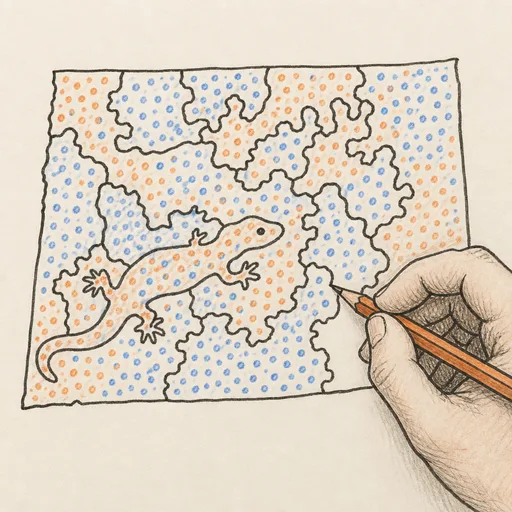
Draw the districts yourself and watch the same voters produce opposite election results.
Pareto Frontier Evolution
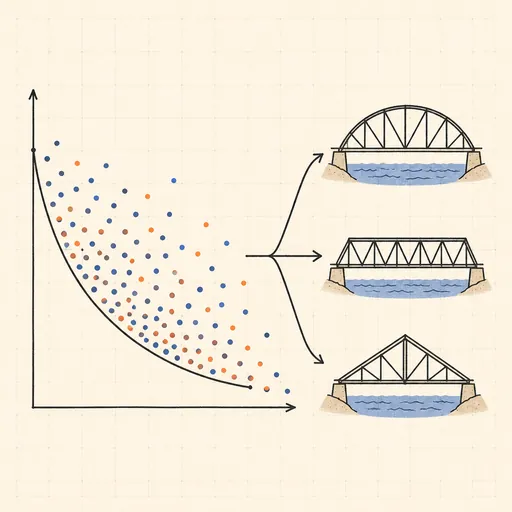
Watch a genetic algorithm breed bridge designs and trace out the weight-vs-stiffness Pareto frontier, generation by generation.
SIR Epidemic Simulator
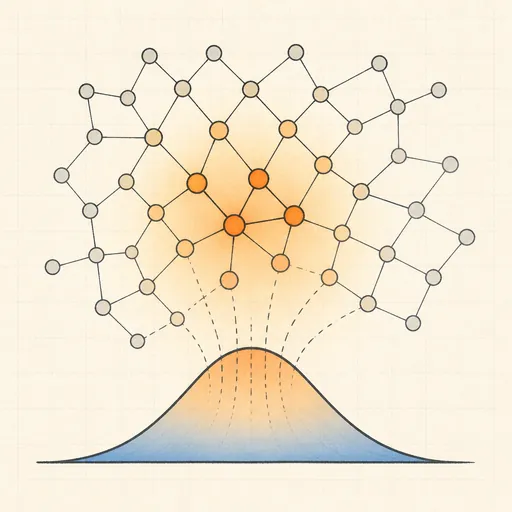
Watch an epidemic spread and burn out with the classic susceptible–infected–recovered model.

Sailing & Tacking Simulator
Sail a boat against the wind — trim to the polar diagram, ride the shifts and race the optimal route.
Schelling’s Segregation Model
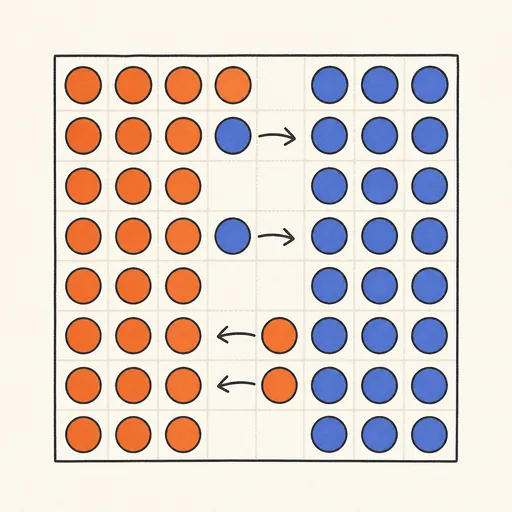
Give agents a mild preference for similar neighbours and watch a mixed city sort itself into stark blocks.
Traffic Jam Simulator
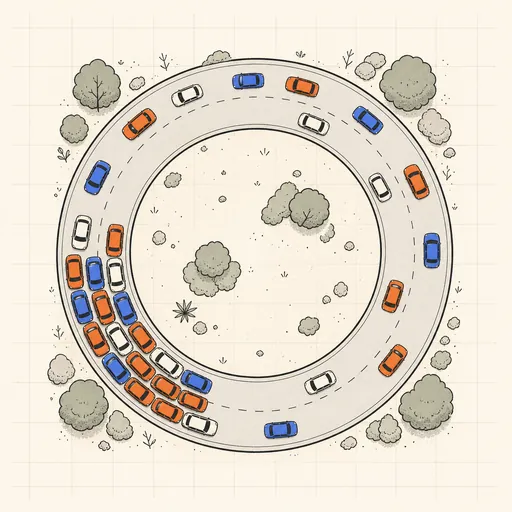
See phantom traffic jams appear from nothing on a ring road with the Nagel–Schreckenberg model.