Brownian Motion
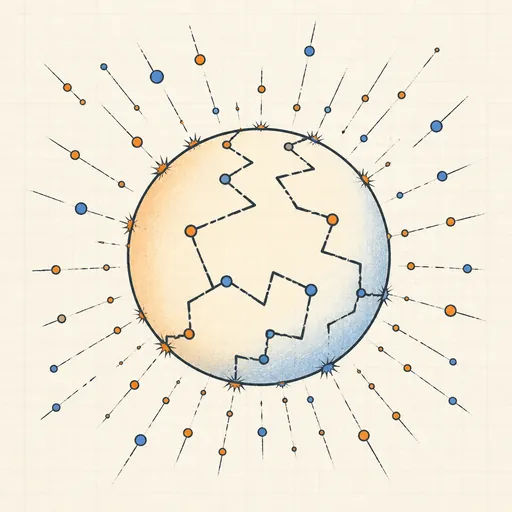
In 1827 Robert Brown saw pollen grains jiggling in water for no visible reason; Einstein explained it in 1905 as the grain being kicked by unseen water molecules. This simulation makes that visible: a large tracer particle sits in a gas of many small fast molecules that collide with it elastically, and every lopsided volley of hits nudges the tracer a little. Its path is traced as a jagged random walk. Turn the temperature (molecule speed), the number of molecules and the tracer size up and down, and a live plot of mean squared displacement grows in a straight line over time — the signature Einstein predicted.
Runs 100% in your browser — simulations are computed locally on your device.
Read the full guide to this tool
Notes
- The tracer moves because molecular impacts do not cancel exactly at any instant; the net kick is a tiny random imbalance, so the path is a random walk with no preferred direction.
- Mean squared displacement grows linearly with time, ⟨r²⟩ = 4Dt in two dimensions, so the plot is a straight line whose slope is the diffusion coefficient D — the relationship Einstein used to estimate the size of atoms.
- Hotter, lighter, more numerous molecules kick harder and more often, so raising the temperature or lowering the tracer size makes it wander faster and the MSD line steepen.
- Runs 100% in your browser — simulations are computed locally on your device.
Related tools
Buoyancy Tank
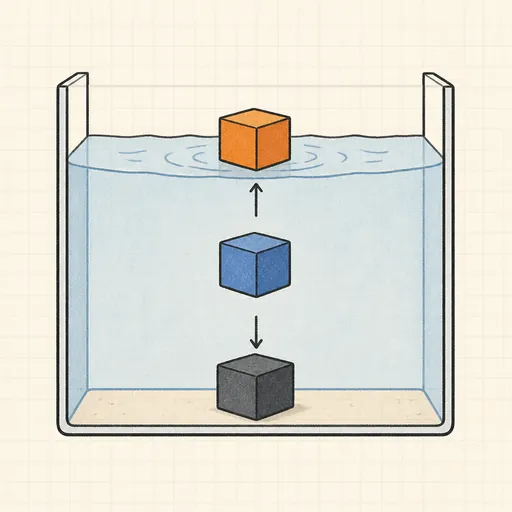
Drop blocks of different density into water and watch Archimedes decide what floats, sinks or hovers.
Double Pendulum
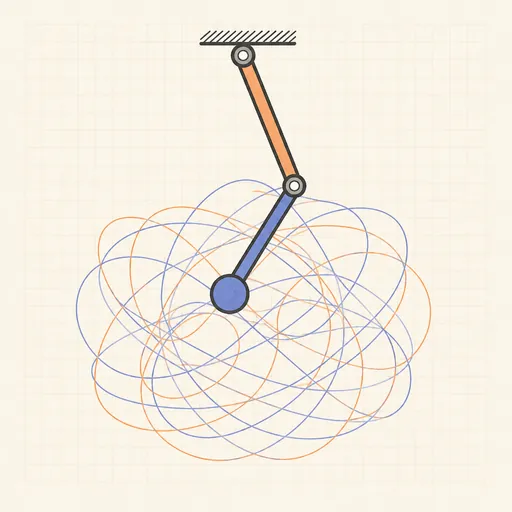
Swing a chaotic double pendulum and split it into a rainbow swarm to watch nearby starts diverge.
Falling-Sand Playground
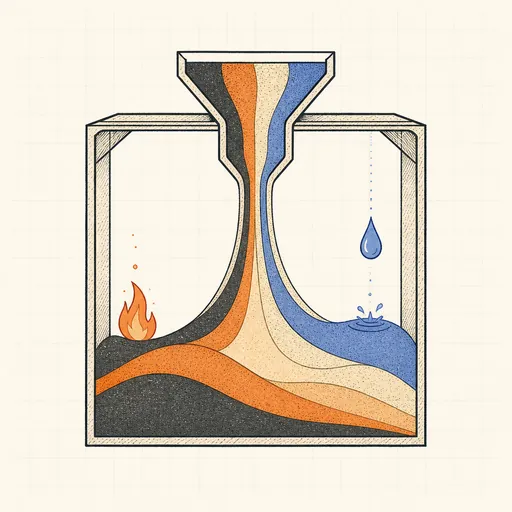
Paint sand, water, oil, fire and more and watch them pour, settle, burn and react pixel by pixel.

Fluid Flow Simulator
Stir glowing dye through a real-time GPU fluid simulation.
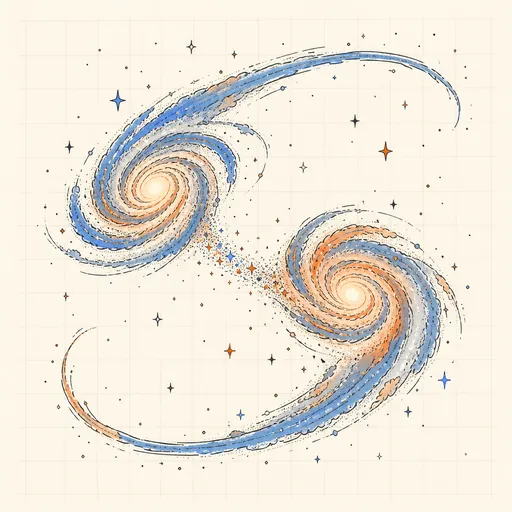
Galaxy Collision Simulator
Smash two spiral galaxies together and watch tidal tails and bridges form.
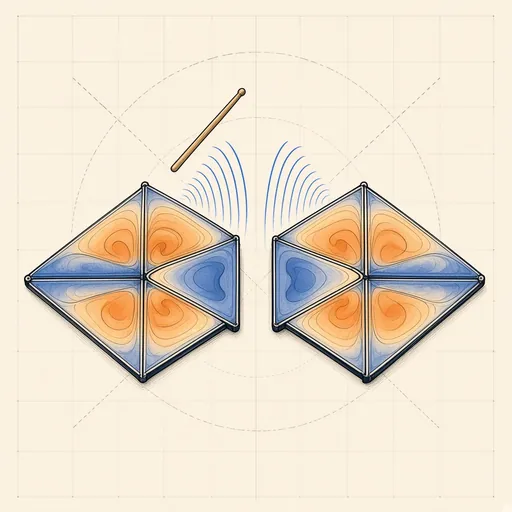
Hear the Shape of a Drum
Draw any drum and hear its true vibration modes — then meet two different drums that sound exactly the same.