Braess’s Paradox
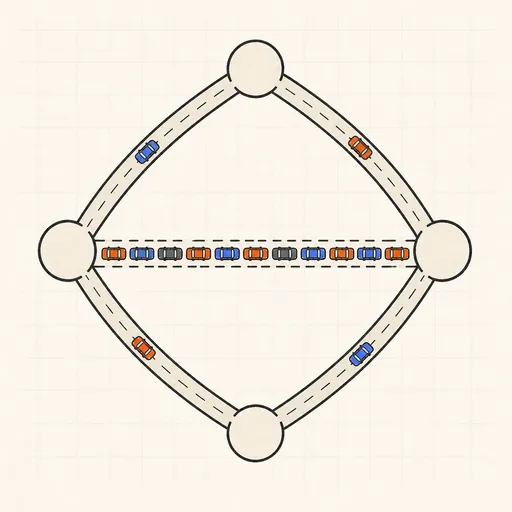
In 1968 Dietrich Braess proved something road planners still trip over: adding a road to a network can make everyone’s commute longer. This simulator builds the classic diamond network — two routes from start to end, each with one congestion-sensitive link whose delay grows with traffic and one fixed-delay link — and lets you toggle a zero-cost shortcut between the middles. Cars are drawn as dots flowing along the edges, and each round a fraction of drivers switches to whichever route is currently fastest, until the system settles into user equilibrium. Watch the average travel time with and without the shortcut, compare the selfish equilibrium against the social optimum a dictator would enforce, and drag the demand slider to find where the paradox appears and disappears.
Runs 100% in your browser — simulations are computed locally on your device.
Read the full guide to this tool
Notes
- The paradox: with the shortcut open every driver takes start→congested→shortcut→congested, loading both congestion-sensitive links at once — individually rational, collectively slower.
- User equilibrium (no driver can gain by switching) and social optimum (minimum total time) differ whenever congestion exists; the gap is the price of anarchy, at most 4/3 for linear delays.
- The effect is real: closing 42nd Street in New York and demolishing the Cheonggyecheon expressway in Seoul both improved traffic flow.
- The paradox only bites at intermediate demand — with few cars the shortcut genuinely helps, with very many it becomes irrelevant.
- Runs 100% in your browser — simulations are computed locally on your device.
Related tools
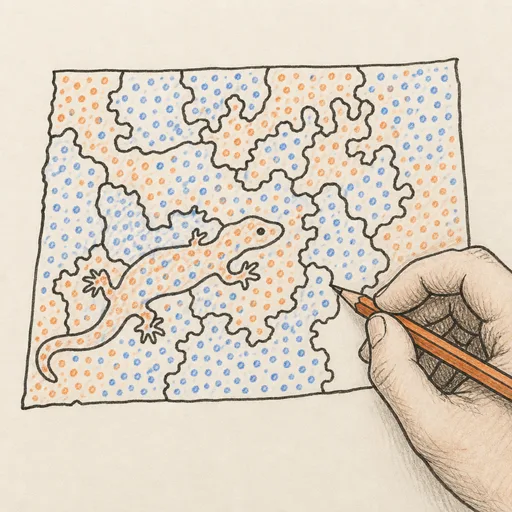
Gerrymandering Sandbox
Draw the districts yourself and watch the same voters produce opposite election results.
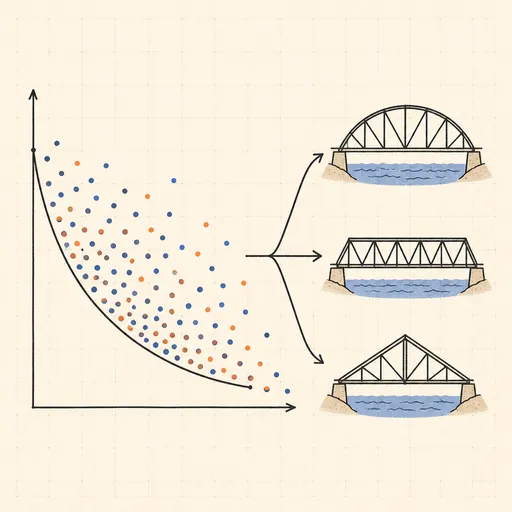
Pareto Frontier Evolution
Watch a genetic algorithm breed bridge designs and trace out the weight-vs-stiffness Pareto frontier, generation by generation.
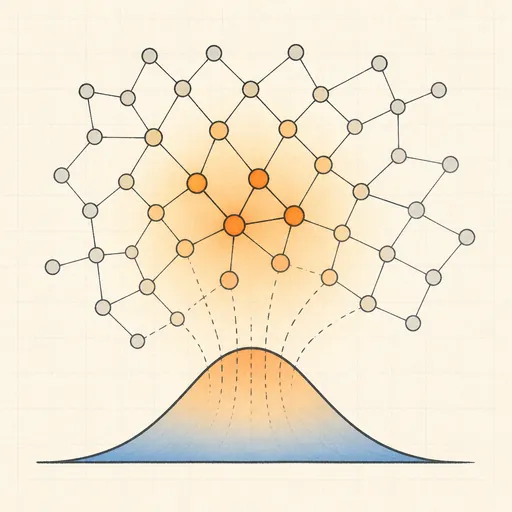
SIR Epidemic Simulator
Watch an epidemic spread and burn out with the classic susceptible–infected–recovered model.

Sailing & Tacking Simulator
Sail a boat against the wind — trim to the polar diagram, ride the shifts and race the optimal route.
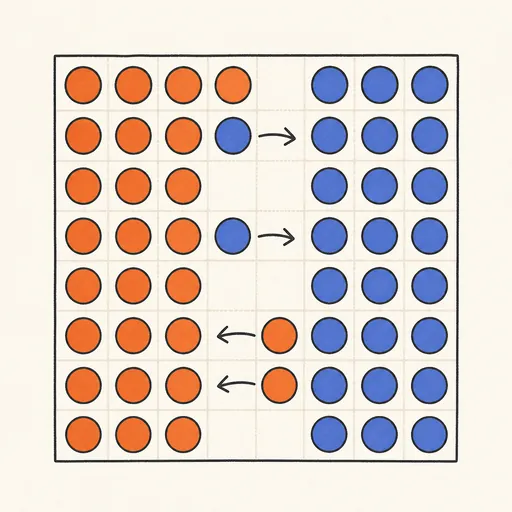
Schelling’s Segregation Model
Give agents a mild preference for similar neighbours and watch a mixed city sort itself into stark blocks.
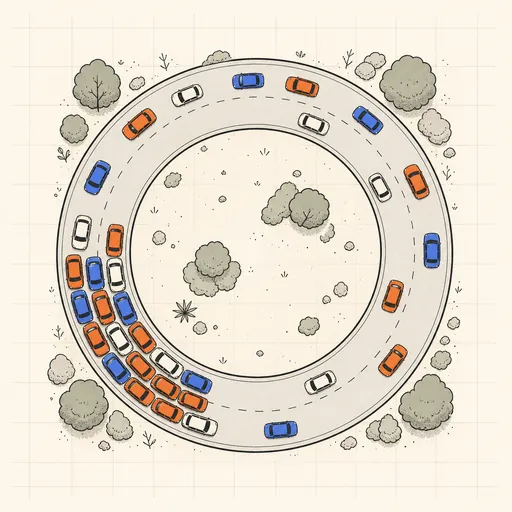
Traffic Jam Simulator
See phantom traffic jams appear from nothing on a ring road with the Nagel–Schreckenberg model.