
Bullwhip Effect (Beer Game)
The Beer Game is the famous MIT supply-chain exercise: a retailer, a wholesaler, a distributor and a factory pass orders up the chain and beer back down it, with two-week shipping and ordering delays at every link. Customer demand does almost nothing — it steps from four cases a week to eight in week five and stays there — yet orders and inventories oscillate ever more wildly the further up the chain you look. This simulator plays all four tiers automatically under a selectable ordering policy: naive pass-through, a base-stock rule, or exponential smoothing with adjustable reaction speed and safety stock. Charts overlay each tier’s orders and inventory/backlog over time, and the bullwhip ratio — the variance amplification from customer to factory — is reported live, so you can hunt for the policy that tames the whip.
Runs 100% in your browser — simulations are computed locally on your device.
Read the full guide to this tool
Notes
- The bullwhip effect: order variance grows multiplicatively at every tier, so a 2× step in demand can swing factory orders from zero to several times the true demand.
- The delays are the engine: goods ordered today arrive weeks later, so every tier over-orders to cover the pipeline it cannot see, then over-corrects into backlog or glut.
- Smoothing forecasts and carrying honest safety stock damps the whip; reacting sharply to every order blip amplifies it — in the real game, human players routinely do the latter.
- Information beats inventory: sharing point-of-sale demand with every tier (as modern retailers do) removes most of the amplification that hiding it creates.
- Runs 100% in your browser — simulations are computed locally on your device.
Related tools

Gerrymandering Sandbox
Draw the districts yourself and watch the same voters produce opposite election results.
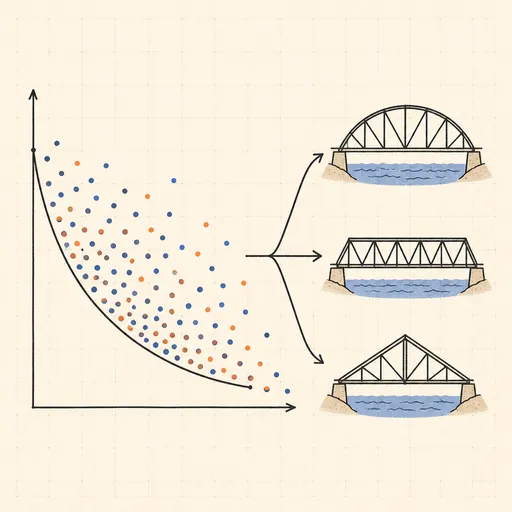
Pareto Frontier Evolution
Watch a genetic algorithm breed bridge designs and trace out the weight-vs-stiffness Pareto frontier, generation by generation.
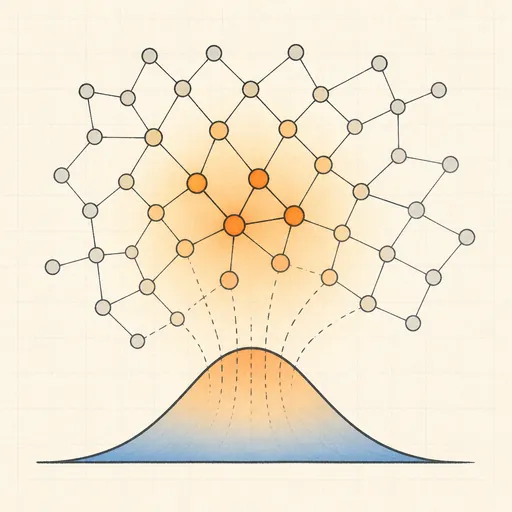
SIR Epidemic Simulator
Watch an epidemic spread and burn out with the classic susceptible–infected–recovered model.

Sailing & Tacking Simulator
Sail a boat against the wind — trim to the polar diagram, ride the shifts and race the optimal route.
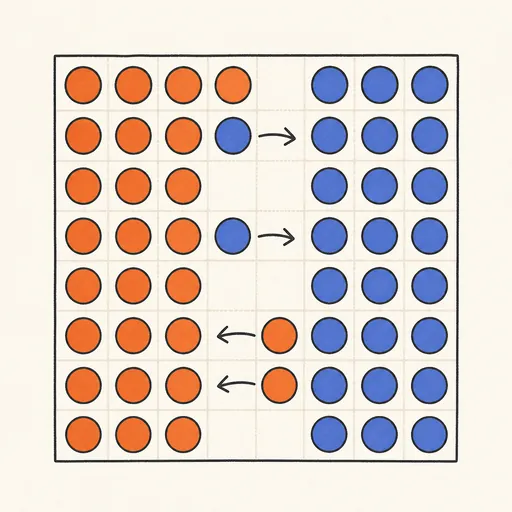
Schelling’s Segregation Model
Give agents a mild preference for similar neighbours and watch a mixed city sort itself into stark blocks.
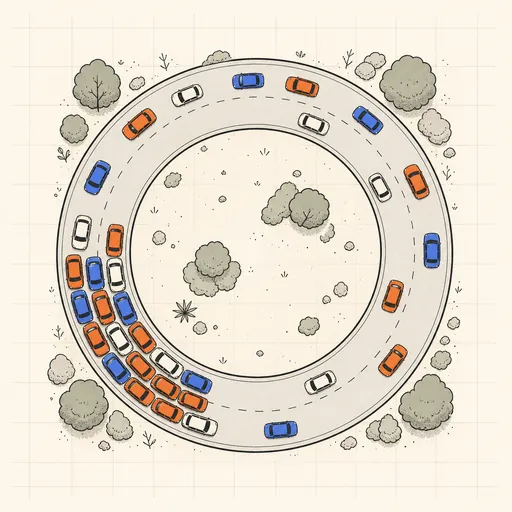
Traffic Jam Simulator
See phantom traffic jams appear from nothing on a ring road with the Nagel–Schreckenberg model.