Stoichiometry, Explained
After reading this you can take one known amount in a chemical reaction, in grams or moles, and predict the moles and mass of every other reactant and product.
Stoichiometry is bookkeeping for atoms. A balanced equation tells you the fixed proportions in which substances combine and form. If you know how much of one species you have, the balanced equation fixes how much of everything else you need or produce. Nothing is created or destroyed, so the atoms on the left must all appear on the right.
Here is the hook. Burn 44 grams of propane, and you can say in advance that it consumes about 160 grams of oxygen and produces about 132 grams of carbon dioxide plus 72 grams of water. You never touched a scale for the products. The equation told you.
What stoichiometry does and when to use it
A stoichiometric calculation answers one question: given a fixed amount of one species, how much of each other species is involved when the reaction runs to completion in the exact ratios the equation demands?
Use it when you have a balanced (or balanceable) reaction and one solid quantity, and you want the rest. Predicting product yield, sizing a reactant for a target amount of product, and checking a lab result all fit this shape.
Pure stoichiometry assumes the known species reacts fully and that every other species is present in exactly the right amount. Real reactions have a limiting reagent, and yields fall short. Treat the numbers here as the ideal ceiling, not the guaranteed outcome.
Do not use it to decide which reactant runs out first. That is a limiting-reagent problem, which needs two known amounts, not one. Do not use it for equilibrium reactions that stop partway; those need an ICE table solver. And it says nothing about how fast the reaction goes, which is the domain of the reaction rate calculator.
The mole ratio is the engine
The coefficients in a balanced equation are counts of molecules, and therefore counts of moles. They are not mass ratios. This is the single idea everything else rests on.
For the reaction a\,A + b\,B \to c\,C, the mole ratio between any two species is just the ratio of their coefficients. To go from moles of a known species to moles of a target species:
Here n_{\text{known}} is the moles you have, \nu_{\text{known}} and \nu_{\text{target}} are the balanced coefficients of the known and target species, and n_{\text{target}} is the moles of the target. The ratio \nu_{\text{target}}/\nu_{\text{known}} is the mole ratio.
Mass enters only at the ends, through molar mass. To convert between grams and moles:
where m is mass in grams, M is molar mass in grams per mole, and n is moles. So the full path is always the same three steps: grams to moles, scale by the mole ratio, moles back to grams. The mole calculator handles the two conversions on their own, and the molar mass calculator gives you the M values.
Balancing comes first. If the equation you enter is not balanced, the coefficients are wrong and every mole ratio is wrong. The chemical equation balancer does this step alone if you want to check it.
Worked example: burning propane
44 grams of propane, fully combusted
Take the demo reaction and known amount: burn 44 grams of propane in oxygen.
- Balance the equation. Propane combustion balances to
C3H8 + 5 O2 = 3 CO2 + 4 H2O. Check the atoms: 3 carbon each side, 8 hydrogen each side, and 5 \times 2 = 10 oxygen on the left against 3 \times 2 + 4 \times 1 = 10 on the right. - Grams to moles for the known. Molar mass of C3H8 is 3(12.011) + 8(1.008) = 44.10 g/mol. So n = 44 / 44.10 = 0.9978 mol of propane. Call it
1.000mol for readability; the tool keeps the extra digits. - Scale by the mole ratios. Oxygen has coefficient 5 against propane's 1, so 0.9978 \times 5 = 4.989 mol O2. Carbon dioxide: 0.9978 \times 3 = 2.993 mol. Water: 0.9978 \times 4 = 3.991 mol.
- Moles back to grams. Multiply each by its molar mass. O2 is 32.00 g/mol, CO2 is 44.01 g/mol, H2O is 18.02 g/mol.
| Species | Coefficient | Moles | Molar mass (g/mol) | Mass (g) |
|---|---|---|---|---|
| C3H8 | 1 | 0.9978 | 44.10 | 44.00 |
| O2 | 5 | 4.989 | 32.00 | 159.6 |
| CO2 | 3 | 2.993 | 44.01 | 131.7 |
| H2O | 4 | 3.991 | 18.02 | 71.92 |
The masses check out against conservation. Input mass is 44.00 + 159.6 = 203.6 g. Output mass is 131.7 + 71.92 = 203.6 g. The books balance to the digit, which they must, because mass is conserved.
See the mass shift as the ratio changes
The mole ratio is fixed by the equation, but the mass split is not obvious from the coefficients. Oxygen has five times the moles of propane yet weighs less than four times as much, because O2 is lighter per mole than C3H8. The widget below lets you feel that difference.
Reading the results
The tool reports, for every species, both moles and mass. Read them together.
- Moles
- The count that obeys the coefficient ratio exactly. If propane is 0.9978 mol, oxygen is exactly five times that, no rounding of the ratio involved.
- Mass
- Moles times molar mass. This is what you weigh out in the lab. Reactant masses and product masses must each sum to the same total.
- The known species
- Its row simply echoes your input, converted to the other unit. It is the anchor for everything else.
One useful sanity check: the total mass in equals the total mass out. If they differ by more than rounding, the equation was not balanced or a formula was mistyped.
Common mistakes
Using coefficients as mass ratios. The coefficient 5 on O2 does not mean five times the mass of propane. It means five moles of O2 per mole of propane. The mass ratio here is 160.0 / 44.10 = 3.63, not 5.
Skipping the balance step. Entering H2 + O2 = H2O unbalanced implies one H2 makes one H2O, which loses an oxygen atom. The correct 2 H2 + O2 = 2 H2O changes every ratio.
Mixing up molar masses. A wrong M corrupts the grams-to-moles step and then propagates. Confusing atomic oxygen (16.00) with molecular O2 (32.00) is the classic slip.
Treating the answer as a real yield. This is the theoretical maximum. Actual yield is lower because of incomplete reactions, side products and losses. If you have limited amounts of two reactants, the smaller one limits the reaction, and the tool's single-known model does not catch that.
To spot a limiting reagent by hand, convert each available reactant to moles, divide by its coefficient, and the smallest quotient wins. Feed that limiting species in as the known amount, and the tool's output becomes the honest prediction.
Related tools
Stoichiometry sits in the middle of a chain. Get molar masses and percent composition from the molar mass calculator, and find a formula from lab data with the empirical and molecular formula calculator.
When gases are involved, convert moles to volume with the ideal gas law calculator. For solution work, the dilution calculator and the concentration converter handle molarity and mass-per-volume, and the pH calculator covers acid and base concentrations. To track heat released or absorbed, pair your mole count with the calorimetry calculator. For quick atomic data, use the periodic table element lookup.
Frequently asked questions
Do I have to balance the equation myself?
No. The tool balances it for you before scaling. You can enter N2 + H2 = NH3 and it works with the balanced form N2 + 3 H2 = 2 NH3 internally. Entering an already balanced equation is fine too.
Why are the masses of reactants and products equal?
Conservation of mass. Every atom on the left reappears on the right, so the total grams cannot change. In the propane example both sides total 203.6 g. A mismatch means an input error.
Can I enter the known amount in moles instead of grams?
Yes. Choose moles and the tool skips the first conversion and starts from your mole count directly. It still reports mass for every species using molar masses.
What if my known species appears with a coefficient greater than one?
The math is identical. The tool divides your amount by the known coefficient to get one "unit" of reaction, then multiplies each species by its own coefficient. Nothing about the procedure changes.
Does this account for reactions that do not go to completion?
No. It reports the amounts for complete conversion of the known species. For reversible reactions that reach equilibrium, use the ICE table solver instead, and treat these numbers as the upper bound.
Related tools
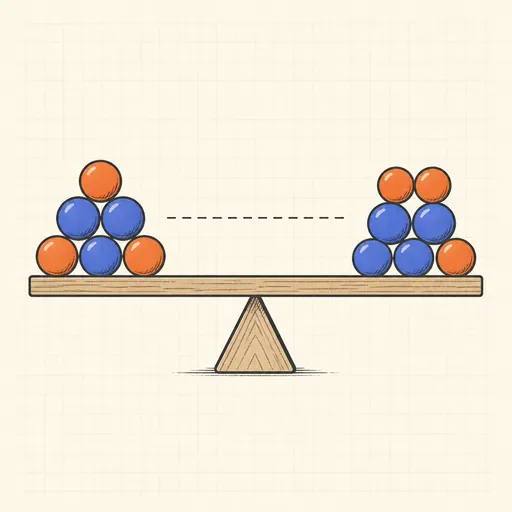
Chemical Equation Balancer
Balance any chemical equation to whole numbers.
Ideal Gas Law Calculator (PV = nRT)
Solve for pressure, volume, moles or temperature.
Molar Mass Calculator
Molar mass and percent composition from a formula.
Mole Calculator (grams ↔ moles ↔ particles)
Convert between mass, moles and number of particles.
pH Calculator
pH, pOH and ion concentrations for acids and bases.
Boiling & Freezing Point Calculator
Boiling-point rise and freezing-point drop of solutions.