
Word Embedding Trainer
word2vec turns words into vectors with a simple trick: train a tiny network to predict which words appear near each other. This tool implements skip-gram with negative sampling from scratch and trains it live on whatever text you paste in. Words that share contexts drift together on an animated 2-D PCA projection of the embedding space while training runs; click any word (or pick one from the list) to see its nearest neighbours by cosine similarity, and try the analogy row, which computes vec(a) − vec(b) + vec(c) and finds the closest word. Choose the embedding dimension, the context window and the number of negative samples, and watch the epoch counter and the loss. A few kilobytes of text give rough embeddings, but related words visibly cluster.
Runs 100% in your browser — models are trained and computed locally on your device.
Read the full guide to this tool
Notes
- Skip-gram trains a word’s vector to score high with the vectors of words seen inside its context window and low with a handful of randomly drawn negative words — a binary logistic loss per pair.
- Negative sampling replaces the full softmax over the vocabulary with k sampled contrasts, cutting the cost per update from O(V) to O(k); negatives are drawn from the unigram distribution raised to the ¾ power.
- The famous analogy king − man + woman ≈ queen works because consistent semantic relations become near-parallel offsets in embedding space — but it needs corpora far larger than fit in a textarea.
- PCA projects the high-dimensional vectors onto the 2-D plane of maximum variance, so distances on screen only approximate the true cosine similarities.
- Runs 100% in your browser — models are trained and computed locally on your device.
Related tools
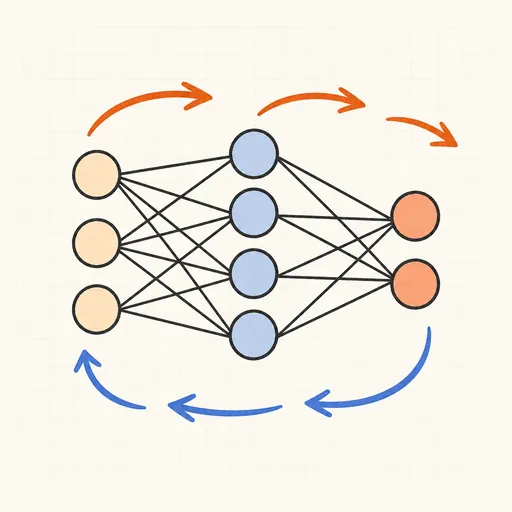
Backpropagation Step-by-Step
Walk through one forward and backward pass of a tiny neural network, number by number.

Handwritten Digit Recognizer
Draw a digit and watch a neural network trained on MNIST recognize it live in your browser.
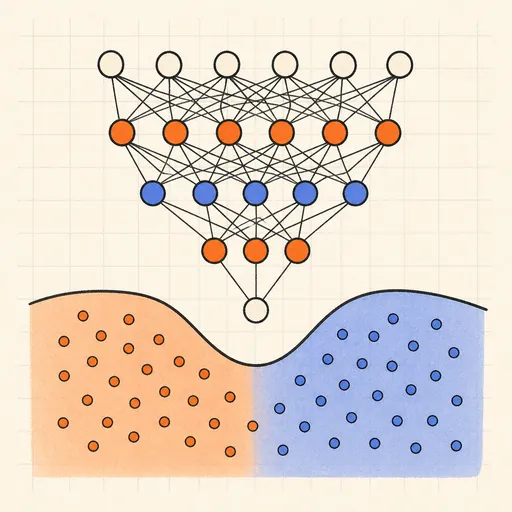
Neural Network Playground
Train a tiny neural network live in your browser and watch its decision boundary learn four classic datasets.

Activation Function Explorer
Compare sigmoid, tanh, ReLU and friends with their derivatives, and see why deep gradients vanish.
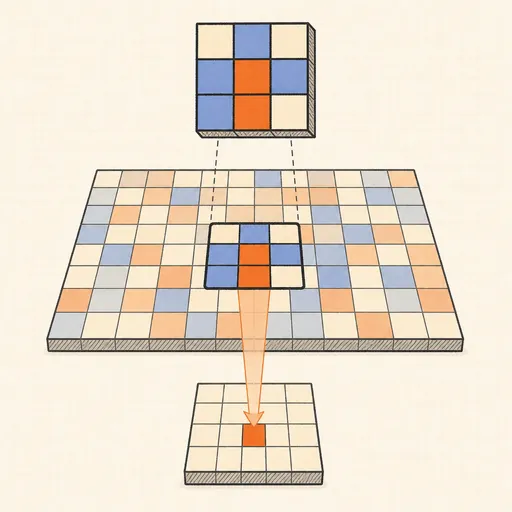
Convolution Filter Visualizer
Slide a 3×3 kernel over an image and watch convolution, ReLU and max-pooling build the output pixel by pixel.
Hopfield Network
Store pixel patterns in a Hopfield memory, corrupt them, and watch the network recall the original.