Hopfield Network
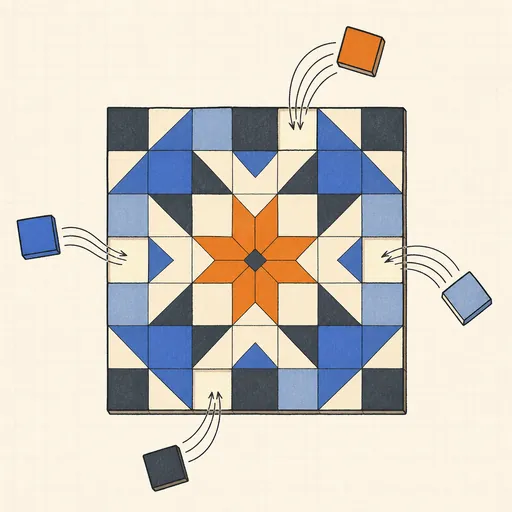
A Hopfield network is content-addressable memory built from physics: 144 binary neurons on a 12×12 grid, every pair joined by a symmetric weight, storing patterns as minima of an energy landscape. Load a preset — letters A, E and T, a smiley, a checkerboard — or draw your own pixels, then press Store to imprint it with the Hebbian outer-product rule. Corrupt the grid by flipping a chosen percentage of pixels and press Play: neurons update one after another, each aligning with its weighted input, and the pattern heals cell by cell while the energy readout falls monotonically until a converged banner appears. Stored patterns show as removable thumbnails — stack five or more overlapping ones and recall starts landing in spurious or inverted attractors, a hands-on demonstration of the network’s capacity limit.
Runs 100% in your browser — models are trained and computed locally on your device.
Read the full guide to this tool
Notes
- Hebbian storage: W = (1/N)Σ p·pᵀ with zero diagonal — “neurons that fire together wire together”; each stored pattern digs an energy minimum at itself and its inverse.
- Asynchronous updates sᵢ ← sign(Σ Wᵢⱼ sⱼ) can only lower the energy E = −½ sᵀWs, which is why convergence to some stable state is guaranteed.
- Random-pattern capacity is about 0.138·N (≈20 for 144 neurons) — but correlated patterns such as letters interfere and recall degrades far earlier.
- Overloaded networks develop spurious attractors: stable mixtures of stored patterns that were never taught — and every attractor coexists with its bit-flipped mirror.
- Runs 100% in your browser — models are trained and computed locally on your device.
Related tools
Backpropagation Step-by-Step
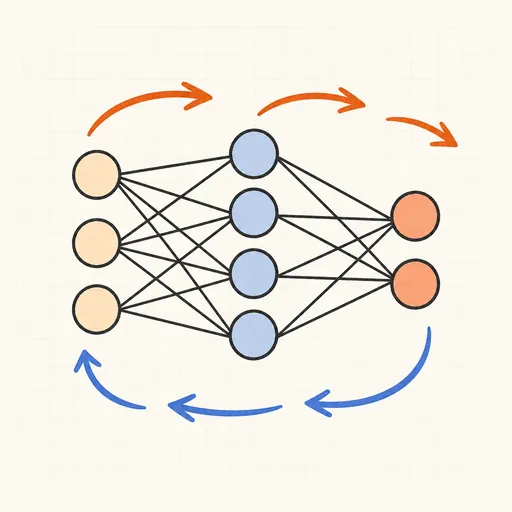
Walk through one forward and backward pass of a tiny neural network, number by number.
Handwritten Digit Recognizer
Draw a digit and watch a neural network trained on MNIST recognize it live in your browser.
Neural Network Playground
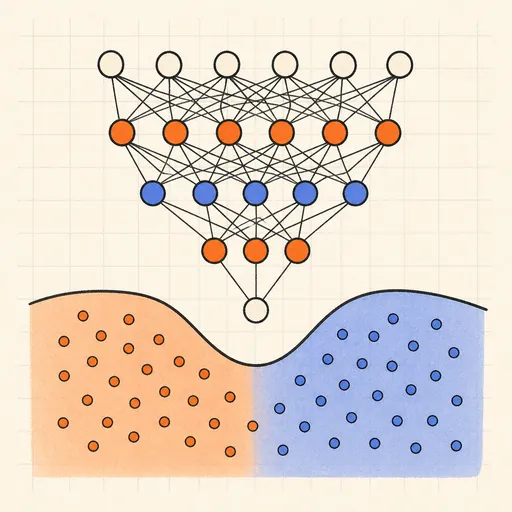
Train a tiny neural network live in your browser and watch its decision boundary learn four classic datasets.
Activation Function Explorer
Compare sigmoid, tanh, ReLU and friends with their derivatives, and see why deep gradients vanish.
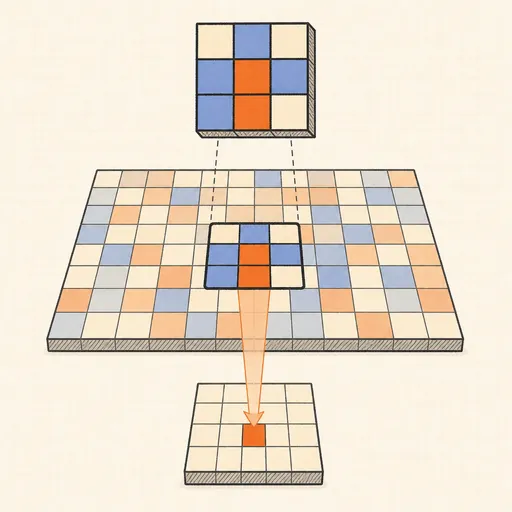
Convolution Filter Visualizer
Slide a 3×3 kernel over an image and watch convolution, ReLU and max-pooling build the output pixel by pixel.
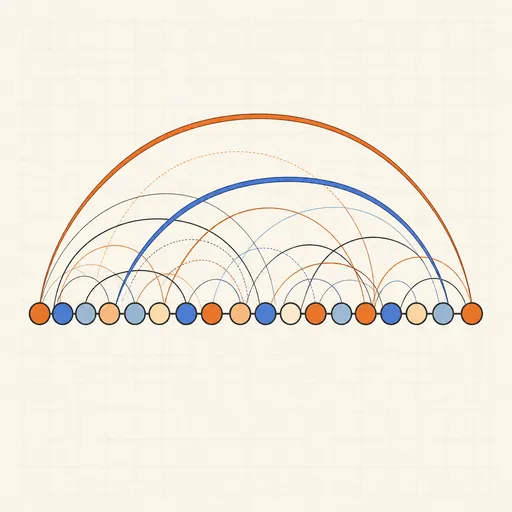
Self-Attention Visualizer
See how Transformer tokens attend to each other with arcs, heatmaps, heads and causal masks.