The Unit Circle, Explained
After reading this you will be able to read cosine, sine and tangent straight off a single circle, convert between degrees and radians with confidence, and reproduce the exact numbers the tool draws as you drag the angle around.
What the unit circle is
Draw a circle of radius 1 centered at the origin. Pick an angle \theta measured counterclockwise from the positive x-axis. The point where that angle meets the circle has coordinates (\cos\theta, \sin\theta). That is the whole idea. Cosine is the horizontal coordinate, sine is the vertical coordinate, and every trigonometric fact you will ever need falls out of that one picture.
Here is the hook. Set \theta = 45^\circ. The point sits on the diagonal, equally far right and up. Both coordinates equal \frac{\sqrt{2}}{2} \approx 0.7071. So \cos 45^\circ = \sin 45^\circ \approx 0.7071, and you did not memorize that: you read it off the symmetry of the diagonal. Now push the point up to the top, \theta = 90^\circ. The coordinates become (0, 1), so \cos 90^\circ = 0 and \sin 90^\circ = 1. No table needed.
When the circle is the right picture
Use the unit circle whenever an angle can be any size, positive or negative, and whenever you care about signs. Right-triangle trigonometry (SOH-CAH-TOA) works only for angles between 0^\circ and 90^\circ, because a triangle cannot have an angle of 120^\circ. The circle has no such limit. At \theta = 210^\circ the point lands in the third quadrant at (-0.8660, -0.5), so both cosine and sine are negative. The triangle picture cannot even represent that.
The circle is also the right picture when you want to see periodicity. Go once around and you are back where you started, so \cos(\theta + 360^\circ) = \cos\theta. When you unroll the vertical coordinate against the angle, you get the sine wave, which is why the same function describes both a spinning point and an oscillating spring.
When you should not reach for it: if you have an actual right triangle with known side lengths and want a missing side, the ratio definitions are faster. The circle earns its keep when angles roam freely or when sign and period matter.
The formulas and where they come from
Start with the coordinate definitions.
Because the point lies on the circle of radius 1, its distance from the origin is 1. Distance is \sqrt{x^2 + y^2}, so squaring both sides gives the single most used identity in trigonometry.
That is not a rule to memorize. It is the Pythagorean theorem applied to the point on the circle. Every symbol is a coordinate: \cos\theta is the horizontal leg, \sin\theta is the vertical leg, and the radius 1 is the hypotenuse.
Tangent is the ratio of the two coordinates.
Geometrically, \tan\theta is the height where the ray through the point crosses the vertical line x = 1. As \theta climbs toward 90^\circ, cosine shrinks toward 0, so the ratio grows without bound. At exactly 90^\circ cosine is 0 and tangent is undefined: the ray is vertical and never meets x = 1.
Radians measure the arc length you travel along the circle. Since the full circumference is 2\pi r = 2\pi when r = 1, one full turn is 2\pi radians = 360^\circ. That makes the conversion 1\text{ rad} = \frac{180}{\pi} \approx 57.30^\circ.
A worked example at the default angle
Reading everything off \theta = 30^\circ
Drag the point to the first marked standard angle, 30^\circ, which is \frac{\pi}{6} radians. Work out every value the tool displays.
- Convert to radians: 30 \times \frac{\pi}{180} = \frac{\pi}{6} \approx 0.5236.
- Vertical coordinate: \sin 30^\circ = 0.5 exactly. This is the one worth memorizing, and the circle shows why: the 30^\circ point sits halfway up.
- Horizontal coordinate: \cos 30^\circ = \frac{\sqrt{3}}{2} \approx 0.8660.
- Check the Pythagorean identity: 0.5^2 + 0.8660^2 = 0.25 + 0.75 = 1. It closes exactly.
- Tangent: \tan 30^\circ = \frac{0.5}{0.8660} = 0.5774 = \frac{1}{\sqrt{3}}.
So the tool shows the point at (0.8660, 0.5), a cosine segment of length 0.8660 running rightward, a sine segment of length 0.5 running up, and a tangent segment of length 0.5774. Every number is consistent because they are all readings of the same point.
Reading and interpreting what you see
The four quadrants tell you the signs at a glance. In the first quadrant (0^\circ to 90^\circ) both coordinates are positive. In the second (90^\circ to 180^\circ) cosine turns negative while sine stays positive. In the third both are negative, and in the fourth cosine is positive again while sine is negative. A common mnemonic is "All Students Take Calculus", where each initial marks which function stays positive in quadrants one through four (All, Sine, Tangent, Cosine).
Watch the segment lengths as you drag. Near 0^\circ the cosine segment is almost the full radius while the sine segment is tiny. They trade places as you approach 90^\circ. That trade is the identity \sin\theta = \cos(90^\circ - \theta) made visible: reflecting the angle across the diagonal swaps the two coordinates.
The tangent segment is the dramatic one. At 45^\circ it equals exactly 1. At 60^\circ it is \sqrt{3} \approx 1.732. At 80^\circ it is 5.671. At 89^\circ it is 57.29. The growth is not steady: it accelerates because you are dividing by a cosine that is racing toward zero.
Common mistakes
The first mistake is a calculator set to the wrong angle mode. If you type sin(30) expecting 0.5 but your calculator is in radians, you get \sin(30\text{ rad}) \approx -0.988, because 30 radians is nearly five full turns. Always check the mode. The tool sidesteps this by showing both units side by side.
The second mistake is confusing which coordinate is which. Sine is the y-coordinate, cosine is the x-coordinate. A memory hook: "sine" and "y" both climb, cosine is the "co" that stays horizontal. If you swap them you will report \sin 30^\circ = 0.8660, which is actually the cosine.
The third is treating tangent at 90^\circ as a large number rather than undefined. It is not 57.29 or a million. There is no value: the ratio \frac{1}{0} does not exist. The function has a vertical asymptote there and jumps from +\infty to -\infty as you cross.
A negative angle does not mean a negative value. At \theta = -30^\circ you rotate clockwise, landing at (0.8660, -0.5). Cosine stays positive at 0.8660; only sine flips sign. Sign depends on the quadrant the point lands in, not on the sign of the angle you typed.
Related tools
Once a point circles at a steady rate, its shadow on each axis is a sine wave, and stacking many such circles builds any waveform. See that directly in the Fourier Epicycles tool and in the Fourier Series Builder, where rotating circles assemble square and sawtooth waves. To watch rotation act on a whole grid of points instead of one, try the Linear Transformation Playground, where a rotation matrix is built from the same \cos\theta and \sin\theta. For angle arithmetic that produces surprising curves, the Modular Times Table and the Spirograph both live on the circle. And for the golden angle, an irrational fraction of a full turn, see Phyllotaxis.
Frequently asked questions
Why is it called the unit circle?
Because its radius is one unit. That single choice makes the coordinates equal the trig functions directly. With any other radius r, the point would be at (r\cos\theta, r\sin\theta) and you would have to divide by r to recover cosine and sine.
How do I convert 30 degrees to radians?
Multiply by \frac{\pi}{180}. So 30 \times \frac{\pi}{180} = \frac{\pi}{6} \approx 0.5236 radians. To go back, multiply radians by \frac{180}{\pi} \approx 57.30.
What is the value of tangent at 90 degrees?
It is undefined. Tangent is \frac{\sin\theta}{\cos\theta}, and at 90^\circ cosine equals 0, so you would be dividing by zero. As you approach 90^\circ from below, tangent grows without limit; approaching from above it comes up from negative infinity.
Why does sine equal 0.5 at exactly 30 degrees?
It comes from a 30-60-90 triangle, whose shortest side is exactly half the hypotenuse. On the unit circle the hypotenuse is the radius 1, so the vertical side, which is sine, is 0.5. This is one of the few values that is a clean fraction rather than an irrational number.
Does the direction of the angle matter?
Yes. Angles are measured counterclockwise from the positive x-axis by convention. A positive angle turns counterclockwise, a negative angle turns clockwise. Turning -90^\circ lands you at the same point as +270^\circ, namely (0, -1).
Related tools
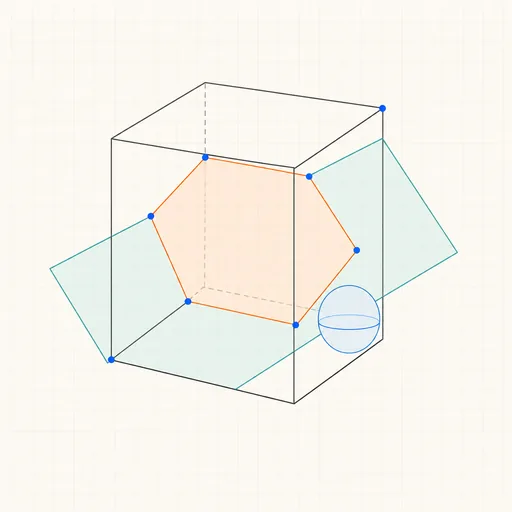
3D Geometry Board
Points, lines, planes, spheres and polyhedra on an orbiting camera — slice solids with planes, unfold nets, drop the Dandelin spheres into a cone and drag everything.
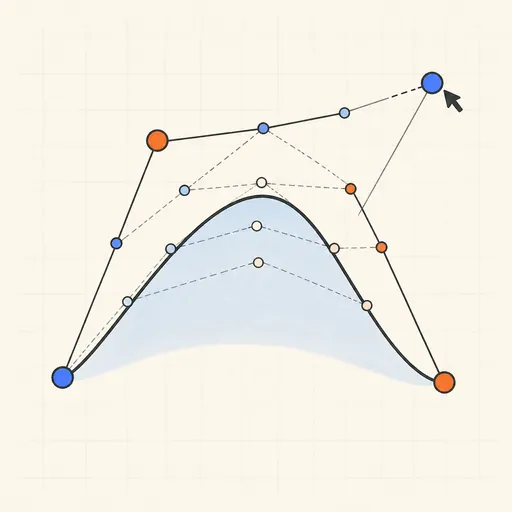
Bézier Curve Playground
Drag control points and watch De Casteljau’s algorithm construct a Bézier curve step by step.
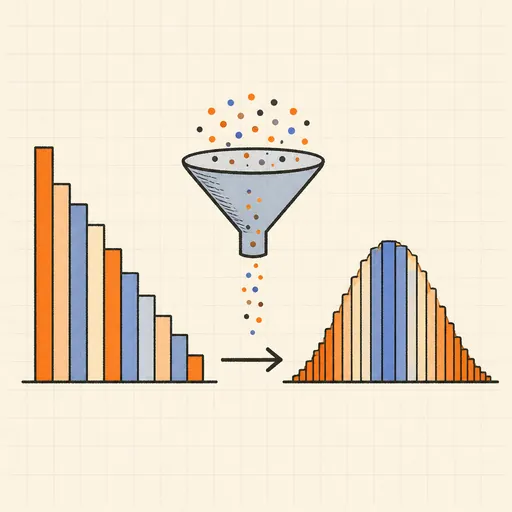
Central Limit Theorem Demo
Sample from any lopsided distribution and watch the averages pile up into a bell curve.
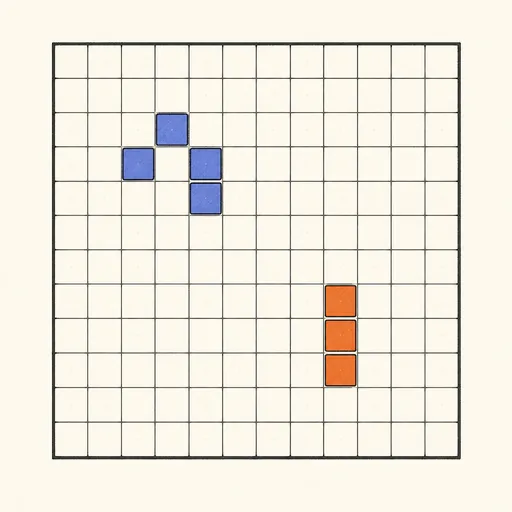
Conway’s Game of Life
Paint cells and watch Conway’s cellular automaton breed gliders, guns and oscillators.
Dynamic Geometry Board
Construct with points, lines, circles and transformations, then drag anything — the construction stays true, and a checker tells you which relations are theorems.

Fantasy Map Generator
Roll a seed and get a continent: coastlines, mountains, rivers, biomes and named towns, ready for your campaign.