The 2×2 Matrix as a Machine for the Plane
After reading this you can look at any 2×2 matrix, predict how it will bend the plane, compute where any point lands, and read the determinant as a signed area.
What a matrix does to the plane
A 2×2 matrix is a rule that takes every point of the flat plane and moves it somewhere else. Feed it the point (1, 0) and it hands you back a new point. Feed it (0, 1) and it hands you back another. Every other point follows from these two, and that fact is the whole story.
Take the matrix with entries a = 1, b = 1, c = 0, d = 1. Written out it is
This is a horizontal shear. Points near the x-axis barely move. Points high above it slide far to the right. A square window sitting above the x-axis becomes a leaning parallelogram. The playground shows exactly this: set those four numbers and watch the grid lean while the vertical lines stay vertical and the horizontal spacing stays fixed.
The reason a matrix can only shear, rotate, scale and reflect (never bend a straight line into a curve) is linearity. Straight lines stay straight, parallel lines stay parallel, and the origin stays put. That constraint is what makes 2×2 matrices simple enough to picture in your head.
Where the columns go, and why that is everything
Name the two special vectors \hat{\imath} = (1, 0) and \hat{\jmath} = (0, 1). They are the unit steps along the x-axis and y-axis. The columns of the matrix are literally where these two land.
For the matrix with columns (a, c) and (b, d), the transformation sends \hat{\imath} to (a, c) and \hat{\jmath} to (b, d). Any point (x, y) is just x steps of \hat{\imath} plus y steps of \hat{\jmath}, so after the transformation it becomes x copies of the new \hat{\imath} plus y copies of the new \hat{\jmath}.
Here a, b, c, d are the four matrix entries and (x, y) is the input point. The output has an x-coordinate ax + by and a y-coordinate cx + dy. That is the entire multiplication rule. Watch the two colored basis vectors in the playground and you are watching the two columns move.
To predict any transformation, do not memorize the matrix. Ask two questions: where does \hat{\imath} go, and where does \hat{\jmath} go? Those two answers are the two columns, and they pin down the rest.
The four moves you can build
Every 2×2 matrix is some blend of four basic actions. Learn to spot them.
- Scaling
- A diagonal matrix with entries
2and3stretches x by 2 and y by 3. Vertical lines spread apart, horizontal lines spread apart, nothing tilts. - Rotation
- The matrix with first column (\cos\theta, \sin\theta) and second column (-\sin\theta, \cos\theta) turns the whole plane by angle \theta about the origin. Lengths and angles are unchanged.
- Shear
- The matrix with a single off-diagonal entry slides one axis along the other. Area is preserved, but angles are not.
- Reflection
- A matrix that swaps or negates an axis flips the plane like a mirror. Reflect across the x-axis with entries
1,0,0,-1.
The presets in the playground are exactly these. A general matrix mixes them. In fact any 2×2 matrix factors into a rotation, a scaling, and another rotation (the singular value decomposition), so those are the only motions available.
The determinant is a signed area
The determinant answers one question: after the transformation, how much bigger or smaller is area, and did the plane flip over? For the matrix above,
with the same four entries. Start with the unit square, the box with corners at (0,0), (1,0), (1,1), (0,1). Its area is 1. After the transformation it becomes a parallelogram, and the area of that parallelogram is exactly |ad - bc|. The sign tells you orientation.
- \det = 2: every region doubles in area.
- \det = 1: area is preserved (all rotations and shears do this).
- \det = 0: the plane is crushed onto a line or a point, and area vanishes.
- \det = -1: area is preserved but the plane is flipped, like a mirror image.
A negative determinant means \hat{\imath} and \hat{\jmath} have swapped their handedness: the shorter turn from the first vector to the second now goes clockwise instead of counterclockwise. The playground shows this signed area live, so you can drag an entry until the number passes through zero and watch the grid collapse.
A determinant of zero is not a small problem, it is a fatal one. The transformation throws away a whole dimension, and there is no way to undo it: infinitely many input points landed on the same output point. Such a matrix has no inverse.
Reproducing the shear preset
Use the demo defaults: the shear matrix with a = 1, b = 1, c = 0, d = 1. Track four points and confirm the picture.
- Point
(0, 0)maps to (1\cdot 0 + 1\cdot 0,\ 0\cdot 0 + 1\cdot 0) = (0, 0). The origin never moves. - Point
(1, 0)maps to (1 + 0,\ 0 + 0) = (1, 0). The tip of \hat{\imath} stays put, so the x-axis is fixed. - Point
(0, 1)maps to (0 + 1,\ 0 + 1) = (1, 1). The tip of \hat{\jmath} slides one unit to the right. - Point
(0, 3)maps to (0 + 3,\ 0 + 3) = (3, 3). The higher the point, the farther it slides. That is the lean.
Now the determinant: ad - bc = (1)(1) - (1)(0) = 1. The leaning parallelogram has the same base 1 and the same height 1 as the original square, so its area is still exactly 1. A shear never changes area, and the number confirms it.
Reading the grid: five things to check
When you set a matrix and watch the grid morph, run through this checklist to name the transformation.
First, does the origin stay fixed? It always should; if the whole grid drifts, you are seeing a translation, which a 2×2 matrix cannot do. Second, are parallel lines still parallel? They always will be. Third, has the grid flipped its handedness (a negative determinant)? Fourth, did any spacing collapse to a single line (a zero determinant)? Fifth, are angles preserved? If yes, you have a rotation, a reflection, or a uniform scaling; if no, a shear or non-uniform scaling is in play.
Composing transformations
Do one transformation, then another, and the combined effect is a single matrix: the product of the two. The order matters, and the rule reads right to left. If you rotate first and shear second, the combined matrix is S \cdot R, with the shear on the left because it acts last.
Determinants multiply cleanly here. If a rotation has \det = 1 and a scaling has \det = 6, doing both gives \det = 6. Areas that grow by one factor and then another grow by the product. This is why a rotation composed with a reflection has \det = -1: the plane is flipped exactly once.
Matrix multiplication is not commutative. Shear then rotate is generally different from rotate then shear. Try both orders in the playground and the final grids will not match, even though both have the same determinant.
Common mistakes
The errors below trip up nearly everyone at first.
- Reading the matrix by rows. The columns tell you where the basis vectors go, not the rows. The first column is the image of \hat{\imath}, the second is the image of \hat{\jmath}.
- Expecting translation. A 2×2 matrix pins the origin. To move the origin you need a translation, which lives outside this model (it takes a 3×3 matrix in homogeneous coordinates).
- Confusing a small determinant with a small transformation. A matrix with \det = 0.01 can still stretch one direction enormously while crushing another. The determinant is a product of stretches, not a measure of how far points move.
- Ignoring the sign. Two matrices with determinants +1 and -1 preserve area equally, but one flips the plane and one does not. That difference matters for orientation.
Related tools
Once a matrix feels like a machine, several neighbors become clearer. The Spirograph and Interactive unit circle both live on rotations, the same (\cos\theta, \sin\theta) columns you met here. For rotation in higher dimensions, see the Quaternion rotation visualizer in 3D and the Tesseract projection in 4D. The Fourier epicycles tool chains rotation matrices into circles that redraw a shape. To see how repeated non-linear maps produce fractals instead of parallelograms, compare with the Hénon map attractor and the Newton fractal. And Map projection distortion uses Tissot circles, which are exactly the images of small circles under a local linear map.
Frequently asked questions
What does the determinant actually measure?
The signed area scaling factor. A determinant of 3 means every region triples in area, a determinant of 1 preserves area, and a negative sign means the plane was flipped. For the shear [[1,1],[0,1]] the determinant is (1)(1)-(1)(0)=1, so area is unchanged.
Why can a 2×2 matrix not move the origin?
Because (0,0) always maps to (a\cdot 0 + b\cdot 0,\ c\cdot 0 + d\cdot 0) = (0,0). Every term has a factor of the input coordinate, which is zero. Moving the origin requires adding a constant, which is a translation, not a linear map.
How do I read a transformation off the matrix quickly?
Look at the two columns as points. The first column is where the arrow \hat{\imath} ends up, the second is where \hat{\jmath} ends up. Sketch those two arrows and the grid follows.
Does the order of two transformations matter?
Usually yes. Matrix multiplication is not commutative, and the rightmost matrix acts first. Rotating then shearing gives a different grid from shearing then rotating, even when both share the same determinant.
What happens when the determinant is zero?
The plane collapses onto a line or a point, area vanishes, and the transformation cannot be reversed. Many different input points now share one output, so no inverse matrix exists.
Related tools
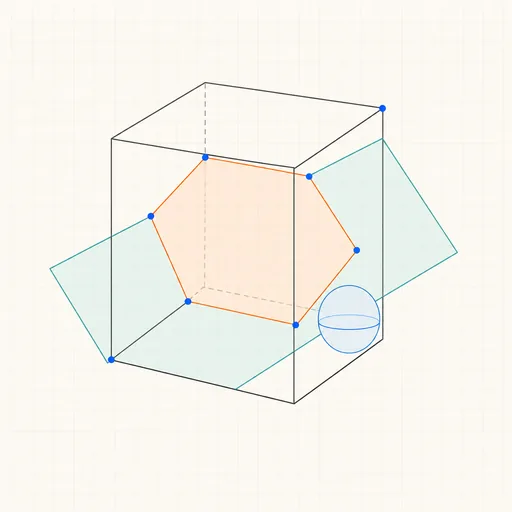
3D Geometry Board
Points, lines, planes, spheres and polyhedra on an orbiting camera — slice solids with planes, unfold nets, drop the Dandelin spheres into a cone and drag everything.
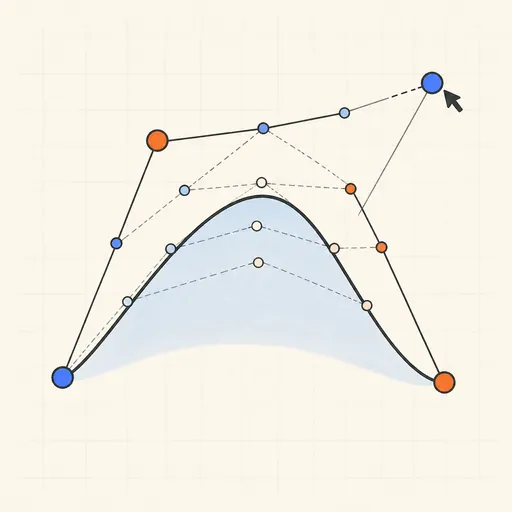
Bézier Curve Playground
Drag control points and watch De Casteljau’s algorithm construct a Bézier curve step by step.
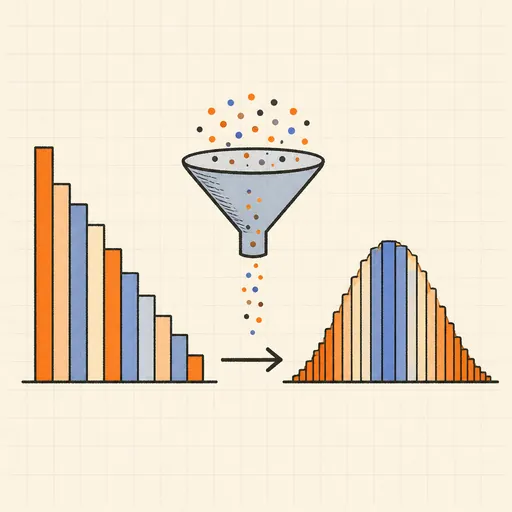
Central Limit Theorem Demo
Sample from any lopsided distribution and watch the averages pile up into a bell curve.
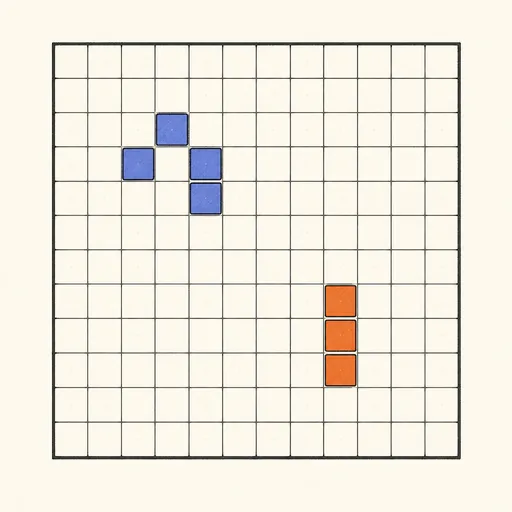
Conway’s Game of Life
Paint cells and watch Conway’s cellular automaton breed gliders, guns and oscillators.
Dynamic Geometry Board
Construct with points, lines, circles and transformations, then drag anything — the construction stays true, and a checker tells you which relations are theorems.
Fantasy Map Generator
Roll a seed and get a continent: coastlines, mountains, rivers, biomes and named towns, ready for your campaign.