Projectile Motion, Explained
After reading this you can predict where a thrown, kicked or launched object lands, how high it climbs, how long it stays airborne and how fast it hits, all from launch speed, angle, height and gravity.
What projectile motion is
A projectile is any object moving under gravity alone once it leaves your hand, the muzzle or the ramp. No thrust, no lift. Ignore air resistance and the path is a clean parabola. That single idealization lets you compute everything with high-school algebra.
Here is the hook. Launch a ball at 20 m/s at 45° on flat ground with Earth gravity. It flies for about 2.88 seconds, climbs to 10.2 m, lands 40.8 m away, and hits the ground at the same 20 m/s it left with. Every one of those numbers falls out of two ideas: horizontal speed never changes, and vertical speed changes at a steady rate.
The key idea: split the motion in two
Velocity is a vector. Break the launch speed v_0 into a horizontal part and a vertical part using the launch angle \theta:
Here v_x is the horizontal speed and v_{y0} is the vertical speed at launch. The horizontal direction feels no force (no air resistance, no gravity sideways), so v_x stays constant for the whole flight. The vertical direction feels gravity g pulling down, so the vertical speed drops by g every second.
For the demo values, v_x = 20 \cos 45° = 14.14 m/s and v_{y0} = 20 \sin 45° = 14.14 m/s. At 45° the two parts are equal, which is why that angle is special on flat ground.
When to use these formulas, and when not
Use them for a first estimate of any launched object: a thrown ball, a water jet, a stunt jump, an artillery round in a vacuum. They are exact when air resistance is negligible and the ground is flat over the range of flight.
Real air drag is not a small correction for fast or light objects. A golf ball hit at typical speed carries roughly half as far as the drag-free number, and a table-tennis ball almost stops in a few meters. Treat the results here as an upper bound on range, not a prediction for a real ball outdoors.
Do not use these formulas when spin, lift or wind matter (a curveball, a frisbee, an arrow), or when the flight covers enough distance that Earth's curvature and gravity variation matter (long-range ballistics). For a straight drop with no horizontal launch, the Free Fall Calculator is the simpler tool.
The four output formulas
Start from the launch height h. The vertical position at time t is y = h + v_{y0} t - \tfrac{1}{2} g t^2. Setting y = 0 and solving the quadratic gives the flight time:
When h = 0 this collapses to the familiar t = 2 v_{y0} / g. The range is horizontal speed times that time:
The peak comes when the vertical speed reaches zero, which takes v_{y0}/g seconds. The maximum height above the ground is:
Impact speed follows from energy or from combining the two velocity components at landing. The horizontal part is still v_x; the vertical part has grown to v_{yf} = \sqrt{v_{y0}^2 + 2 g h}. The impact speed is the vector sum:
Notice that with h = 0 the term under the root is just v_x^2 + v_{y0}^2 = v_0^2, so the ball lands at exactly its launch speed. Gravity gives back on the way down what it took on the way up.
Worked example: the demo values
Use v_0 = 20 m/s, \theta = 45°, h = 0, g = 9.81 m/s². These are the tool's default inputs, so pressing the demo button reproduces every number below.
- Components: v_x = 20 \cos 45° = 14.14 m/s, v_{y0} = 20 \sin 45° = 14.14 m/s.
- Flight time: t = 2 \times 14.14 / 9.81 = 2.883 s.
- Range: R = 14.14 \times 2.883 = 40.77 m.
- Max height: H = 14.14^2 / (2 \times 9.81) = 10.19 m.
- Impact speed: v_f = \sqrt{14.14^2 + 14.14^2} = 20.0 m/s, matching the launch.
A quick shortcut for range on flat ground: R = v_0^2 \sin(2\theta) / g. Check: 400 \times \sin 90° / 9.81 = 40.77 m. Same answer.
Reading the results, and how angle changes them
On flat ground, range peaks at 45° because \sin(2\theta) is largest there. Complementary angles give the same range: 30° and 60° both send the demo ball 35.3 m, but the 60° shot climbs much higher and stays up longer. The table shows the trade.
| Angle | Range (m) | Max height (m) | Flight time (s) |
|---|---|---|---|
| 15° | 20.39 | 1.366 | 1.055 |
| 30° | 35.31 | 5.097 | 2.039 |
| 45° | 40.77 | 10.19 | 2.883 |
| 60° | 35.31 | 15.29 | 3.531 |
| 75° | 20.39 | 19.02 | 3.938 |
Raising the launch height breaks the 45° rule. From a platform, the ball has extra time to travel horizontally, so a slightly flatter angle wins. Launch from 10 m up at 20 m/s and the best angle drops to about 38°, giving a range near 48.5 m instead of the flat-ground 45.9 m at 45°.
Common mistakes
The errors below account for most wrong answers.
- Degrees versus radians
- Sine and cosine of
45read as radians give nonsense. Confirm your calculator is in degree mode, or convert first. The tool takes degrees. - Forgetting launch height in the time equation
- Using t = 2 v_{y0}/g when h \gt 0 undercounts flight time. From
10m the demo ball flies3.44s, not2.88s. - Assuming impact speed equals launch speed
- That holds only when h = 0. From
10m the impact speed rises to \sqrt{20^2 + 2 \times 9.81 \times 10} = 24.4 m/s. - Using the wrong gravity
- On the Moon (
1.62m/s²) the same launch carries about six times as far. Set g to match the world. - Trusting range outdoors
- Air drag is missing here. For fast, light objects the real range can be less than half.
Related tools
For a pure vertical drop or the reverse (finding a fall height from impact speed), use the Free Fall Calculator. If you are working with sound or light instead of thrown objects, the Wavelength and Frequency Converter handles wave speed. For structural loads rather than flight, see the Beam Deflection Calculator, and for rotating machinery the Gear Ratio Calculator. Outdoor throws also depend on conditions the Wind Chill, Heat Index and Dew Point tool describes, though it does not model drag.
Frequently asked questions
Why does 45 degrees give the longest range?
Range on flat ground is v_0^2 \sin(2\theta)/g. The factor \sin(2\theta) peaks at 2\theta = 90°, so \theta = 45°. It balances horizontal speed against airtime. This only holds when the launch and landing heights are equal.
Does mass affect the trajectory?
Not without air resistance. Gravity accelerates every mass at the same rate, so a feather and a cannonball share the same parabola in a vacuum. Mass only matters once you add drag, where lighter objects slow more.
How do I find range when launching from a cliff?
Enter the height. The flight time formula t = (v_{y0} + \sqrt{v_{y0}^2 + 2gh})/g already accounts for it, and range is still v_x t. The best angle drops below 45 degrees as height rises.
What impact speed should I expect?
Use v_f = \sqrt{v_0^2 + 2gh}. With h = 0 it equals the launch speed. Every extra meter of drop adds energy, so from height the object lands faster than it left.
How wrong is the no-drag answer in real life?
It depends on speed, size and mass. A dense, slow object (a shot put) tracks the formula closely. A fast, light one (a golf ball, roughly half the predicted range; a ping-pong ball, far less) does not. Treat the result as a ceiling.
Related tools
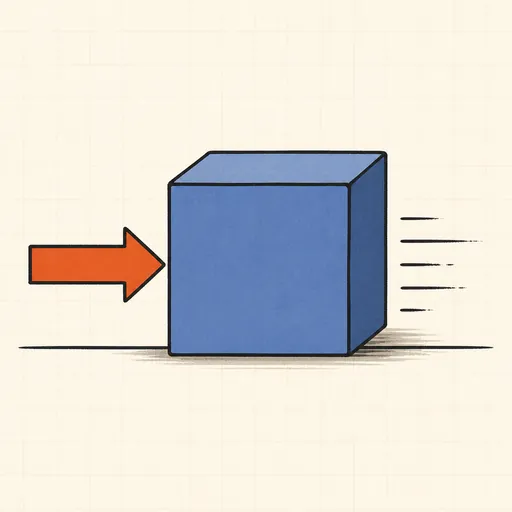
Force Calculator (F = ma)
Solve Newton's second law for force, mass or acceleration.
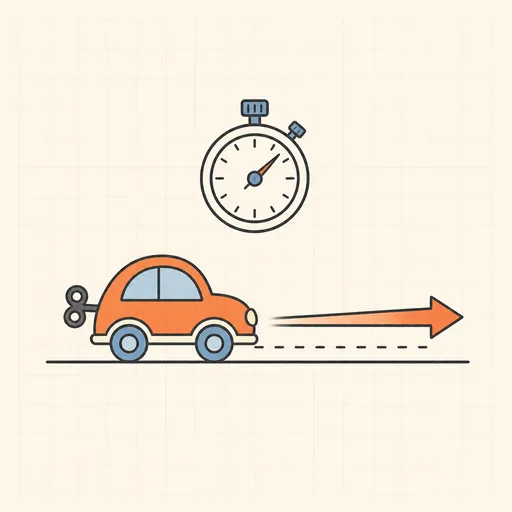
Kinematics Calculator (SUVAT)
Solve motion problems from any three of u, v, a, t, s.
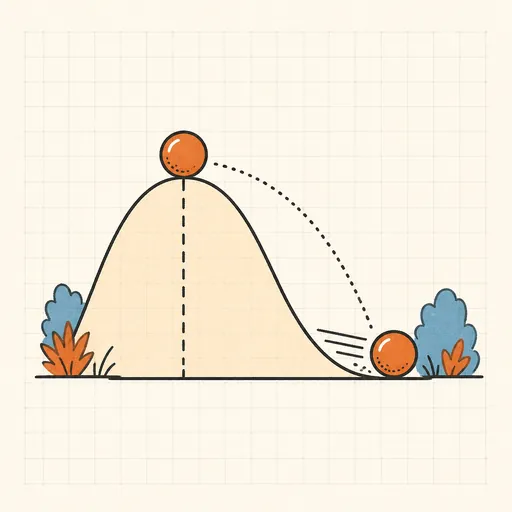
Kinetic & Potential Energy Calculator
KE = ½mv², PE = mgh and total mechanical energy.
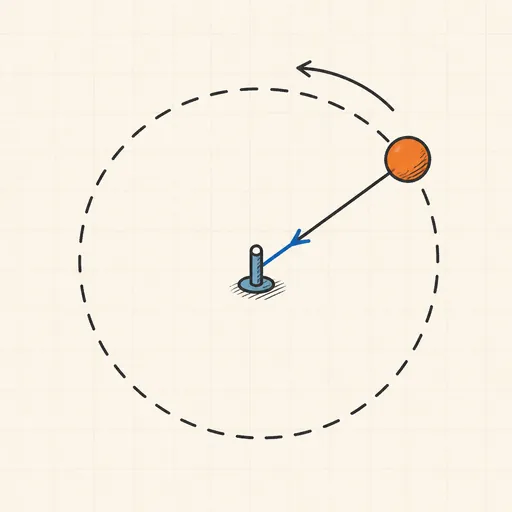
Circular Motion Calculator
Centripetal acceleration, force and angular speed.
Density Calculator (ρ = m/V)
Solve density, mass or volume from the other two.
Free Fall Calculator
Fall time and impact speed from a height, or vice versa.