Boiling & Freezing Point Elevation and Depression, Explained
After reading this you can predict how much a dissolved solute raises a solvent's boiling point, lowers its freezing point, and builds osmotic pressure, using molality and the van't Hoff factor, and you will know exactly where the simple formulas stop being trustworthy.
What these properties are, and one example
Dissolve salt in water and two things change: the water boils above 100 °C and freezes below 0 °C. These shifts are colligative properties. The word means they depend on the number of dissolved particles, not on their chemical identity. One mole of dissolved sugar molecules and one mole of dissolved glucose molecules lower the freezing point by the same amount, because both contribute the same particle count.
Here is the hook. Spread salt on an icy road and you do not melt the ice by heating it. You lower the temperature at which liquid water and ice can coexist. If the air sits at -5 °C, pure ice stays frozen, but a salty film of water can stay liquid down to about -6 °C for a modest salt concentration, so the ice melts. The same physics keeps antifreeze liquid in a cold engine and makes an ice cream churn work when you pack it with rock salt.
When the simple model applies, and when it fails
The equations below are ideal-solution laws. They assume the solute particles barely interact and the solution is dilute. They work well up to roughly 1 molal for many solutes and give useful estimates a bit beyond that. Past that point the numbers drift.
Use this model when you know the molality and the number of particles per formula unit. Do not trust it for concentrated solutions, for solutes that partly dissociate or associate, or when the solute reacts with the solvent. For a strong electrolyte like \text{NaCl} at 1 molal, the measured van't Hoff factor is about 1.9, not the ideal 2, because oppositely charged ions cluster loosely. The gap grows with concentration.
Molality is moles of solute per kilogram of solvent, not per liter of solution. It is chosen on purpose because kilograms of solvent do not change with temperature, while liters of solution expand when heated. If you plug in molarity by mistake, your boiling point will be off by a few percent at room temperature and more when hot.
The formulas and the intuition behind them
Boiling-point elevation and freezing-point depression share the same shape:
Here \Delta T_b is the rise in boiling point in °C, i is the van't Hoff factor (particles per formula unit), K_b is the solvent's ebullioscopic constant in °C·kg/mol, and m is the molality in mol/kg.
The symbols mirror the first equation, with K_f the cryoscopic constant and \Delta T_f the drop in freezing point. The new boiling point is T_b + \Delta T_b; the new freezing point is T_f - \Delta T_f. Note the minus sign: freezing point goes down.
Why does this happen? Dissolved particles lower the vapor pressure of the solvent, because some surface sites that would launch solvent molecules into vapor are occupied by solute. Lower vapor pressure means you must heat further to reach atmospheric pressure, so boiling point rises. On the freezing side, particles get in the way of the ordered crystal forming, so you must cool further before the solid is stable. Both constants, K_b and K_f, come from the solvent's heat of phase change and boiling or freezing temperature, so each solvent has its own pair.
Osmotic pressure follows a related law:
Here \Pi is osmotic pressure in atm, M is molarity in mol/L, R = 0.08206 L·atm/(mol·K), and T is absolute temperature in K. For dilute water solutions the tool treats molality and molarity as nearly equal, so it uses your molality as M. That approximation is fine near 1 molal in water and gets worse as concentration rises.
A worked example with water and 1 molal solute
Reproducing the demo: water, m = 1, i = 1
The demo uses the defaults: water as solvent, K_b = 0.512, K_f = 1.86, normal boiling point 100 °C, normal freezing point 0 °C, molality 1, and van't Hoff factor 1 (a nonelectrolyte like sugar).
- Boiling-point rise: \Delta T_b = 1 \times 0.512 \times 1 = 0.512 °C. New boiling point 100 + 0.512 = 100.512 °C.
- Freezing-point drop: \Delta T_f = 1 \times 1.86 \times 1 = 1.86 °C. New freezing point 0 - 1.86 = -1.86 °C.
- Osmotic pressure at
298.15K: \Pi = 1 \times 1 \times 0.08206 \times 298.15 \approx 24.47 atm.
Two facts stand out. The freezing shift (1.86 °C) is more than three times the boiling shift (0.512 °C) for the same solution, because K_f for water is larger than K_b. And the osmotic pressure of a plain 1 molal solution is about 24 atm, roughly 24 times sea-level air pressure. Osmosis is the most sensitive of the three effects, which is why biologists use it to measure very dilute solutions.
If you have a mass of solute rather than moles, convert first. The Molar Mass Calculator gives you the molar mass, and the Mole Calculator turns grams into moles so you can compute molality.
How i changes everything
The van't Hoff factor multiplies both temperature shifts directly. Compare three solutes at the same 1 molal in water. Sugar stays whole, so i = 1. Table salt splits into two ions, so i \approx 2. Calcium chloride splits into three, so i \approx 3. The freezing-point drops scale in step.
| Solute | i (ideal) | ΔT_f (°C) | New f.p. (°C) | ΔT_b (°C) | New b.p. (°C) |
|---|---|---|---|---|---|
| Sucrose | 1 | 1.86 | -1.86 | 0.512 | 100.5 |
| NaCl | 2 | 3.72 | -3.72 | 1.024 | 101.0 |
| CaCl₂ | 3 | 5.58 | -5.58 | 1.536 | 101.5 |
Reading and interpreting the results
The tool returns four numbers: the boiling-point elevation, the freezing-point depression, the shifted temperatures, and the osmotic pressure. Read them as a set. If your freezing depression comes out tiny, say 0.05 °C, your solution is very dilute or your solute does not dissociate. If it comes out large, check that your molality is realistic; a 5 molal number pushes past where the ideal law holds.
Work backward too. Measure a freezing-point drop of 0.93 °C for a 0.5 molal aqueous solution and solve i = \Delta T_f / (K_f \cdot m) = 0.93 / (1.86 \times 0.5) = 1.0. That tells you the solute is a nonelectrolyte. This is how chemists measure molar mass of an unknown: dissolve a known mass, measure the freezing drop, back out the moles.
Common mistakes
The errors below account for most wrong answers.
- Forgetting i for ionic solutes
- A
1molal NaCl solution behaves like2molal in particle count. Leave i at 1 and your freezing drop is half of reality. - Using molarity instead of molality
- These agree only for dilute aqueous solutions near room temperature. For other solvents or hot solutions they diverge.
- Adding the drop instead of subtracting
- Freezing point goes down. The new freezing point is T_f - \Delta T_f, so water at
1molal freezes at-1.86°C, not+1.86. - Mixing up the constants per solvent
- Water's K_f = 1.86 and K_b = 0.512. Benzene's are
5.12and2.53. Swapping them silently produces plausible but wrong numbers. - Applying the law to concentrated solutions
- Above roughly
1to2molal, real shifts fall below the ideal prediction. Treat the output as an estimate, not a measurement.
Related tools
Colligative work usually starts before the molality and continues after. To get moles from a formula and a mass, use the Mole Calculator and the Molar Mass Calculator. When you need molarity in different units for the osmotic-pressure side, the Concentration Converter handles g/L, ppm and percent. If you are diluting a stock solution first, the Dilution Calculator gives the new concentration. For the vapor-pressure and gas side of phase behavior, the Ideal Gas Law Calculator uses the same R that appears in the osmotic-pressure formula. And when heat rather than particle count is the question, the Calorimetry Calculator handles Q = mc\Delta T.
Frequently asked questions
Why does salt lower the freezing point of water?
Dissolved ions disrupt the ordered ice crystal and lower the solvent's vapor pressure, so water must be cooled further before ice becomes stable. At 1 molal NaCl with i \approx 2, the drop is about 2 \times 1.86 \times 1 = 3.72 °C.
What van't Hoff factor should I use?
Count the particles one formula unit releases in solution: 1 for sugar and other nonelectrolytes, 2 for NaCl or KCl, 3 for CaCl₂ or Na₂SO₄. Real values run slightly below these ideals because ions pair up, more so at higher concentration.
Why is the boiling shift smaller than the freezing shift?
For water, K_b = 0.512 is much smaller than K_f = 1.86. Same molality, same i, so the freezing drop is about 1.86 / 0.512 \approx 3.6 times the boiling rise.
Can I use this to find an unknown molar mass?
Yes. Measure the freezing-point drop, solve for molality with m = \Delta T_f / (i \cdot K_f), multiply by kilograms of solvent to get moles, then divide the solute mass by moles for the molar mass.
Does osmotic pressure really reach tens of atmospheres?
For a 1 molal water solution at 25 °C, yes: about 24 atm. That is why osmosis pushes water strongly across membranes and why sea water needs high pressure to desalinate by reverse osmosis.
Related tools

Chemical Equation Balancer
Balance any chemical equation to whole numbers.
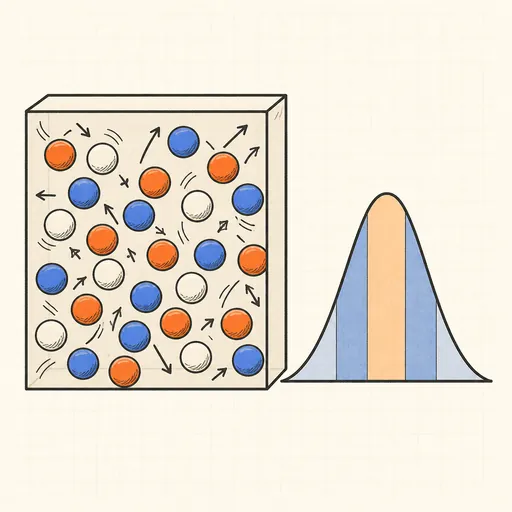
Ideal Gas Law Calculator (PV = nRT)
Solve for pressure, volume, moles or temperature.

Molar Mass Calculator
Molar mass and percent composition from a formula.
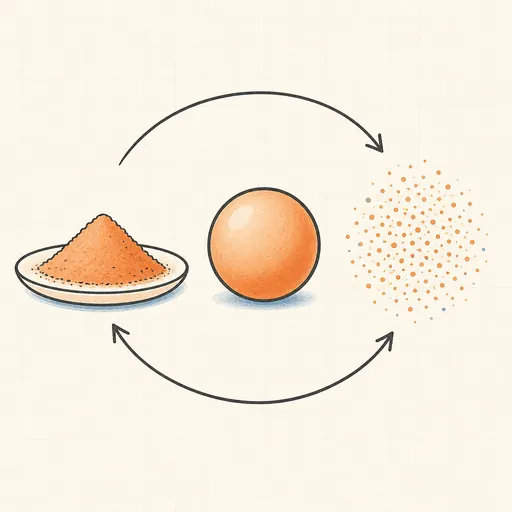
Mole Calculator (grams ↔ moles ↔ particles)
Convert between mass, moles and number of particles.
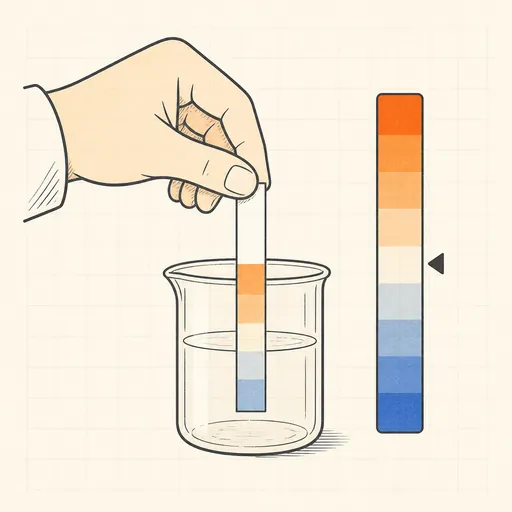
pH Calculator
pH, pOH and ion concentrations for acids and bases.

Calorimetry Calculator (Q = mcΔT)
Heat, mass, specific heat or temperature change.