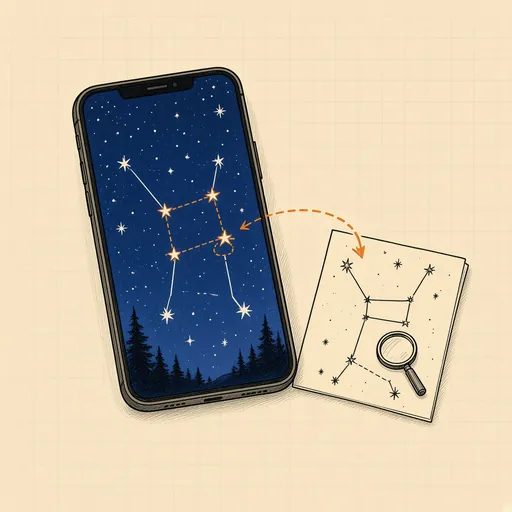
Star Photo Identifier
Point your phone at the stars, take a picture, drop it here. The tool finds every star in the photo and works out, from the pattern alone, which part of the sky it shows: it turns groups of four stars into shape codes that do not care how the photo is rotated or zoomed, looks them up in an index built from 41,000 stars of the Hipparcos catalogue, and checks every candidate against the rest of the stars until one fits beyond doubt. This is plate solving, the method astronomers and spacecraft star trackers use, done blind and in your browser. The result is your photo with the constellation lines drawn in and the stars, deep-sky objects and, when the date is known, the planets and the Moon labelled, plus the exact pointing, field of view and lens model of the camera. If the photo carries its date and location, it also tells you which way you were facing and how high you aimed.
Runs 100% in your browser — your files never leave your device.
Notes
- How it works: up to 500 star-like points are found and centred to a fraction of a pixel. Groups of four bright ones become codes that ignore rotation, zoom and position, and each matching code among 80,000 four-star patterns in the index is tested against all the other stars. A match is accepted only when the odds of a coincidence are below one in a hundred million.
- The camera model is then fitted to every matched star: pointing, rotation, focal length, the lens projection (normal or one of three fisheye types) and barrel or pincushion distortion. Mirrored pictures, such as those through a star diagonal or from a selfie camera, are recognised as well.
- It needs roughly ten stars or more. A night-mode phone shot with the main or wide lens almost always works; a zoomed-in shot of a bright city sky showing only a handful of stars may not.
- The date, time and place come from the photo’s EXIF data when it has them (many messaging apps strip them), or you can type them in. They add the planets and the Moon, the horizon with compass points, and the height and direction the camera was aimed, and hide whatever was below the horizon.
- Star data: Hipparcos stars, IAU star names and the Messier catalogue via the d3-celestial dataset by Olaf Frohn (BSD licence). Sample photos: NASA/Don Pettit (Orion from the International Space Station, 2003) and NPS/Neal Herbert (Yellowstone, 2014), both public domain.
- Runs 100% in your browser — your files and data never leave your device.
Related tools
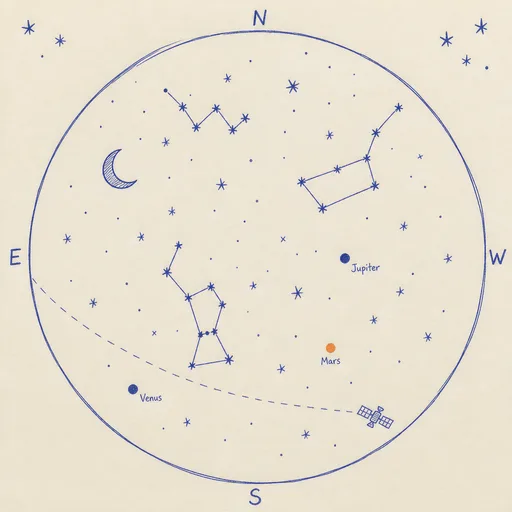
Planetarium & Star Chart
The whole sky over any place and time: stars, constellations, planets, the Moon and satellite passes.
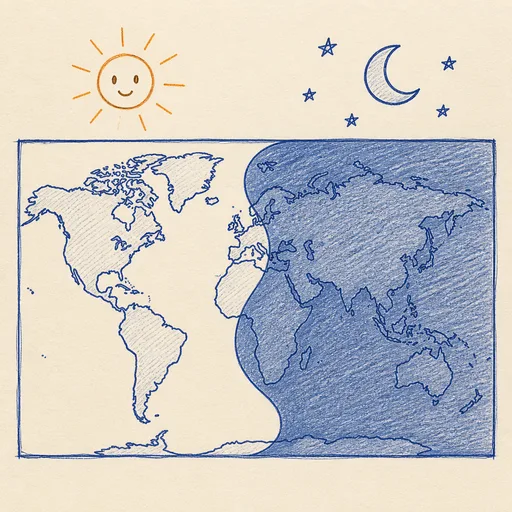
Day & Night World Map
Live sunlight terminator on a world map, with date and time sliders.

Solar Time vs Clock Time
How wrong is your clock? See the gap between official time and sun time anywhere on Earth.
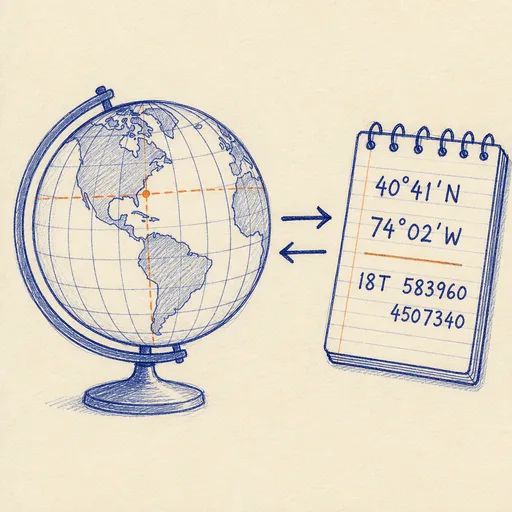
Coordinate Converter
Convert between decimal degrees, DMS, UTM, MGRS, geohash and Plus Codes — with a map.
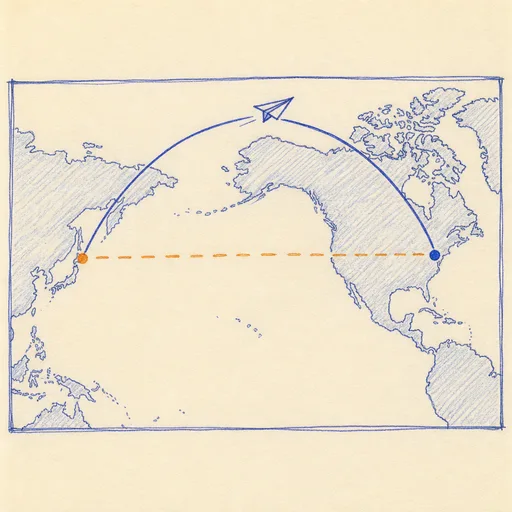
Great Circle vs Rhumb Line
Why flights look curved on the map: shortest path vs constant bearing between any two points.
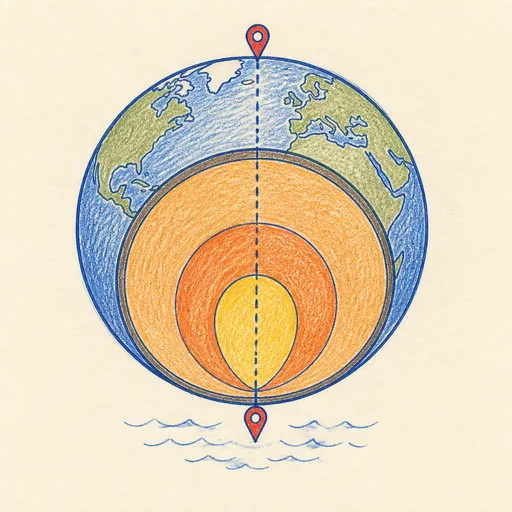
Antipode Finder
Click any point on Earth and see where you would come out if you dug straight through.