Loan Calculator, Explained
After reading this you can compute the fixed monthly payment on any amortizing loan by hand, predict how much interest you will pay in total, and read an amortization schedule well enough to spot where your money actually goes.
What an amortizing loan is
Most car loans, personal loans and fixed-rate mortgages are amortizing. You borrow a lump sum, then repay it in equal monthly installments. Each payment is the same size, but its split between interest and principal changes every month. Early on, most of the payment covers interest. Later, most of it reduces the balance.
Here is the hook. Borrow 20000 at 8% for 5 years. The payment works out to about 405.53 per month. Over 60 months you hand back 24331.67, so the loan costs you 4331.67 in interest. That extra amount, roughly 22% of what you borrowed, is the price of spreading repayment over five years.
The word "amortize" comes from the Latin for "to kill off." Each payment kills off a slice of the principal until nothing is left. A loan with a final lump sum instead of a clean zero is a different animal (see the balloon loan tool later).
When to use this calculator, and when not
Use it for any loan with a fixed rate, a fixed term, and equal payments: car loans, student loans on a standard plan, personal loans, and fixed-rate mortgages (ignoring taxes and insurance).
Do not use it, or use it with care, in these cases:
- Credit cards. The payment is not fixed and the balance revolves. Use the Credit Card Payoff Calculator instead.
- Variable-rate loans. The rate changes, so a single monthly figure is only a snapshot.
- Loans with fees. Origination fees raise the true cost. To see the real yearly rate, use the APR from Fees Calculator.
- Balloon loans. These leave a large final payment. Use the Balloon Loan Calculator.
The formula and why it looks that way
The fixed payment comes from one equation:
Here A is the monthly payment, P is the amount you borrow, i is the monthly interest rate (the annual rate divided by 12), and n is the total number of payments (years times 12).
The intuition: each month interest of i times the current balance is added, then you pay A. The formula picks the single value of A that drives the balance to exactly zero after n payments. It is the present value of an annuity, solved for the payment.
To see where the denominator comes from, imagine reversing the process. The value today of a payment made k months from now is A(1+i)^{-k}. Sum that geometric series from k=1 to n, set it equal to P, and rearrange. The closed form of the sum gives the 1 - (1+i)^{-n} term.
Watch your units. If the annual rate is 8%, then i = 0.08/12 = 0.006667, not 0.08. A common error is plugging the annual rate straight in, which inflates the payment badly.
A worked example with the demo numbers
20000 at 8% for 5 years
These are the tool's default values, so you can press the demo button and check every figure below.
- Monthly rate: i = 0.08 / 12 = 0.0066667.
- Number of payments: n = 5 \times 12 = 60.
- Compute (1+i)^{-n} = 1.0066667^{-60} = 0.67121.
- Denominator: 1 - 0.67121 = 0.32879.
- Numerator: P \cdot i = 20000 \times 0.0066667 = 133.33.
- Payment: A = 133.33 / 0.32879 = 405.53.
Now trace the first month. Interest is 20000 \times 0.0066667 = 133.33. Of your 405.53 payment, that leaves 405.53 - 133.33 = 272.20 to reduce the balance. The new balance is 19727.80.
The last month is the mirror image. The balance before it is about 402.85, interest is only 2.69, and nearly the whole payment clears the principal. Total interest over all 60 months is 60 \times 405.53 - 20000 = 4331.67.
Watching the balance fall
The balance does not drop in a straight line. It curves. Because interest is charged on whatever you still owe, a large balance eats up more of each early payment, so principal repayment starts slow and speeds up.
At month 30, the halfway point in time, the balance is 10895, not 10000. You have repaid slightly less than half the principal even though half the payments are gone. That gap is the interest working against you.
How each payment splits
Every payment is the same 405.53, but the interest portion shrinks and the principal portion grows. The table below samples one payment per year.
| Payment # | Interest | Principal | Balance after |
|---|---|---|---|
| 1 | 133.33 | 272.20 | 19728 |
| 12 | 110.57 | 294.96 | 16585 |
| 24 | 85.81 | 319.72 | 12872 |
| 36 | 58.87 | 346.66 | 8832 |
| 48 | 29.57 | 375.96 | 4436 |
| 60 | 2.69 | 402.84 | 0 |
In payment 1 interest is 133.33. In payment 60 it is 2.69. Same payment, wildly different composition. This is why paying extra early helps so much: an extra dollar now removes future interest on that dollar for the whole remaining term.
The interactive: how the term reshapes the loan
Term length is the parameter people underestimate. A longer term lowers each payment but raises total interest, and not gently. Move the slider and watch both numbers respond.
Common mistakes
Confusing rate with APR. The nominal rate ignores fees. If a loan has an origination fee, the real yearly cost is higher. Check it with the APR from Fees Calculator linked above.
Assuming payment equals cost. A lower monthly payment can hide a higher total cost. Always look at total interest, not just the installment.
Forgetting escrow on mortgages. The calculator gives principal and interest only. Property taxes and insurance are added separately by your lender, so the real bill is larger.
Do not compare two offers on monthly payment alone. A 7-year loan almost always has a smaller payment than a 3-year loan for the same amount, yet it can cost thousands more. Compare total interest and the true APR side by side.
Related tools
Once you have the base payment, these tools answer the next questions:
- To see what overpaying does, use the Extra Loan Payment Calculator.
- To weigh two offers with fees included, use the Loan Comparison Calculator.
- To find the balance left after a set number of payments, use the Remaining Loan Balance Calculator.
- To decide if refinancing pays off, use the Refinance Break-Even Calculator.
- To check whether a new loan fits your income, use the Debt-to-Income Ratio Calculator.
- To attack several debts, compare methods with Debt Snowball vs Avalanche, roll them into one with the Debt Consolidation Calculator, or see the cost of paying only the minimum with the Minimum Payment Trap Calculator.
Frequently asked questions
Why is my total interest so much higher on a longer loan?
You carry the balance longer, so interest accrues over more months. With 20000 at 8%, a 3-year term costs about 2562 in interest, while a 7-year term costs about 6196. Same amount, same rate, more than double the interest.
How do I convert the annual rate to a monthly rate?
Divide by 12. An 8% annual rate gives a monthly rate of 0.08/12 = 0.0066667. This is the standard method lenders use for monthly-compounding loans.
Does paying extra reduce my monthly payment?
No. On a standard amortizing loan the payment is fixed. Extra payments cut the principal, which shortens the term and lowers total interest, but the monthly amount stays the same unless you formally recast the loan.
Why does the balance at the halfway point exceed half the loan?
Early payments are mostly interest, so principal falls slowly at first. For 20000 at 8% over 60 months, the balance at month 30 is 10895, not 10000. The 895 gap reflects the interest-heavy early payments.
Is this the same math a bank uses?
The core formula is identical for fixed-rate amortizing loans. Small differences appear from rounding rules, day-count conventions, and fees. Treat this as an accurate educational estimate, and confirm exact figures with your lender.
This is an educational estimate, not financial advice. Talk to a qualified adviser before making money decisions.
Related tools
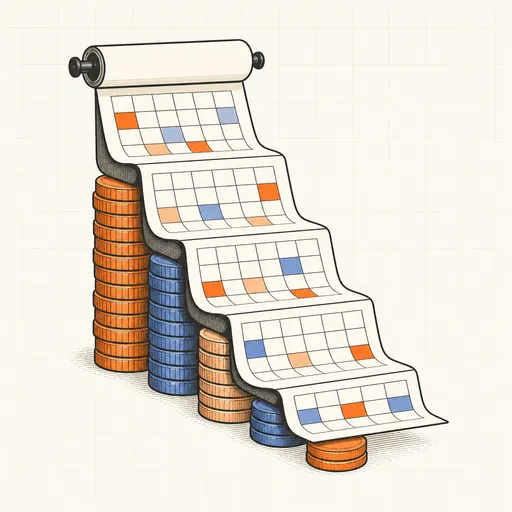
Amortization Schedule Calculator
Full month-by-month loan schedule with CSV export.

Credit Card Payoff Calculator
Months to debt-free at a given monthly payment.

Debt Snowball vs Avalanche
Compare the two payoff strategies on your debts.
Extra Loan Payment Calculator
Interest and years saved by paying extra.

APR from Fees Calculator
True yearly cost of a loan once fees are counted.

Debt Consolidation Calculator
Current debts vs one consolidating loan.