Extra Loan Payment Calculator, Explained
After reading this you will know exactly how a monthly overpayment or a one-off lump sum cuts the interest you pay and shortens a loan, and you will be able to reproduce the numbers by hand.
What paying extra actually does
A loan payment splits into two parts every month: interest on the current balance, and principal that reduces the balance. The interest part is fixed by the balance and the rate. You cannot change it for this month. But every extra unit you pay lands entirely on principal, because the interest was already covered by the scheduled payment.
Here is the hook. Take a 20000 loan at 8% over 5 years. The scheduled payment is about 405.53 per month, and you pay roughly 4331.67 in total interest. Add 100 per month on top, and you finish in about 50 months instead of 60, paying roughly 3502 in interest. That single change saves close to 830 and ten months, with no extra risk.
The reason the saving is larger than the extra cash suggests: reducing principal early starves every future month of interest. You are not just paying down debt, you are removing the interest that debt would have generated for the rest of the term.
When this helps, and when it does not
Overpaying makes the most sense when the loan rate is high and there is no penalty for early repayment. At 8%, every unit sent to principal earns a guaranteed 8% return, tax-free, because it is interest you now never pay. Few safe investments match that.
It helps less, or not at all, in three cases. First, if the lender charges a prepayment penalty that eats the saving. Second, if you carry other debt at a higher rate: pay that first. A credit card at 22% beats a car loan at 8% every time. Third, if you have no emergency fund: money locked into a loan is hard to get back.
Compare the loan rate to what your cash could earn elsewhere. If a savings account pays 4% and the loan costs 8%, overpaying wins by 4 percentage points. If the loan is 3% and savings pay 5%, keeping the cash wins.
The formula and the intuition
The monthly payment on a fixed-rate loan comes from the standard amortization formula. Let P be the loan amount, i the monthly rate (annual rate divided by 12), and n the number of months.
Here M is the fixed monthly payment, i = 0.08/12 \approx 0.006667, and n = 60. This is the same engine behind the Loan Calculator.
To see where extra payments bite, track the balance month by month. Each month the balance grows by interest, then shrinks by whatever you pay.
In this recursion B_k is the balance after month k, E is the extra monthly payment, and L_k is any one-off lump sum paid in that specific month (zero in every other month). The loan is done when B_k reaches zero, which now happens before month n.
The intuition: M is designed to zero the balance at exactly month n. Adding E or L_k pulls the balance below the scheduled path, so it hits zero sooner. Interest for each month is B_{k-1} \cdot i, so a smaller balance in every future month means a smaller interest bill every future month.
A worked example with the demo numbers
20000 at 8% over 5 years, plus 100 per month
- Monthly rate: i = 0.08 / 12 = 0.0066667.
- Months: n = 5 \times 12 = 60.
- Compute (1+i)^{60} \approx 1.48985.
- Payment: M = 20000 \cdot \frac{0.0066667 \times 1.48985}{1.48985 - 1} \approx 405.53.
- Original total interest: 405.53 \times 60 - 20000 \approx 4331.67.
- Now run the balance recursion with E = 100, so you pay
505.53per month. The balance reaches zero during month50. - Accelerated total interest: about
3502. Interest saved: 4331.67 - 3502 \approx 830. Time saved:10months.
To reproduce this, open the tool with its default values (amount 20000, rate 8, years 5, extra 100, lump 0) and press Calculate.
Lump sums versus monthly extras
A one-off lump sum works the same way, but timing matters more. A lump paid in month 12 removes that amount from the balance immediately, and every later month charges interest on the smaller balance. The earlier the lump lands, the more interest it kills.
Compare two 2000 lump sums on the same 20000 loan at 8%. Paid in month 6, it saves more interest than the same 2000 paid in month 36, because it works for longer. The rule of thumb: with lump sums, sooner beats later, and a big early lump often beats spreading the same money across months.
A lump sum does not usually change your monthly payment. It shortens the term instead. The scheduled payment stays at 405.53, you just finish sooner. Some lenders let you re-amortize to lower the payment instead: ask which applies before you pay.
See the trade-off yourself
Reading and interpreting the results
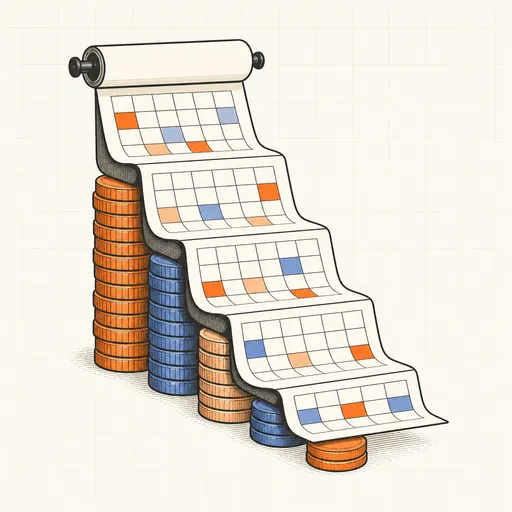
The tool shows two schedules side by side. Read three numbers. Interest saved is the headline: the difference between original and accelerated total interest. Time saved tells you how many months earlier the debt clears. New payoff month is the actual finish line.
Convert interest saved into an effective return to judge it fairly. On the demo, you added 100 per month for about 50 months, roughly 5000 of extra cash, and saved 830 in interest while freeing ten months of payments worth about 4055. The guaranteed return equals the loan rate, 8%, on every unit while it stays in the loan.
- Total interest
- The sum of the interest portion of every payment across the whole loan.
- Accelerated schedule
- The payment plan once your extra payments are included.
- Payoff month
- The month the balance first reaches zero.
Common mistakes
The frequent errors are small but they change the answer.
- Assuming the payment drops. With most loans, overpaying shortens the term, it does not lower the required monthly payment. Budget for the full payment until payoff.
- Ignoring prepayment penalties. Some loans charge a fee for early repayment. If the fee is
500and you would save830, the real saving is330. - Overpaying the wrong loan. Attack the highest rate first. Sending
100to an8%loan while a22%card grows is a costly ordering error. - Emptying the emergency fund. Money in the loan is gone. If you lose income, you cannot borrow it back at
8%.
Confirm with your lender that extra payments reduce principal, not future payments held in advance. If an overpayment just credits next month's bill, the balance never falls and you save nothing.
Related tools
Start with the Loan Calculator for the baseline payment and full schedule, then come here to test overpayments. For card debt, the Credit Card Payoff Calculator and the Minimum Payment Trap Calculator show what fixed payments do. If you juggle several debts, the Debt Snowball vs Avalanche tool decides the order.
Weighing a new deal instead of overpaying the old one? Use the Loan Comparison Calculator, the Refinance Break-Even Calculator, the APR from Fees Calculator, or the Debt Consolidation Calculator. To check where you stand today, try the Remaining Loan Balance Calculator, the Debt-to-Income Ratio Calculator, or the Balloon Loan Calculator.
Frequently asked questions
Does an extra payment lower my monthly bill?
Usually no. On most loans it shortens the term, so you make fewer payments of the same size. Some lenders offer re-amortization, which lowers the payment instead. Ask which your loan uses.
Is it better to pay extra monthly or one big lump sum?
It depends on when the money is available. A lump sum paid early beats the same total spread out slowly, because it cuts the balance sooner. But small monthly extras you can sustain often beat a lump sum you are waiting to accumulate.
What return am I really earning by overpaying?
The loan's interest rate. On an 8% loan, every unit paid early saves 8% per year in interest you would otherwise owe, and that saving is tax-free.
Should I overpay or invest the money?
This is an educational estimate, not advice. Compare the guaranteed loan rate to the after-tax return you expect elsewhere, and factor in risk. Overpaying is certain; investment returns are not.
What if my loan has a prepayment penalty?
Subtract the penalty from the interest you would save. If the penalty is larger than the saving, do not overpay. Check the loan agreement for the exact fee.
Related tools
Amortization Schedule Calculator
Full month-by-month loan schedule with CSV export.

Credit Card Payoff Calculator
Months to debt-free at a given monthly payment.

Debt Snowball vs Avalanche
Compare the two payoff strategies on your debts.
Loan Calculator
Monthly payment, total interest and full schedule.

APR from Fees Calculator
True yearly cost of a loan once fees are counted.

Debt Consolidation Calculator
Current debts vs one consolidating loan.