Emergency Fund Calculator, Explained
After reading this, you will know how to size a cash safety net from your essential spending, work out the gap you still have to fill, and calculate how many months of saving it takes to close it.
What an emergency fund is and why the number matters
An emergency fund is a pot of cash you keep for the shocks that break a normal budget: a lost job, a car repair, a medical bill, a broken boiler. It is not for holidays or a new phone. Its whole point is to sit still and be available fast.
The size question has a simple structure. Decide how much you spend each month on essentials, decide how many months you want to cover, and multiply. Suppose your essential spending is 2000 a month and you want six months of cover. Your target is 12000. If you already hold 3000, the gap is 9000. Saving 400 a month, you close that gap in 22.5 months, which rounds up to 23 full months because the final partial month still needs a whole month to arrive.
Every number in this article is checkable with that arithmetic. Nothing here depends on market returns, because an emergency fund is cash, not an investment.
When to use this calculation, and when not
Use it when you are building or topping up a cash buffer and want a concrete finish line. A finish line matters: "save more" has no end, but "reach 12000 by month 23" tells you when you can redirect that 400 a month elsewhere.
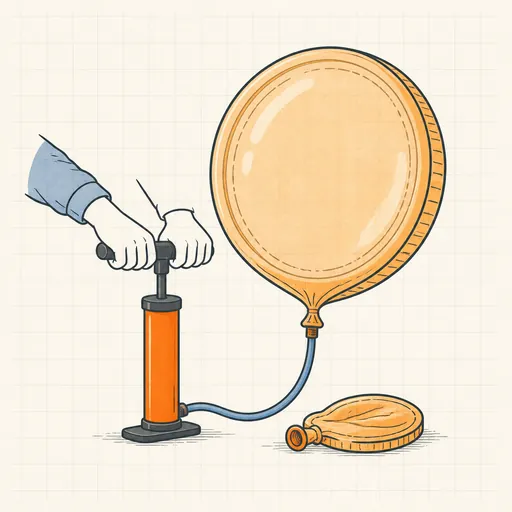
Do not use this framing for money you want to grow. Cash loses purchasing power to inflation, so an emergency fund is deliberately a defensive holding, not a wealth-building one. Once the fund is full, longer-term money belongs in different accounts, and the trade-off between cash and inflation is worth understanding separately.
Three months of essentials is a common minimum. Six months or more suits variable income, self-employment, or a household with a single earner. Steady salaried income with strong job security can justify a smaller target.
The formula and the intuition behind it
Start with the target. It is spending per month times the months you want covered.
Here T is the target fund, E is essential monthly expenses, and m is the number of months to cover. The gap is what remains after subtracting what you already hold.
Here G is the gap and S is the amount already saved. The \max with zero matters: if you already hold more than the target, the gap is zero, not a negative number. You are done.
The time to fill divides the gap by your monthly saving, then rounds up because a partial month of contribution does not arrive until that month ends.
Here n is the number of months and c is your monthly contribution. The ceiling brackets \lceil \; \rceil round any fraction up to the next whole month. If c = 0 the fund never fills, so the time is undefined rather than infinite in a useful sense.
A worked example using the demo numbers
Six months of cover from a partial start
Use the demo values: essentials 2000, months to cover 6, already saved 3000, saving 400 a month.
- Target: T = 2000 \times 6 = 12000.
- Gap: G = 12000 - 3000 = 9000.
- Raw months: 9000 \div 400 = 22.5.
- Round up: n = \lceil 22.5 \rceil = 23 months.
- At month 22 you hold 3000 + 22 \times 400 = 11800, still
200short. Month 23 adds another400and carries you past12000.
So the calculator reports a target of 12000, a gap of 9000, and a fill time of 23 months. If nothing changes, you reach a six-month cushion in just under two years.
How each input moves the answer
The target scales directly with both spending and months. Cut essentials from 2000 to 1800 and the six-month target drops from 12000 to 10800, a fall of 1200. Drop the cover from six months to three and the target halves to 6000.
The fill time is more sensitive to your saving rate than people expect, because it sits in the denominator. Keep the 9000 gap and raise saving from 400 to 600 a month: the time falls from 22.5 to 15 months, a cut of a third. Halve the saving to 200 and the time doubles to 45 months. The table shows the pattern.
| Monthly saving | Raw months | Rounded months |
|---|---|---|
| 200 | 45.0 | 45 |
| 300 | 30.0 | 30 |
| 400 | 22.5 | 23 |
| 600 | 15.0 | 15 |
| 900 | 10.0 | 10 |
Reading the result honestly
The fill time assumes three things hold steady: your essential spending, your saving rate, and no withdrawals along the way. Real life breaks all three. A rent increase raises the target after you started. A bonus lets you overshoot the monthly rate. A car repair mid-build resets the balance downward.
Treat the number as a checkpoint, not a contract. Rerun the calculation whenever your spending or income changes by more than a little. If you overshoot the target one month because of a windfall, the gap simply reaches zero sooner and the tool reports fewer months.
Base the target on essential spending only: rent or mortgage, food, utilities, insurance, minimum debt payments, transport to work. Leaving out discretionary spending gives a smaller, more reachable target that still covers the months you cannot work.
Common mistakes
Using your whole budget instead of essentials. If your full monthly outgoings are 2800 but essentials are 2000, a six-month target built on the wrong figure is 16800 rather than 12000. You would spend an extra 4800 of saving building a bigger cushion than an emergency requires.
Counting money you cannot reach fast. A locked savings bond or an investment that takes days to sell and might be down when you need it does not belong in the "already saved" figure. Emergency money has to be liquid.
Forgetting the rounding. At 22.5 months you are not finished. The half month rounds up to a full 23, because the last 400 contribution only lands at the end of its month.
Setting the rate too high to sustain. A saving rate of 900 a month fills the fund in 10 months on paper, but if it leaves nothing for the rest of life you will dip into the fund and undo the progress. A rate you can hold beats a rate that looks fast.
Related tools
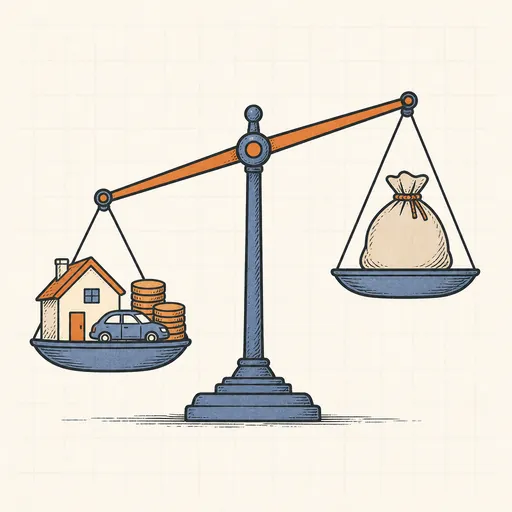
Getting the essentials figure right is easier with a budget split, so the 50/30/20 Budget Calculator helps you separate needs from wants. To trim recurring costs before you set the target, the Subscription Cost Calculator and the Cost of a Habit Calculator show where money leaks. Once the fund is full, the Inflation Calculator shows why cash beyond your buffer loses value over time, and the Net Worth Calculator puts the fund in the context of everything you own and owe.
Frequently asked questions
How many months should an emergency fund cover?
Three months of essentials is a common floor. Six months suits variable income, self-employment, or a single-earner household. If your income is steady and secure, three to four months may be enough. There is no single correct answer, only the level that lets you sleep.
Should I pay off debt before building an emergency fund?
Many people build a small starter buffer first, perhaps one month of essentials, then attack high-interest debt, then return to finish the fund. A buffer stops the next surprise from pushing you back onto the same expensive credit. This is a personal trade-off, not a rule.
Where should I keep the money?
Somewhere safe and quick to access: an instant-access savings account or similar. The goal is availability, not return. Any interest earned is a bonus, not the point.
Does the calculator account for interest earned on the fund?
No. It assumes the balance grows only by your contributions, so the fill time is a slight overestimate if your account pays interest. On a small balance the effect is minor: 2 percent on a 9000 balance is about 15 a month, far less than a 400 contribution.
What if I already have more than my target?
The gap is reported as zero and the fill time is nothing, because you are already funded. Any surplus above the target is money you could consider directing toward longer-term goals.
This is an educational estimate, not financial advice. Your own targets depend on your job security, dependants, and debts. Talk to a qualified adviser before making money decisions.
Related tools

50/30/20 Budget Calculator
Split take-home pay into needs, wants and savings.

Currency Converter
Convert between 30+ currencies at ECB rates.

Discount Calculator
Sale price, savings and stacked discounts.
Inflation Calculator
What money is worth across the years.
Net Worth Calculator
Assets minus liabilities, with a breakdown.

Tip Calculator
Tip, total and per-person split with rounding.