How the Math Worksheet Generator Builds Fair Practice
After reading this you will know how random practice sheets are constrained so the answers stay clean, how much practice actually moves a skill, and how to space worksheets over days so the practice sticks.
What the generator does and one quick example
The Math Worksheet Generator produces a printable page of problems and a separate answer key. You pick the operations, the number range, and the count. Every sheet is drawn at random, so two students can get different problems at the same difficulty.
The random draw is not unconstrained. If you ask for subtraction in the range 0 to 20, the tool never gives you 4 - 9. It swaps the operands so the answer stays at or above zero. Division problems are built backwards from a whole-number quotient, so 56 ÷ 8 = 7 appears but 57 ÷ 8 never does. One-step algebra like x + 6 = 13 is generated from a whole-number solution, so x = 7, not x = 6.5.
The point of those rules is simple: the difficulty comes from the operation you chose, not from an accidental remainder or a negative you did not want to teach yet.
When a worksheet is the right tool, and when it is not
A worksheet is a good fit when a skill is already understood and needs to become fast and automatic. Single-digit multiplication is the clearest case. A child who understands that 6 × 7 means six groups of seven still needs practice to recall 42 in under a second. Worksheets build that speed.
A worksheet is a poor fit for a skill the student does not yet understand. Twenty problems of long division handed to a child who has never seen the algorithm produces twenty wrong answers and a discouraged learner. Teach the method first, check two or three problems together, then hand out the sheet.
Match the range to the goal. For multiplication fact fluency, keep factors from 0 to 12. A range of 0 to 100 turns fact recall into a written-algorithm exercise, which is a different skill.
How much practice actually helps: the power law
Reaction time on a fixed skill drops with practice, but not linearly. Newell and Rosenbloom described this in 1981 as the power law of practice. The time to complete one problem falls as a power of the number of times you have practiced.
Here T(n) is the time to solve the n-th problem, T_1 is the time on the first attempt, n is the number of practice trials, and \beta is a learning-rate exponent, often near 0.2 to 0.4 for simple facts.
Suppose a student takes 4.0 seconds on the first multiplication fact and \beta = 0.3. After 10 problems the model predicts 4.0 \times 10^{-0.3} \approx 2.00 seconds. After 100 problems it predicts 4.0 \times 100^{-0.3} \approx 1.00 second. Ten times the practice roughly halves the time. The gains are large early and shrink later, which is why the first worksheet feels transformative and the tenth feels like maintenance.
A worked example using the demo defaults
One page of addition, 0 to 10
The demo button loads the defaults: addition, range 0 to 10, a set number of problems in a few columns. Say it produces 20 problems. Here is how to reason about the sheet and the practice it delivers.
- Each problem is two random integers a and b, both drawn uniformly from 0 to 10. That is 121 possible ordered pairs.
- The mean sum is 5 + 5 = 10, since the average of 0 to 10 is 5. So expect answers to cluster near 10, ranging from 0 to 20.
- With 20 problems drawn from 121 pairs, repeats are likely. The chance that all 20 are distinct is about
0.19, so most sheets show at least one repeated problem. That is fine for fluency; repetition is the point. - Time the student. If they finish 20 problems in 90 seconds, that is
4.5seconds each. Regenerate a fresh sheet the next day and time it again. A drop toward 3 seconds is real progress you can measure.
Print the sheet, keep the answer key on its own page, and mark it in under a minute. Twenty problems at one page per day is a realistic dose that does not exhaust a young student.
Spacing the sheets: why the calendar matters more than the count
Ebbinghaus measured his own memory in 1885 and found that recall drops sharply soon after learning, then levels off. His forgetting curve is often written as an exponential decay.
R(t) is the fraction still retained after time t, and S is a stability constant measured in the same time units. A larger S means slower forgetting. Each successful review increases S, which is the core idea behind spaced repetition.
Concrete numbers: suppose after one worksheet S = 2 days. Then after 1 day retention is e^{-1/2} \approx 0.61, and after 4 days it is e^{-4/2} \approx 0.14. Review on day 1 while retention is still high, and stability might rise to S = 6. Now after 4 more days retention is e^{-4/6} \approx 0.51 instead of 0.14. The same total number of problems, spread across days instead of crammed into one afternoon, leaves far more in memory.
Reading a graded sheet without fooling yourself
A single score is noisy. If a 20-problem sheet comes back with 18 correct, that is 90 percent. But 20 items is a small sample. The standard error of a proportion is roughly:
With p = 0.9 and n = 20, that is \sqrt{0.9 \times 0.1 / 20} \approx 0.067, about 6.7 percentage points. So the true skill level behind a 90 percent sheet plausibly sits anywhere from roughly 77 to 100 percent. Do not treat 85 percent on Monday and 90 percent on Tuesday as improvement; the difference is inside the noise.
To see real change, track the same skill across several sheets and watch the trend, or increase the problem count. A 50-problem sheet cuts the standard error to \sqrt{0.9 \times 0.1 / 50} \approx 0.042, about 4.2 points, so the picture sharpens.
| Problems (n) | Score if 90% correct | Standard error | Rough 68% range |
|---|---|---|---|
| 10 | 9 of 10 | 0.0949 | 80.5% to 99.5% |
| 20 | 18 of 20 | 0.0671 | 83.3% to 96.7% |
| 50 | 45 of 50 | 0.0424 | 85.8% to 94.2% |
| 100 | 90 of 100 | 0.0300 | 87.0% to 93.0% |
Common mistakes
The most frequent error is overloading. A 100-problem sheet handed to a seven-year-old produces fatigue, not fluency. The power law says the last 50 problems add little speed while costing a lot of attention. Prefer short daily sheets to one weekly marathon.
The second mistake is mismatched range. Setting multiplication factors from 0 to 100 does not make a harder fact drill; it makes a written-computation drill. If the goal is recall of the times tables, hold factors to 0 to 12.
Do not reuse the exact same sheet day after day to show improvement. A student can memorize the answer positions rather than the facts. Regenerate a fresh random sheet each session so the score measures the skill, not the page.
A third mistake is grading speed and accuracy as one number. Track them separately: problems correct, and seconds per problem. A student can be 100 percent accurate and still slow, which is exactly the case where more practice helps.
Related tools
Once a fact set is stable on paper, move it to retrieval practice with the Printable Flashcard Maker, which turns a CSV list into fold-over or double-sided cards with cut guides. Worksheets build written fluency; flashcards build fast recall in both directions, and the two together cover more of the skill than either alone.
Frequently asked questions
Why does division always come out even?
Each division problem is built from a whole-number quotient and divisor, then multiplied to form the dividend. So 7 × 8 = 56 becomes 56 ÷ 8 = 7. Remainders never appear, which keeps the sheet suitable for a grade level that has not learned remainders yet.
How many problems should one sheet have?
For daily fact fluency, 20 to 30 problems is a practical dose for elementary students. The power law shows most speed gain lands in the first 20 to 30 trials, and shorter sheets keep attention high. For a diagnostic where you want a reliable percent, use 50 or more so the standard error drops near 4 points.
Can two students get different sheets at the same difficulty?
Yes. Regenerate the sheet for each student. The problems differ but the operation, range, and count are identical, so the difficulty is matched while copying is prevented.
How often should the same skill get a worksheet?
Space it. Practice today, again in 1 or 2 days, then stretch the gap to 4 days, then a week, as long as accuracy stays high. The forgetting curve model shows a review while retention is still above about 0.6 raises stability the most.
Does everything stay on my device?
Yes. The generator runs entirely in your browser, so nothing you type or practice is sent anywhere. Use the browser print dialog to save a sheet as PDF instead of printing on paper.
Related tools
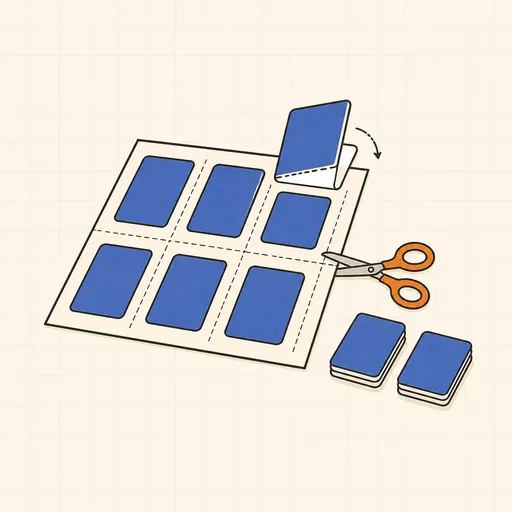
Printable Flashcard Maker
Quizlet/CSV/Excel to print-ready cards — Avery sizes, A4/Letter, groups, images and duplex flip options.
Final Grade Calculator
What do you need on the final exam to reach your target grade? Instant answer for any weight.

GPA Calculator
Compute your GPA from course grades and credits — or ask what term GPA you need to hit a cumulative goal.
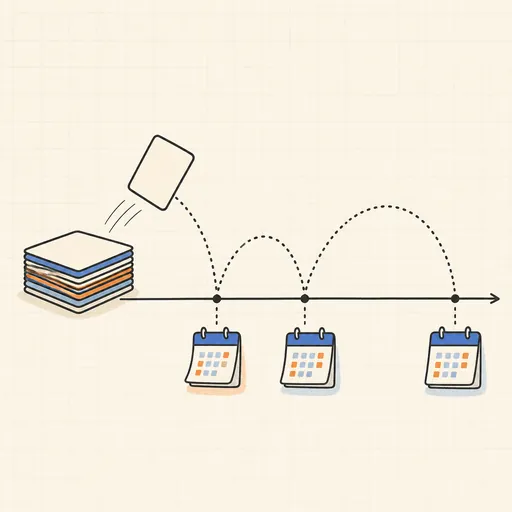
Spaced Repetition Simulator
SM-2, FSRS, HLR, Leitner and Pimsleur side by side — workload, retention and knowledge per study hour.
Exam Pass Probability Calculator
How likely are you to pass a multiple-choice exam by guessing the rest? Supports ruling out options and per-section pass rules.

Flashcard Workload Planner
How many daily reviews will your Anki deck really cost — vacation strategies, easy days, exam pacing, SM-2 vs FSRS.