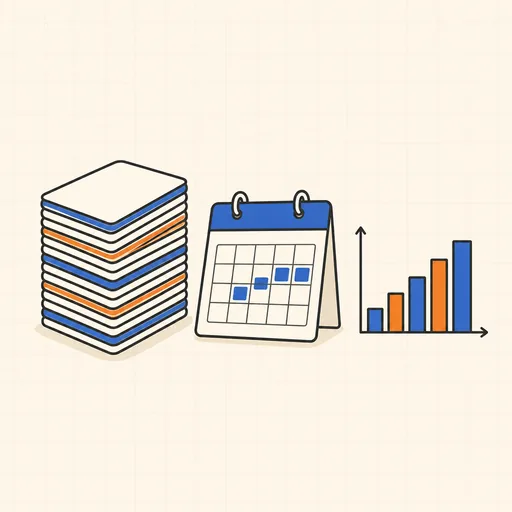
Flashcard Workload Planner
Set how many new cards you add per day (or flip to exam mode: N cards and D days → suggested new/day), pick FSRS-style or classic SM-2 scheduling for the same new-card rate, and the planner projects the workload on an internal memory model: every card carries a stability S, recall decays as R = exp(−t/S), and FSRS books each review when recall is predicted to hit your target (SM-2 uses ease × multiplying intervals instead). Retention is an output — after a vacation overdue cards fail more often because they kept decaying. Choose how to handle time off (stop and eat the backlog, spread reviews into the days before you leave, or ease the cap back in after), paint easy days (e.g. half load on Sundays) on the chart, and export daily numbers to CSV.
Runs 100% in your browser — simulations are computed locally on your device.
Read the full guide to this tool
Notes
- Successful reviews multiply a card's stability, and the later the review happens, the bigger the boost — the spacing effect. Lapsed cards keep a quarter of their stability and enter a next-day relearning step that gets first claim on the daily review budget, so lapses never rot at the back of the backlog.
- The memory-strength gauge scales initial stability and stability growth relative to the general population (p50 = average learner); stronger memories mean longer intervals and fewer daily reviews for the same target.
- Spread mode redistributes cards that would fall due during the vacation across the preceding days; ease-in ramps the review cap from 25% back to full after you return. Easy days (day 0 = Monday) shrink both new cards and the review budget by the easy-day load factor.
- The model tracks expected fractions of cards instead of random draws, so the curves are smooth and reproducible.
- Runs 100% in your browser — nothing you type or practice leaves your device.
Explore the idea
Related tools
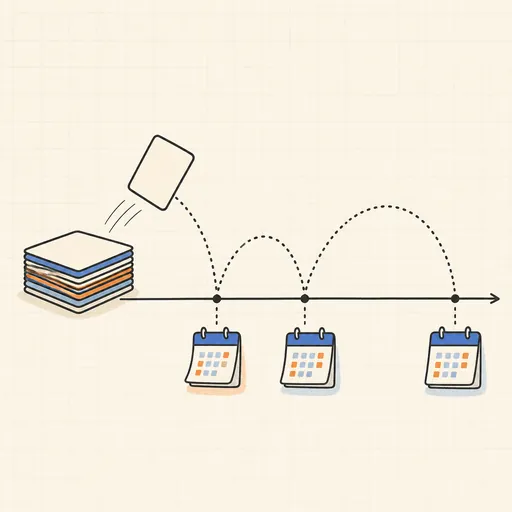
Spaced Repetition Simulator
SM-2, FSRS, HLR, Leitner and Pimsleur side by side — workload, retention and knowledge per study hour.
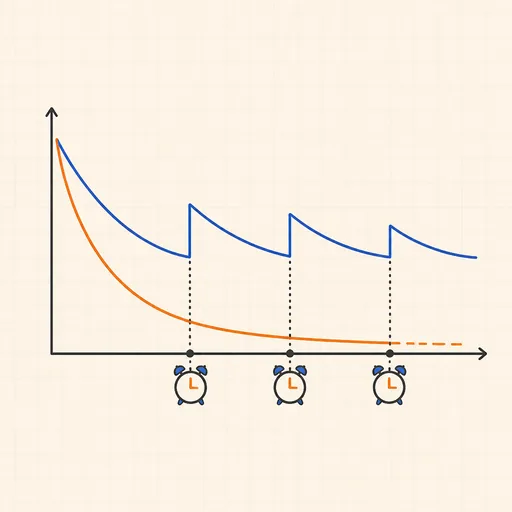
Forgetting Curve Visualizer
Ebbinghaus curve with a sweet-spot band — drag reviews early, on time, or late and watch the decay flatten.

Knowledge Tracing Simulator
Bayesian Knowledge Tracing live — each right / wrong answer shows the Bayes math in plain numbers.
Final Grade Calculator
What do you need on the final exam to reach your target grade? Instant answer for any weight.

GPA Calculator
Compute your GPA from course grades and credits — or ask what term GPA you need to hit a cumulative goal.
Math Worksheet Generator
Printable worksheets: arithmetic, fractions, algebra, order of ops, decimals, mixed numbers and percents.