How a Word and Character Counter Works
After reading this, you will know exactly how words, characters, sentences and paragraphs are counted, why two counters can disagree on the same text, and how to read a reading-time estimate without trusting it too much.
What the counter measures
A word and character counter turns a block of text into five numbers: words, characters, sentences, paragraphs and unique words. It then converts the word total into an estimated reading time and speaking time. Every one of those numbers is the output of a rule, and the rule is a choice. Different tools choose differently, so the same paragraph can score 98 words in one place and 101 in another.
Here is a hook. Take the string naïve café, résumé. How many characters is that? Counting what you see, it is 18 characters including spaces. The accented letters are each one codepoint in this text, but if the accents had been typed as a base letter plus a combining mark, the count would rise even though the text looks identical. Counting is never as simple as "count the letters." This article shows you the rules underneath.
When to use it, and when not
Reach for a counter when a limit is fixed and external. A tweet caps at 280 characters. A meta description is usually trimmed near 160 characters. A journal abstract may allow 250 words. A university essay might demand 1500 to 2000 words. In all of these the count is the contract, and you need the same rule the grader or platform uses.
Do not use raw counts to judge whether writing is good. A count of 1500 words tells you nothing about clarity. For that you want a readability formula, and this site has a separate Readability Scorer for Flesch, Flesch-Kincaid, SMOG and Gunning fog. To see which words carry your text, use the Word Frequency and N-gram Analyzer. The counter answers "how much," not "how well."
The counting rules, one at a time
Each statistic has its own definition. Keep them separate in your head.
- Characters with spaces
- The number of Unicode grapheme clusters, that is, the units a reader perceives as single characters. This is what most platforms mean by "characters." An emoji like a flag is one grapheme even though it is built from two codepoints.
- Characters without spaces
- The same count, minus every space, tab and line break. Useful when a limit ignores whitespace.
- Words
- Runs of non-whitespace text separated by whitespace. Formally, split the text on one or more whitespace characters and count the non-empty pieces.
- Sentences
- Segments ending in
.,!,?or…followed by whitespace and then an uppercase letter, digit or quotation mark. - Paragraphs
- Blocks of text separated by one or more blank lines.
- Unique words
- The count of distinct word forms, usually after lowercasing, so
Theandthecount once.
The word rule is the one that surprises people. Under "split on whitespace," the hyphenated state-of-the-art is one word, and don't is one word, but 5,000 is also one word. A counter that split on punctuation instead would report four words for state-of-the-art. Neither is wrong; they answer different questions. Whitespace splitting matches how most word processors count, which is why it is the common default.
Grapheme counting and codepoint counting diverge on accents and emoji. The word café is 4 graphemes. If the é is stored as e plus a combining acute accent (Unicode normalization form NFD), it is 5 codepoints but still 4 graphemes. A counter that reports codepoints would say 5. Check which one your target platform uses before trusting a near-limit number.
Reading and speaking time
Reading time is arithmetic, not measurement. Divide the word count by a rate in words per minute.
Here W is the word count, R is the reading rate in words per minute, and t_{\text{read}} is the time in minutes. The default rate is 238 words per minute. That figure comes from Marc Brysbaert's 2019 review, which pooled 190 studies and reported a mean silent-reading rate of about 238 wpm for adults reading English non-fiction. Speaking time uses 150 wpm, close to a measured conversational and presentation pace.
So a 1000-word article gives 1000 / 238 \approx 4.20 minutes of reading and 1000 / 150 \approx 6.67 minutes of speaking. The estimate scales linearly: double the words, double the time. What it cannot capture is difficulty. A page of legal text and a page of a children's book have the same word count and the same estimate, but not the same real reading time. Treat the number as an order-of-magnitude guide, accurate to maybe plus or minus 30 percent for any single reader.
A worked example you can reproduce
Counting a short paragraph
Take this exact text, two paragraphs separated by a blank line:
The café is naïve. It opens at 9 a.m.

Come early! You will enjoy it, truly.
- Paragraphs. One blank line splits the text into 2 blocks, so paragraphs = 2.
- Words. Split on whitespace. Block one:
The café is naïve. It opens at 9 a.m.gives 8 tokens. Block two:Come early! You will enjoy it, truly.gives 6 tokens. Total words = 14. Note that9anda.m.each count as one word, andit,counts once because the comma is attached. - Sentences. Look for terminal punctuation followed by whitespace and then an uppercase letter or digit. After
naïve.comes a space thenIt, so that is a boundary. Aftera.m.comes a paragraph break thenCome, a boundary. Afterearly!comesYou, a boundary. The finaltruly.ends the text. Sentences = 4. The.insidea.m.is not counted as a boundary because it is followed bym, a lowercase letter. - Characters with spaces. Counting graphemes across both blocks, ignoring the blank-line handling, the visible text is 74 characters including the internal spaces.
- Unique words. Lowercase everything and remove trailing punctuation.
itappears twice (inItandit,), so it counts once. That leaves 13 distinct forms out of 14 words.
The tricky step is sentence 3. A naive counter that treats every period as a sentence end would count 6 sentences here, inflating the total by 50 percent, because it would break inside a.m. twice. The whitespace-and-capital rule avoids most of that.
Reading and interpreting the results
Read the counts as a set, not one at a time. Words divided by sentences gives average sentence length. In the example, 14 / 4 = 3.5 words per sentence, which is very short because the sample is short. Real prose runs 15 to 25 words per sentence. Characters divided by words gives average word length in characters; English averages about 4.7 to 5.1 letters per word, so a value near 7 signals dense or technical vocabulary.
Unique words divided by total words is the type-token ratio, a rough measure of vocabulary variety. In the example, 13 / 14 \approx 0.93, near the maximum because almost nothing repeats. Over a long document this ratio falls, because function words like the and of repeat constantly. A 1000-word article often lands near 0.40 to 0.50. The ratio is sensitive to length, so only compare it across texts of similar size.
Common mistakes
The errors below cause most disagreements between counters and platforms.
- Trusting characters near a hard limit. If a field allows 280 characters and you paste emoji or accented text, the platform may count codepoints, UTF-16 code units, or graphemes. A single emoji can register as 1, 2 or 4 depending on the rule. Verify with the Unicode Inspector, which shows every codepoint.
- Assuming word rules match. A counter that splits on whitespace and one that splits on word boundaries disagree on hyphenated and contracted words. Expect a difference of 1 to 3 percent on ordinary prose, more in technical writing.
- Reading time as a promise. The estimate uses one fixed rate. A slow or careful reader can take twice the printed time. Do not schedule a talk to the second from the speaking estimate.
- Trailing whitespace and empty lines. Extra blank lines can inflate the paragraph count. Two blank lines between paragraphs still means one break, but three separate blocks separated by blanks means three paragraphs even if one is a stray fragment.
When a limit really matters, count in the same environment that enforces it. Paste your text into the actual field once, or use the exact rule the platform documents. A general-purpose counter gets you close, not to the last character.
Related tools
The counter answers volume. These tools answer other questions about the same text. Use the Text Diff Checker to see what changed between two drafts word by word, and the Anagram and Palindrome Checker when you care about the letters themselves rather than the count.
Frequently asked questions
Why does my word count differ from Microsoft Word?
Word uses its own tokenizer that treats some punctuation and numbers differently. On plain prose the gap is usually under 2 percent. On text with many hyphens, numbers or symbols, it can be larger. Neither count is the true one; they apply different rules.
Does the counter count emoji as characters?
Yes, as grapheme clusters. A flag emoji is one character even though it is built from two regional-indicator codepoints. A platform that counts codepoints would report two, so a near-limit message full of emoji can behave unexpectedly.
How accurate is the reading time?
It is exact arithmetic on an assumed rate of 238 wpm. The arithmetic is right; the rate is an average. Individual readers vary widely, so treat the estimate as accurate to roughly plus or minus 30 percent for any one person.
Why is my sentence count too low or too high?
The boundary rule needs terminal punctuation followed by whitespace and a capital, digit or quote. A sentence with no closing period is not counted as complete, and text with no spaces after periods (common when pasting from PDFs) can merge sentences. Abbreviations like e.g. are mostly handled because the following character is lowercase.
Are unique words case-sensitive?
No. Words are lowercased before counting distinct forms, so The and the count as one type. Trailing punctuation is stripped, so truly. matches truly.
Related tools
Keyboard Layout Analyzer
Paste your text and see QWERTY, Dvorak and Colemak fight it out — finger heatmaps, travel and effort.
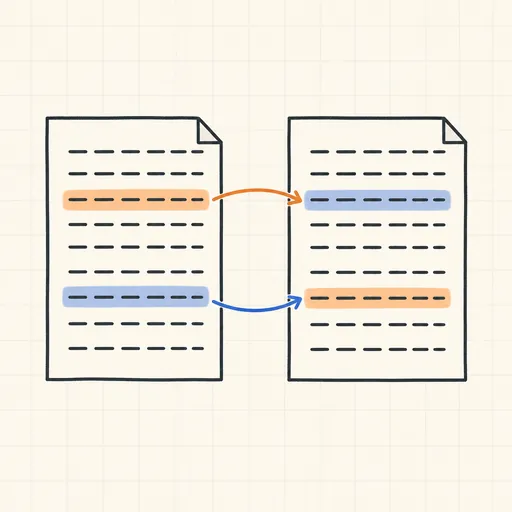
Text Diff Checker
Compare two texts line by line, with word highlights.
Word Cloud Generator
Paste any text and get a word cloud in seconds — shapes, fonts, colours, stop words in 8 languages, PNG/SVG export.
Anagram & Word Finder
Words from your letters, exact anagrams and c?t patterns.
Readability Scorer
Flesch, Flesch–Kincaid, SMOG, Gunning fog and more.
Repeated Phrase Finder
Find the phrases you repeat too often in a draft or manuscript.