Error Propagation, Explained
After reading this you will be able to combine two measured uncertainties through addition, subtraction, multiplication, division or a power, and read the result without fooling yourself about your precision.
What error propagation is
Every measurement carries an uncertainty. A meter stick reads a length as 10.0 cm give or take 0.5 cm. A stopwatch reads a time as 4.0 s give or take 0.2 s. When you feed those numbers through a formula, the result inherits an uncertainty too. Error propagation is the arithmetic that tells you how big that inherited uncertainty is.
Here is the hook. Suppose you compute a speed as distance divided by time, v = 10.0 / 4.0 = 2.5 in some units. The distance is good to 5 percent and the time is good to 5 percent. A naive guess might add those to get 10 percent. The correct rule adds them in quadrature and gives about 7.1 percent. That difference is not cosmetic. Report 10 percent and you overstate your ignorance; report 5 percent and you understate it. The quadrature rule is the honest middle.
When to use these rules, and when not
The rules on this page assume three things. First, the two uncertainties are independent: knowing that A came out high tells you nothing about whether B came out high. Second, the uncertainties are small relative to the values, so a straight-line approximation of the formula is good near your measured point. Third, you care about the standard uncertainty (roughly one standard deviation), not a worst-case bound.
If the two inputs are correlated, for example two lengths read off the same miscalibrated ruler, quadrature undercounts the real uncertainty and you need a covariance term. If an uncertainty is a large fraction of the value, the linear approximation breaks and you should simulate instead. And if you want an absolute worst case, add the uncertainties directly rather than in quadrature.
Quadrature means "square, add, take the square root." It appears because independent random errors partly cancel. Two errors of size 3 and 4 combine not to 7 but to \sqrt{3^2 + 4^2} = 5.
The formulas and the intuition
Start with a function f(a, b). A small change in a shifts f by the partial derivative times that change, and likewise for b. Treating the two shifts as independent random contributions and adding their variances gives the general rule:
Here \delta a and \delta b are the input uncertainties, and \delta f is the output uncertainty. The partial derivatives measure how sensitive f is to each input. Everything below is this one formula applied to specific operations.
For addition and subtraction, f = a \pm b, both partial derivatives are \pm 1, so the absolute uncertainties add in quadrature:
For multiplication and division, differentiate and divide through by f. The relative uncertainties add in quadrature:
Notice the switch. Sums and differences work in absolute terms; products and quotients work in relative terms. This is why you cannot use one habit for everything.
For a power f = a^b, both inputs contribute. Differentiating \ln f = b \ln a gives:
The exponent b multiplies the relative error in the base, so raising to the fourth power roughly quadruples that relative error. If b is an exact integer with no uncertainty, drop the second term.
A worked example with the demo numbers
Multiplying 10 ± 0.5 by 4 ± 0.2
Use the tool defaults: a = 10, \delta a = 0.5, b = 4, \delta b = 0.2, operation A × B.
- Compute the central value: f = 10 \times 4 = 40.
- Relative uncertainty in A: 0.5 / 10 = 0.05, that is 5 percent.
- Relative uncertainty in B: 0.2 / 4 = 0.05, also 5 percent.
- Add in quadrature: \sqrt{0.05^2 + 0.05^2} = \sqrt{0.005} \approx 0.0707, about 7.07 percent.
- Convert back to absolute: 0.0707 \times 40 \approx 2.83.
The answer is 40 \pm 2.83. Both inputs contributed equally because both were 5 percent uncertain. The combined 7.07 percent is smaller than the 10 percent a direct sum would give, and larger than either input alone. That is the signature of quadrature: the result sits between the largest single term and the plain sum.
A fast sanity check for products: if one input is far more uncertain than the other, the answer's relative uncertainty is close to that of the worse input. A 10 percent value times a 1 percent value gives \sqrt{0.10^2 + 0.01^2} \approx 0.1005, essentially 10 percent. The small error barely registers.
Reading and interpreting the result
The output 40 \pm 2.83 is a shorthand for a range. Read it as: the true value most likely lies between about 37.2 and 42.8, with the middle of that range the most probable. It does not mean the value is definitely inside those bounds. Under the usual assumption of roughly normal errors, a one-sigma band like this covers the truth about 68 percent of the time.
Round the uncertainty to one or two significant figures, then match the value to the same decimal place. Reporting 40.0 \pm 2.83 pretends the last digit of the value is meaningful when the uncertainty already swamps it. Write 40 \pm 3 or 40.0 \pm 2.8, not more.
The chart below shows how the combined relative uncertainty of a product grows as one input's relative error rises, with the other fixed at 5 percent.
The subtraction trap
Subtraction of two close numbers is where careful people get burned. Suppose you measure a = 100.0 \pm 0.5 and b = 99.0 \pm 0.5. Each is good to 0.5 percent. Their difference is 100.0 - 99.0 = 1.0, and the absolute uncertainty adds in quadrature to \sqrt{0.5^2 + 0.5^2} \approx 0.707.
So the difference is 1.0 \pm 0.707, a relative uncertainty of about 71 percent. Two measurements known to better than 1 percent produced a result known to worse than a factor of two. The absolute error stayed small, but the value shrank, and relative error is the ratio of the two.
This is loss of significance. It appears whenever a formula subtracts nearly equal quantities: computing a small mass difference, a redshift from two wavelengths, or a resistance change. If you can rearrange the algebra to avoid the subtraction, do it. If you cannot, know that your final precision is set by that difference, not by the raw inputs.
Never judge a subtraction by the inputs' relative errors. A 0.5 percent input and a 0.5 percent input can yield a 71 percent output. Always compute the difference's own relative uncertainty before trusting it.
Explore how the operation changes the answer
Common mistakes
Four errors account for most wrong uncertainty reports.
- Adding absolute errors for a product. Products and quotients combine relative errors, not absolute. Mixing these gives numbers that can be off by a large factor.
- Adding linearly instead of in quadrature. Linear addition assumes the errors always push the same way. For independent errors it overstates the uncertainty. Two 5 percent errors give 7.07 percent, not 10 percent.
- Forgetting the exponent in a power. In a^3, the relative error of the result is three times the relative error of
a. A 2 percent error inabecomes 6 percent in a^3. - Over-reporting digits. An uncertainty of
2.83means the value is uncertain in its ones place. Writing four decimals on the value is false precision.
Related tools
Error propagation matters most when you feed measured quantities into a physics formula. The Lens & Mirror Equation Calculator combines two reciprocal distances, a case where small errors in each can dominate. The Coulomb's Law Calculator divides by distance squared, so a distance error doubles into the force. The Doppler Effect Calculator and the Photon Energy Calculator often start from two wavelengths whose difference triggers the subtraction trap. For half-life work, the Radioactive Decay & Half-Life Calculator uses exponentials where the power rule applies. If you only need to compare a measured value against a known one, use the Percent Error Calculator instead.
Frequently asked questions
Why add in quadrature instead of just adding the errors?
Because independent random errors partly cancel. Sometimes A is high while B is low, and the errors work against each other. Adding variances (the squares) and taking the root captures this. Plain addition assumes the errors always reinforce, which is the worst case, not the typical case.
When should I add errors linearly?
When you want a guaranteed worst-case bound rather than a standard uncertainty, or when the two errors are perfectly correlated. Linear addition of two 5 percent errors gives 10 percent; quadrature gives 7.07 percent. The linear number is a ceiling, the quadrature number is the honest estimate.
What if my exponent is an exact integer?
Drop the term involving \delta b. For f = a^b with b exact, the relative uncertainty is simply |b| \cdot \delta a / a. So a^2 doubles the relative error and \sqrt{a} = a^{0.5} halves it.
How do I handle three or more variables?
Extend the same rule: for a product or quotient, add every input's squared relative error under one square root. For a sum, add every squared absolute error. This tool takes two inputs at a time, so chain it, propagating through one operation, then feeding the result and its uncertainty into the next.
Does a bigger measured value always mean smaller relative error?
For a fixed absolute uncertainty, yes. An uncertainty of 0.5 is 5 percent of 10 but only 0.5 percent of 100. This is exactly why subtracting close numbers hurts: the difference is small, so a fixed absolute error becomes a large fraction of it.
Related tools
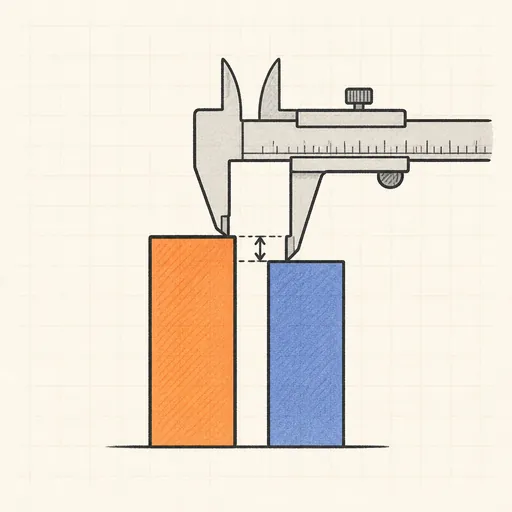
Percent Error Calculator
Percent error against a true value, or percent difference.
Radioactive Decay & Half-Life Calculator
Amount remaining, activity and radiometric dating.
Coulomb's Law Calculator
Electrostatic force between two charges.

Doppler Effect Calculator
Observed frequency for a moving source or observer.
Lens & Mirror Equation Calculator
Image distance and magnification from 1/f = 1/dₒ + 1/dᵢ.

Photon Energy Calculator (E = hf)
Energy, frequency and wavelength of a photon.