Team & Pair Randomizer, Explained
After reading this you will know how a Fisher-Yates shuffle turns a list of names into fair teams or pairs, how to check that the split is unbiased, and which common shuffling shortcuts quietly favor some people over others.
What this tool does
Give it a list of names. It produces one of four things: a fixed number of teams, teams of a given size, pairs, or just the names in a random order. The same engine drives all four: a full Fisher-Yates shuffle reorders the list, then the tool slices the shuffled order into groups.
Here is the hook. Suppose 12 coworkers need to split into 3 teams for a code review rotation. You could let people self-sort, but friends cluster and the loudest person picks first. Instead, drop 12 names in, ask for 3 teams, and each of the possible groupings is equally likely. Nobody can game the order, because the order is decided before anyone sees it.
When to use it, and when not to
Use it when every name should have the same chance at every position. Standups, lab partners, secret Santa draws, chore rotations, tournament seeding when you want random seeds: all of these want a flat, unbiased shuffle.
Do not use it when the outcome must be reproducible from a public seed for audit reasons, or when some entries deserve heavier odds. If one player should be picked twice as often, that is weighting, not shuffling. And if you are drawing prizes where money or fairness disputes are on the line, a browser tool is fine for the shuffle but you still need an agreed procedure so everyone trusts the result.
This tool uses your browser's random source, which is fine for games, rotations and casual draws. It is not a certified randomness source for regulated lotteries. If a result must survive a legal challenge, run it in front of witnesses and record the inputs.
The shuffle behind it
Fisher-Yates walks the list from the last index down to the first. At each position i it picks a random index j between 0 and i inclusive, then swaps the two entries.
Here r is a uniform random number from the browser, i is the current position counting down from n-1 to 1, and j is the index chosen to swap into position i. Because j can equal i, an element can stay put.
The key property: this produces every one of the n! orderings with equal probability. For 12 names that is 12! = 479{,}001{,}600 distinct orders, each with probability 1/479{,}001{,}600 \approx 2.088 \times 10^{-9}. The proof is short: position n-1 gets any of n elements with probability 1/n, the next position picks from the remaining n-1 with probability 1/(n-1), and multiplying the chain gives 1/n!.
A tempting shortcut is "loop through each slot and swap it with any random slot from the whole list". That is not Fisher-Yates. It generates n^n equally likely swap sequences, and n^n is not divisible by n! for n \ge 3, so some orderings come out more often. Avoid it.
Reproducing the demo
Twelve names into three teams
Take the demo list of 12 names and ask for 3 teams. Twelve divides evenly, so each team holds 4 people. Follow the shuffle on a small trace to see how order becomes teams.
- Start with the list in entry order, indices
0through11. - At i = 11, draw r = 0.34, so j = \lfloor 0.34 \times 12 \rfloor = 4. Swap index 11 with index 4.
- At i = 10, draw r = 0.90, so j = \lfloor 0.90 \times 11 \rfloor = 9. Swap 10 with 9.
- Continue down to i = 1. You now have a fully shuffled order.
- Slice it: positions 0 to 3 are Team 1, positions 4 to 7 are Team 2, positions 8 to 11 are Team 3.
Because the shuffle is uniform and the slice is fixed, every person has probability 4/12 = 0.3333 of landing on any given team, and any specific set of 4 teammates is as likely as any other.
Uneven groups and odd pairs
Numbers rarely divide cleanly. The tool spreads leftovers so team sizes differ by at most one. Split 13 people into 3 teams and you get sizes 5, 4, 4 rather than 5, 5, 3. The rule: with n people and t teams, n \bmod t teams get one extra member.
For 13 into 3, 13 \bmod 3 = 1, so exactly one team is larger. Which team gets the extra person is decided by the shuffle, not fixed, so no team position is favored across repeated runs.
| People | Teams | Base size | Extras | Resulting sizes |
|---|---|---|---|---|
| 12 | 3 | 4 | 0 | 4, 4, 4 |
| 13 | 3 | 4 | 1 | 5, 4, 4 |
| 14 | 3 | 4 | 2 | 5, 5, 4 |
| 10 | 4 | 2 | 2 | 3, 3, 2, 2 |
For pairs, an odd count cannot split into twos. Rather than leave one person out, the tool forms one group of three. Nine names become three pairs and one triple: 4 groups, sizes 2, 2, 2, 3.
Reading and checking the result
A single run tells you nothing about fairness. Fairness is a statement about the distribution over many runs. To test it, count how often a chosen person lands on team 1 across many shuffles. With 12 people and 3 teams, that fraction should sit near 0.3333.
The count of hits over N runs follows a binomial distribution with p = 0.3333. Its standard deviation is
where N is the number of runs and p = 0.3333 is the target probability. For N = 1000, the expected count is 333.3 and \sigma = \sqrt{1000 \times 0.3333 \times 0.6667} \approx 14.9. So seeing anywhere from about 304 to 363 hits (within two standard deviations) is normal. A count of 250 or 420 would be a red flag.
Common mistakes
The gambler's fallacy shows up here constantly. If Ben landed on team 1 three runs in a row, he is not "due" for team 2. Each shuffle is independent, so his chance next run is still 0.3333. Three in a row has probability 0.3333^3 \approx 0.037, uncommon but not suspicious across dozens of sessions.
A second mistake is re-rolling until the teams "look balanced" by skill. That is a legitimate goal, but re-rolling breaks uniformity: you are now sampling from a filtered subset, and people you consider strong will cluster differently than raw chance predicts. If skill balance matters, assign it explicitly instead of pretending the result is random.
A third: reading meaning into a single split. One shuffle putting all the tall people on one team is not a bug. With 12 people the chance of any particular 4 sharing a team is 1 / \binom{12}{4} \times 3 = 3/495 \approx 0.006 for a named quartet, small but real. Rare things happen when you run often.
Related tools
If you need uniform integers rather than a shuffle, for example a random starting number or a die roll, use the Random Number Generator. When some entries should win more often, the Weighted Random Picker handles unequal odds directly. And once teams exist, the Tournament Bracket Generator arranges them into a single-elimination bracket with byes, seeded or random.
Frequently asked questions
Is the shuffle actually random or just shuffled once?
Every run performs a fresh Fisher-Yates shuffle using your browser's random source. Two runs on the same list almost always give different orders. For 12 names there are 479,001,600 possible orders, so repeats by chance are extremely rare.
Why do some teams have one more person than others?
When the count does not divide evenly, the extra people are spread out so sizes differ by at most one. With 13 people in 3 teams you get 5, 4, 4. Which team gets the fifth member is chosen by the shuffle each run.
What happens with an odd number of names in pair mode?
One group of three is formed rather than leaving anyone out. Nine names become three pairs plus one triple.
Can I trust it for a prize draw?
For casual draws, yes: the distribution is flat and unbiased. For anything with legal or financial stakes, record the input list and run the shuffle in front of witnesses so the process is verifiable, since a browser tool alone is not an audited source.
Does anything I enter get uploaded?
No. The shuffle runs entirely in your browser. Names and results are never sent to any server.
Related tools
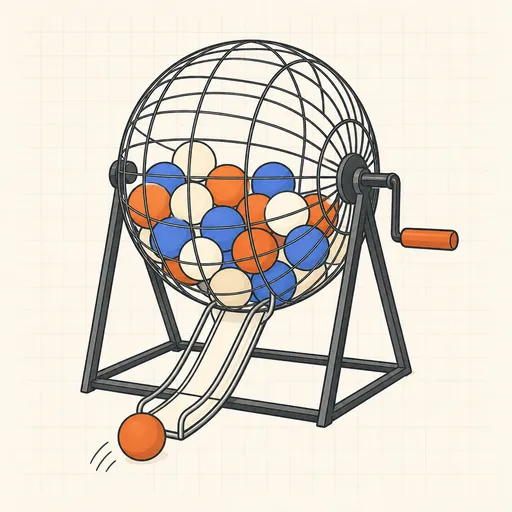
Random Number Generator
Uniform random integers in any range, with no bias.
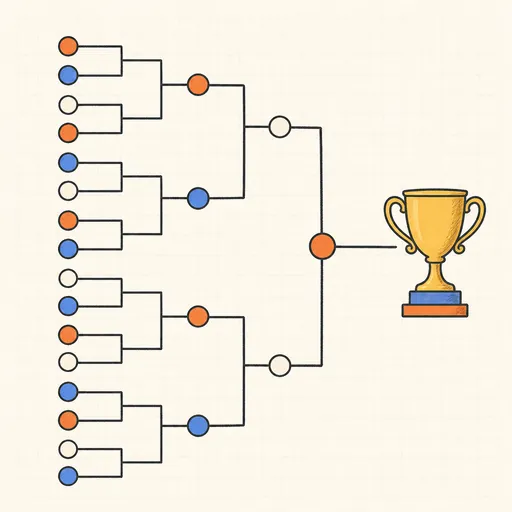
Tournament Bracket Generator
Single-elimination brackets with byes, seeded or random.
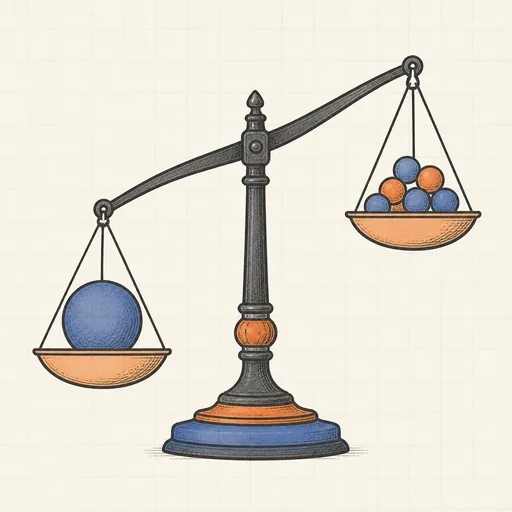
Weighted Random Picker
Pick from a list where some entries deserve better odds.
Are You Random? — The Oracle
Press left or right at random. The machine predicts your next press — and wins.
Dice Probability Lab
Exact odds for any dice expression — 4d6kh3, 2d20kh1…
Dice Roller (RPG Notation)
Roll 3d6+2, d20, 4d6 keep highest 3 — with statistics.