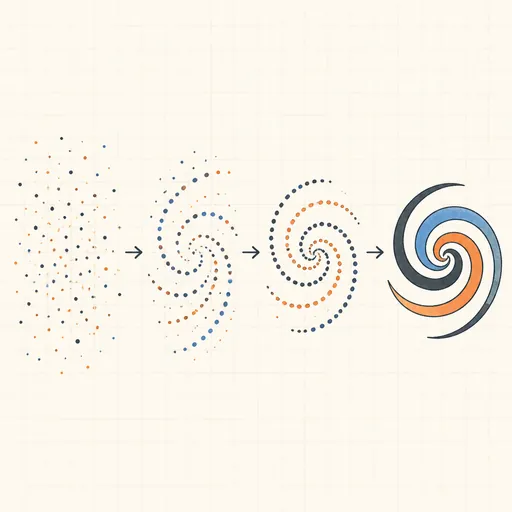
Diffusion Model Toy
Denoising diffusion models (DDPM) learn to generate data by reversing a gradual noising process. Pick a target shape — spiral, two moons, ring, smiley or checkerboard — and scrub the forward slider to watch the blue point cloud dissolve into Gaussian noise over 50 steps of a linear beta schedule, computed in closed form. Press Play to train a small MLP denoiser ε̂(x, t) — the point coordinates plus an 8-dimensional sinusoidal time embedding, one hidden layer of 64 units — with minibatch SGD on the noise-prediction loss, its loss curve drawn live. Then press Sample and watch reverse ancestral sampling animate step by step: 500 orange points condense from static into the target shape next to the real data.
Runs 100% in your browser — models are trained and computed locally on your device.
Read the full guide to this tool
Notes
- The forward process has the closed form q(x_t|x_0) = N(√ᾱ_t x_0, (1 − ᾱ_t)I) with ᾱ_t = ∏(1 − β_s), which is why the noise slider can jump to any t instantly.
- Training minimises the simplified DDPM objective ‖ε − ε̂(x_t, t)‖²: the network only ever learns to guess which noise was added, never the data density itself.
- Each reverse step computes x_{t−1} = (x_t − β_t/√(1−ᾱ_t) · ε̂)/√α_t + √β_t z, adding fresh noise z at every step except the last — sampling is stochastic by design.
- With a 64-unit denoiser and 50 steps the generated cloud stays slightly thicker than the real one; longer training and a lower learning rate sharpen it.
- Runs 100% in your browser — models are trained and computed locally on your device.
Related tools

GAN Trainer (2D)
Pit a tiny generator against a discriminator on 2D toy data and watch mode collapse happen live.
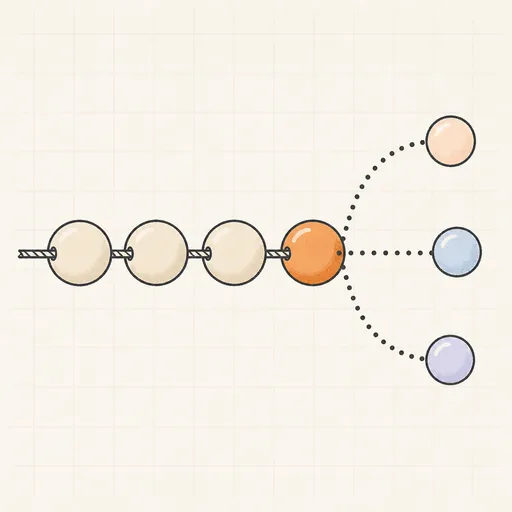
Markov Chain Text Generator
Train an order-k Markov chain on any text and generate new text one token at a time.
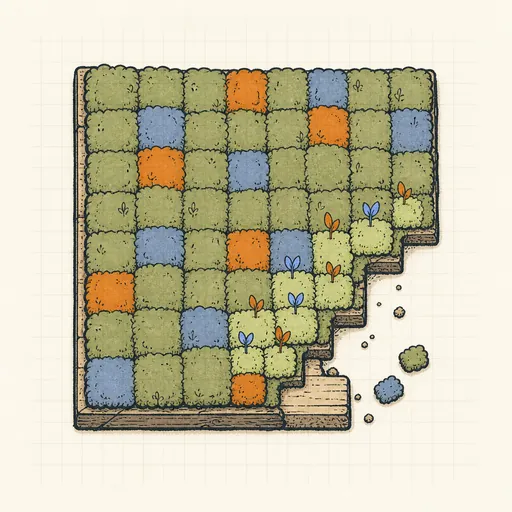
Neural Cellular Automata Sandbox
Grow, damage and heal living textures driven by a tiny convolutional network in every cell.
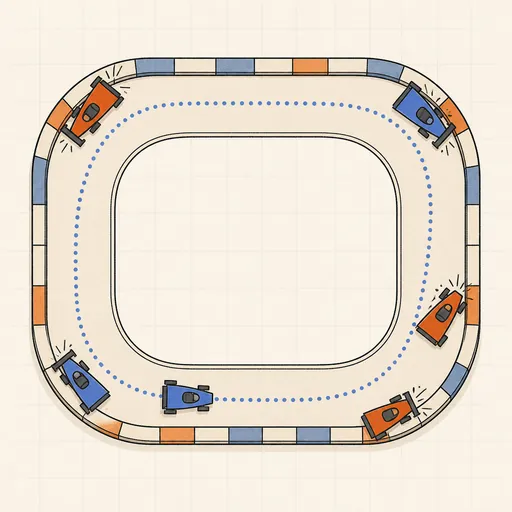
AI Learns to Drive (Neuroevolution)
Watch a population of neural-network cars evolve from crashing into corners to lapping a race track.
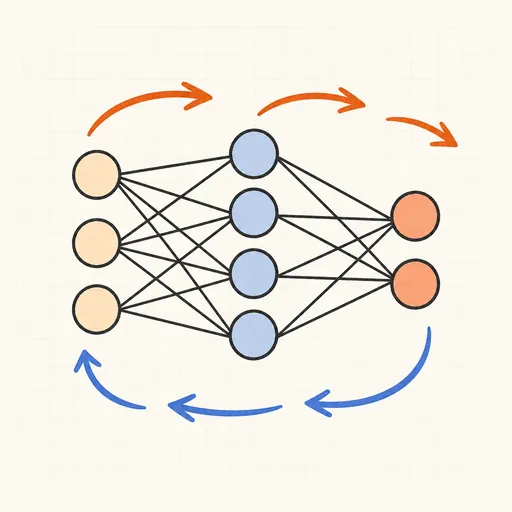
Backpropagation Step-by-Step
Walk through one forward and backward pass of a tiny neural network, number by number.
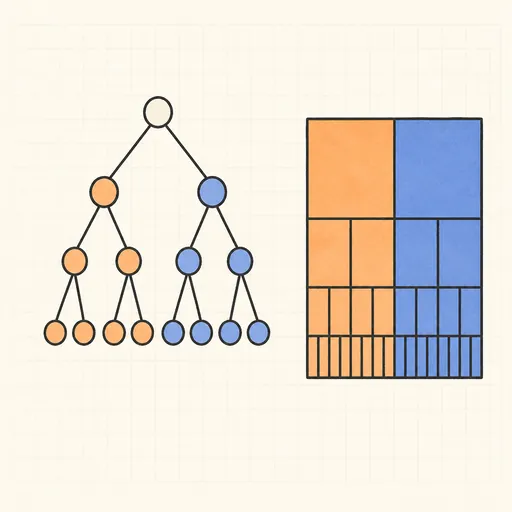
Decision Tree Builder
Grow a CART decision tree split by split and watch the partition map and tree diagram build together.