Omaha Hi/Lo (Eight-or-Better) Odds, Explained
After reading this you can read the equity split for any Omaha eight-or-better matchup, work out when a low is even possible, and avoid the two-hole-card rule that trips up most players.
What this calculator does
Omaha eight-or-better splits the pot in two. Half goes to the best five-card high hand. The other half goes to the best qualifying low hand, where a low must use five distinct ranks all eight or below, with the ace counting as the lowest card. Both the high and the low must be built from exactly two of your four hole cards plus exactly three board cards. You can use different pairs of hole cards for each half.
The calculator takes two to nine four-card hands and an optional board, then reports each hand's share of the whole pot, how often it wins the high half, how often it wins the low half, and how often it scoops (takes both halves alone).
Here is the hook. Give one player As 2s Ad Kh and the other Th 9h 8d 7d with no board. The first hand holds the nut-low draw (ace-two) plus two aces for a high, so it plays for both halves. The second hand is a strong high-only hand: connected, suited, but it can never make a qualifying low because it holds no card below seven. That structural difference, not a small edge in card strength, is what drives the equity.
When to use it, and when not
Use this when the pot can split. If nobody can make a low, the game plays exactly like high-only Omaha and you should reach for the Omaha Odds Calculator instead. The split logic here only earns its keep when a low is live.
The seven-card cousin is Stud Hi/Lo (Eight-or-Better), which shares the same low rules but deals differently. For pure high formats, the Texas Hold'em Odds Calculator, the Seven-Card Stud Odds Calculator and the Razz Odds Calculator cover the rest. When you already know your equity and just want to compare it against a call, use Poker Pot Odds & Outs.
No low is possible unless the board shows at least three distinct ranks of eight or below. On a board of Kh Qd 9c the low half simply does not exist, and the whole pot goes to the best high hand. Watch the board first.
The math behind the split
Equity is the average share of the whole pot across every possible runout. For a single runout, a hand's share is the sum of the halves it wins:
Here H is how many hands tie for the best high on that runout and L is how many tie for the best qualifying low. The bracket is 1 if your hand is among the winners and 0 otherwise. If no one qualifies for low, the high winner takes the whole pot, so the high half pays double for that runout.
Average S over all runouts and you get equity:
N is the number of runouts. With a flop or turn showing, the engine enumerates every remaining board exactly, so N is the exact count of card combinations. Preflop, N is the number of simulated boards you choose with the gear icon, from 50,000 up to 1,000,000.
The intuition worth carrying: high equity and low equity are separate accounts. A hand can hold 60% of the high account and 5% of the low account. Its pot equity is the average of the two halves, weighted by how often each half is actually contested.
A worked example: the demo matchup
Ace-two double-suited versus a high-only rundown
Load the demo: As 2s Ad Kh against Th 9h 8d 7d, empty board, standard 150,000 simulated boards.
- Hand 1 can make a low whenever the board brings three low ranks that pair with its ace-two. Its ace-two is the best possible low draw, so when a low exists it usually scoops that half.
- Hand 2 has no card below seven, so it can only make a low if the board itself supplies three low ranks and Hand 2 uses two of its own low-ish cards, but 7 is its lowest, and it needs two hole cards eight or below with the third rank supplied by the board. Its low chances are thin and never nut.
- For the high half, Hand 2's connected suited cards make straights and flushes often. Hand 1 leans on its aces and can pair up, but it makes fewer straights.
- The result is roughly a 59% to 41% pot-equity edge for Hand 1. Hand 1 wins most of the low half outright while splitting the high half; Hand 2 collects the high half often enough to stay competitive.
Your exact figures will wobble by a few tenths of a percent because preflop uses a seeded simulation. Bump the trials to 1,000,000 and the numbers settle.
Reading the results
Four numbers matter for each hand.
- Equity
- Average share of the whole pot. This is the single number to compare when deciding whether to call or fold.
- Hi %
- How often the hand wins or ties the high half. It counts the half, not the whole pot.
- Lo %
- How often the hand wins or ties the qualifying low half. If this reads 0%, the hand cannot make an eight-or-better low against this board.
- Scoop %
- How often the hand takes the entire pot alone, either because it wins both halves or because no low qualifies and it wins the high.
A common pattern: two players each hold 50% equity, but one wins the high 70% of the time and the low 30%, while the other is the mirror. Equity is equal, yet the swings and the value of scooping differ. Scoop percentage tells you who has the freeroll.
When your Lo % is high but your Hi % is low, you are drawing to a quartering risk. If another player shares your low, you split half the pot in half again and collect just a quarter. Check whether your low is the nut low before committing chips.
Common mistakes
The two-hole-card rule is the biggest trap. You cannot play three low cards from your hand to make a low. If you hold As 2s 3h Kd and the board is 4c 5d 9h Ts Qc, you use exactly two hole cards. Ace-two with board 4-5-9 gives 9-5-4-2-A: a qualifying low. You could not instead use ace-two-three, because that is three hole cards.
Second, players count a low that does not qualify. A "low" of 9-7-4-2-A is not eight-or-better, because the 9 is above eight. No qualifying low means the high winner scoops.
Third, ignoring counterfeiting. Suppose you hold ace-two and the board is 3-4-7, giving you 7-4-3-2-A. A turn of a 2 counterfeits your 2: now your best two hole cards are ace-something, and any opponent with ace-five plays a better low. Enumerate the turn and river before trusting a made low.
Fourth, forgetting that flushes and full houses do not qualify for low at all. Only the five-card low ranking matters for the low half, and pairs kill a low.
Explore the low-card count
How trial count affects precision
Preflop equity is estimated by sampling boards. The standard error of a proportion falls with the square root of the sample size:
Take p = 0.58. At N = 50,000 the standard error is about 0.0022, so 0.22 percentage points. At N = 500,000 it drops to about 0.0007, roughly 0.07 points. At the maximum 1,000,000 it is near 0.05 points.
For most decisions the standard 150,000 boards is plenty; the answer is accurate to about a tenth of a percent. Push to 500,000 or more only when you are comparing two hands whose equities sit within half a point of each other.
Frequently asked questions
Why does the calculator show 0% low for both hands sometimes?
Because the board cannot support a low. With fewer than three distinct ranks of eight or below on the board, no one can build a five-card eight-or-better low, so the whole pot plays for high.
What is quartering and does the calculator show it?
Quartering is winning only half of the low half because you tie another player for the best low, leaving you a quarter of the pot. The equity figure already accounts for this through the 1/L term, since two tied low hands each get half of the low half.
Can a hand win the high half and the low half at once?
Yes, and that is a scoop. An ace-two-three-four type hand on a coordinated low board can make both the best low and a straight for high, taking the entire pot.
Does the ace count high or low?
Both. For the low it is the lowest card, so ace-two-three-four-five is the best low, called the wheel. For the high the same ace can play as the top of a straight or as a pair of aces.
Why do my preflop numbers change slightly each run?
Preflop uses a seeded simulation over the number of boards you select. Different runs sample different boards, so results shift by a fraction of a percent. Increase the trial count to tighten them, or deal a flop so the engine enumerates every runout exactly.
Related tools
Hold'em Hand vs Range Equity
Exact all-in equity of a hand against a whole range.

ICM & Deal Calculator
ICM equity per stack and a final-table deal vs chip chop.
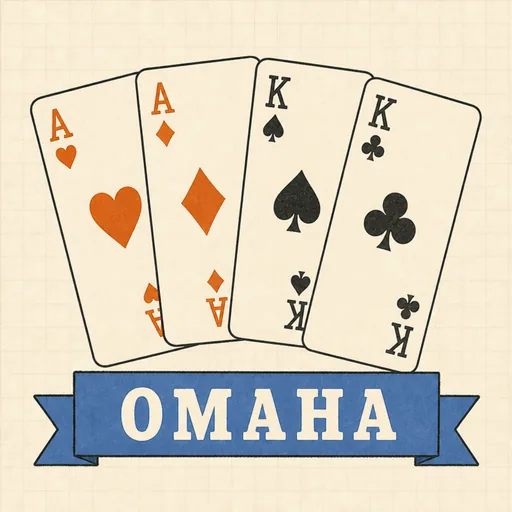
Omaha Odds Calculator
Win, tie and equity odds for Omaha hands and boards.
Poker Pot Odds & Outs
Equity from outs vs the pot odds of a call.
Push/Fold Nash Charts (Heads-Up)
Nash jam and call ranges for 1–25 bb, on a live grid.
Texas Hold'em Odds Calculator
Exact win, tie and equity odds for any hold'em matchup.