The Kelly Criterion, Explained
After reading this you will know how to size a bet when you hold a real edge, why betting the full Kelly fraction maximizes long-run growth, and why most careful bettors deliberately use less.
What the Kelly criterion does
The Kelly criterion answers one question: given a bet you can repeat many times, what fraction of your bankroll should you stake to make your money grow as fast as possible over the long run? Bet too little and you leave growth on the table. Bet too much and variance eats you alive, even when every single wager has positive expected value.
Here is the hook. Suppose you have a coin that lands heads 52% of the time, and a bookmaker pays you decimal odds of 2.10 when you win. Every bet is profitable on average. If you stake your whole bankroll each time, one tails wipes you out. If you stake a tiny sliver, you barely move. Kelly finds the sweet spot: with these numbers the optimal stake is about 7.9% of your bankroll per bet.
The criterion comes from John Kelly's 1956 paper on information theory. The result is exact, not a rule of thumb. It maximizes the expected logarithm of your bankroll, which is the same as maximizing the long-run compound growth rate.
When to use it, and when not to
Kelly applies when three things hold. You have a genuine edge (a probability estimate better than the odds imply). You can bet repeatedly. You can size each bet as a fraction of your current bankroll. Card counters, sports bettors with real models, and some investors fit this picture.
It does not apply when your edge is negative. No bankroll rule turns a losing game into a winner. On a fair casino table the house edge is baked into the payout, so Kelly returns a stake of zero or tells you not to play. It also breaks down when you cannot estimate your win probability honestly. Kelly is savagely sensitive to that number, as you will see below.
If your true edge is smaller than you think, full Kelly overbets. Estimating prob = 55% when the truth is 51% can turn a growth strategy into a slow bleed. When in doubt, use a smaller fraction and a conservative probability.
The formula and the intuition
For a bet with two outcomes, write b for the net decimal odds (the profit per unit staked on a win, equal to decimal odds minus 1), p for your win probability, and q = 1 - p for the loss probability. The Kelly fraction is:
The symbol f^* is the fraction of your bankroll to stake. The numerator bp - q is your edge measured in the right units: expected profit per unit staked. If it is zero or negative, f^* is zero or negative and you should not bet.
The intuition is a balance. The term bp pulls you to bet more when the payout or your probability is high. The term q pulls you back for the risk of losing. Dividing by b scales the stake down when the odds are long, because a long-shot payout means each loss costs a larger share of the wins you were counting on.
Once you have f^*, the expected exponential growth rate per bet is:
Here f is whatever fraction you actually bet. Setting f = f^* makes g as large as it can be. That is the precise sense in which Kelly is optimal: it maximizes the average log-growth per wager.
A worked example with the demo numbers
Bankroll 1000, odds 2.10, win probability 52%, half Kelly
- Convert the odds to net odds: b = 2.10 - 1 = 1.10.
- Set p = 0.52 and q = 0.48.
- Compute the edge: bp - q = 1.10 \times 0.52 - 0.48 = 0.572 - 0.48 = 0.092.
- Divide by b: f^* = 0.092 / 1.10 \approx 0.0836, so full Kelly is about
8.36%. - Apply the half-Kelly fraction: 0.5 \times 0.0836 \approx 0.0418, about
4.18%. - Turn that into a stake: 0.0418 \times 1000 \approx 41.80, so you bet about
$41.80.
At full Kelly the growth rate is g = 0.52 \ln(1 + 1.10 \times 0.0836) + 0.48 \ln(1 - 0.0836) \approx 0.00427 per bet. At half Kelly it is about 0.00320. So half Kelly keeps roughly 75% of the growth while cutting the bet size in half.
How growth reacts to the fraction you bet
The growth curve is a hill. It rises from zero, peaks exactly at f^*, and falls back through zero at twice the Kelly fraction. Bet more than 2f^* and your expected log-growth goes negative: you are now shrinking your bankroll on average despite a positive edge on each bet.
Notice how flat the top of the hill is. Between 0.06 and 0.10 the growth rate barely changes, from about 0.00398 to 0.00419. This flatness is why fractional Kelly costs so little growth: you sit slightly left of the peak and give up almost nothing.
Why most people bet a fraction of Kelly
Full Kelly is optimal for growth but brutal for variance. At full Kelly you should expect your bankroll to be cut in half at some point with probability near 50%, and drawdowns of 90% are entirely normal on the way to long-run gains. Few people can hold a position through that calmly.
Half Kelly gives up about a quarter of the growth rate but roughly halves the volatility of your bankroll path. Quarter Kelly is milder still. Because the growth curve is so flat near the top, the trade is generous: you buy a much smoother ride for a small price in speed.
The other reason to use fractional Kelly is estimation error. Your win probability is a guess. Betting half Kelly protects you against overestimating your edge, since the penalty for underbetting is small and the penalty for overbetting is severe.
Common mistakes
The mistakes below turn a sound rule into a losing one.
- Overestimating your edge
- Kelly rewards accuracy and punishes optimism. Using
prob = 56%when the truth is52%can push you past twice the true Kelly fraction, where growth is negative. - Betting the whole edge on correlated bets
- The formula assumes independent, sequential wagers. If you place ten correlated bets at once, treat them as fewer independent bets, or the effective fraction balloons.
- Confusing decimal odds with net odds
- Decimal odds of
2.10mean net odds b = 1.10. Plug the wrong one in and the stake is wrong. - Ignoring the minimum edge
- When bp - q \le 0, Kelly says do not bet. A negative fraction is not an instruction to bet the other side unless that side genuinely has an edge.
Related tools
Kelly sizes the bet, but it does not tell you the chance of a bad run. To see how likely you are to lose the bankroll before reaching a goal, use the Risk of Ruin Calculator. To understand why chasing losses fails even when each bet looks small, compare against the Martingale Simulator. For the odds of hitting a long losing streak that would test your discipline, see the Streak Probability tool. And if your "edge" comes from a casino promotion, check what it is really worth with Bonus Wagering EV.
Frequently asked questions
What happens if I bet more than full Kelly?
Your long-run growth drops. Past twice the Kelly fraction (about 16.7% in the worked example) the expected log-growth goes negative, so you shrink your bankroll on average even though each bet is profitable. There is no reward for overbetting.
Is half Kelly really that much safer?
Yes. Half Kelly roughly halves the volatility of your bankroll path while keeping about 75% of the growth rate (0.00320 versus 0.00427 in the example). That is why it is the common default.
What if my win probability is only a guess?
Then bet less. Kelly assumes you know p exactly. When you do not, a quarter or half fraction cushions the damage from overestimating, because overbetting is far more costly than underbetting.
Does Kelly work for investing?
The same log-growth logic applies, but stock returns are continuous and correlated, so the two-outcome formula does not fit directly. The continuous version divides your edge by the variance of returns. Treat the simple formula as a bounded bet model, not a portfolio rule.
Why does the stake shrink as bankroll shrinks?
Kelly is a fraction of current bankroll, so a run of losses automatically reduces your bets. That built-in reduction is why full Kelly never busts in theory, though real minimum bet sizes and estimation error can still ruin you.
Related tools
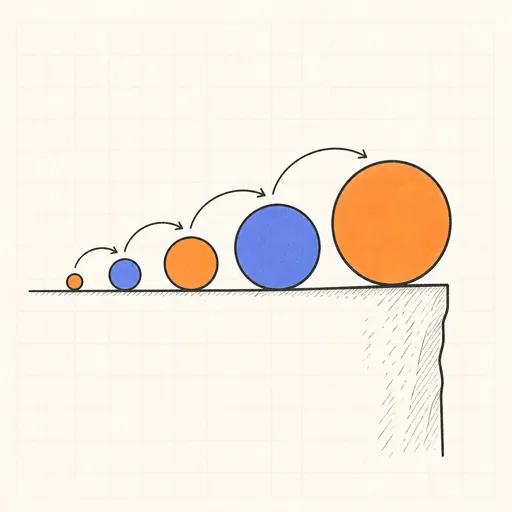
Martingale Simulator
Bust probability and true EV of doubling after losses.
Risk of Ruin Calculator
Chance of losing the bankroll before hitting a target.
Streak Probability
Chance of long winning or losing streaks in n bets.
Bonus Wagering EV
What a casino bonus is worth after the rollover.
Blackjack Strategy & EV Explorer
Exact basic strategy charts and EVs for your exact rules.
Card Counting Trainer
Learn Hi-Lo card counting: speed drills, true-count quizzes and a bankroll simulator with your bet spread.