Arbitrage Betting, Explained
After reading this you can tell whether a set of bookmaker odds guarantees a profit, split your stake so every outcome pays the same, and know exactly how much you keep.
What arbitrage betting is
Arbitrage betting means backing every outcome of an event at different bookmakers so that whichever result occurs, you collect more than you staked. It works when two or more bookmakers disagree enough about the odds that their combined prices leave a gap in your favor.
Here is the hook. A tennis match has two outcomes. Bookmaker A prices player one at decimal odds 2.10. Bookmaker B prices player two at 2.08. Stake 488.10 on player one and 511.90 on player two, for a total of 1000. If player one wins you collect 488.10 \times 2.10 = 1025.01. If player two wins you collect 511.90 \times 2.08 = 1064.75. Wait, those are not equal, which tells you the split matters. Set it correctly and both outcomes return the same 1024.14, a profit of 24.14 no matter who wins. The rest of this article shows how to find that split and when the opportunity is real.
When the numbers allow a profit
Convert each decimal price to an implied probability by taking its reciprocal. Odds of 2.10 imply 1/2.10 = 0.4762, or 47.62%. Odds of 2.08 imply 1/2.08 = 0.4808, or 48.08%. Add them: 95.70%. Because that total is below 100%, an arbitrage exists.
The sum of implied probabilities is called the book sum. When you bet with a single bookmaker on both sides, the book sum is usually above 100%, and the excess is the bookmaker's margin. Arbitrage appears only when you cherry-pick the best price for each outcome across several books and the combined book sum drops below 100%.
The gap between the book sum and 100% is your edge. A book sum of 95.70% leaves a 4.30% shortfall on the bookmakers' side, and that shortfall becomes your guaranteed return relative to the stake tied up.
The formula and the intuition
Write the decimal odds for each outcome as o_1, o_2, \dots, o_n. The book sum is the total implied probability:
Here S is the book sum and o_i is the best available decimal price for outcome i. An arbitrage exists exactly when S \lt 1.
To make every outcome return the same amount from a total stake T, put a share of the stake on each outcome proportional to its implied probability:
Here s_i is the stake on outcome i. Each outcome then returns s_i \cdot o_i = T/S, which is the same for every i. That is the key: dividing by S forces all payouts to equal T/S.
Your guaranteed profit is the common return minus the total stake:
With S = 0.9570 and T = 1000, the profit is 1000 \times (1/0.9570 - 1) = 44.95. That figure differs from the 24.14 in the hook because the hook rounded stakes to whole units. Exact stakes give the exact profit.
A worked example with the demo data
Two outcomes at 2.10 and 2.08, staking 1000
Load the demo (2.10 and 2.08 on separate lines, total 1000) and press Calculate. The steps below reproduce the result.
- Implied probabilities: 1/2.10 = 0.47619 and 1/2.08 = 0.48077.
- Book sum: S = 0.47619 + 0.48077 = 0.95696. Below 1, so an arb exists.
- Stake on outcome one: 1000 \times 0.47619 / 0.95696 = 497.61.
- Stake on outcome two: 1000 \times 0.48077 / 0.95696 = 502.39.
- Return if outcome one wins: 497.61 \times 2.10 = 1044.98.
- Return if outcome two wins: 502.39 \times 2.08 = 1044.97. Same to the cent.
- Profit: 1044.98 - 1000 = 44.98, a 4.50% return on stake.
Reading the results
The calculator reports three things worth checking. First, whether an arbitrage exists at all: if the book sum is 100% or higher, there is no risk-free profit and the tool tells you so. Second, the stake on each outcome, which you place at the bookmaker offering that price. Third, the guaranteed return and profit.
The profit expressed as a percentage of stake is the number that lets you compare opportunities. A 4.50% return on 1000 is 45. The same 4.50% on 10000 is 450. The percentage does not change with stake size, only the absolute profit does.
Round stakes to whole currency units in the direction that keeps every outcome above break-even. Rounding the smaller-odds stake up slightly protects the thinner margin. Always recheck both returns after rounding.
How the edge changes with the odds
The size of the arbitrage depends entirely on how far the book sum falls below 100%. The interactive below fixes one price and lets you move the other, so you can watch the profit appear, grow, and vanish.
Common mistakes
The math is simple. The traps are practical.
- Stale odds
- Bookmakers move prices in seconds. If you calculate on
2.10and2.08but the second price drops to1.98before you place both bets, your book sum jumps and the arb can disappear. Place the second leg fast. - One leg rejected
- If a bookmaker voids or limits your bet on one side, you are left exposed on the other. That is the largest real risk in arbitrage, and it has nothing to do with the arithmetic.
- Wrong price direction
- You must enter the best price for each outcome, and each from wherever it is best. Mixing in a shorter price on one leg inflates the book sum and hides a real arb.
- Ignoring rounding
- Rounding stakes changes returns by small amounts. On a thin 1% edge, careless rounding can turn a profit into a loss on one side.
Arbitrage is only risk-free if both bets stand and settle as expected. Cancelled bets, closed accounts, palpable-error void rules, and different definitions of an outcome across bookmakers can all break the guarantee. Treat the printed profit as the best case, not a certainty.
Related tools
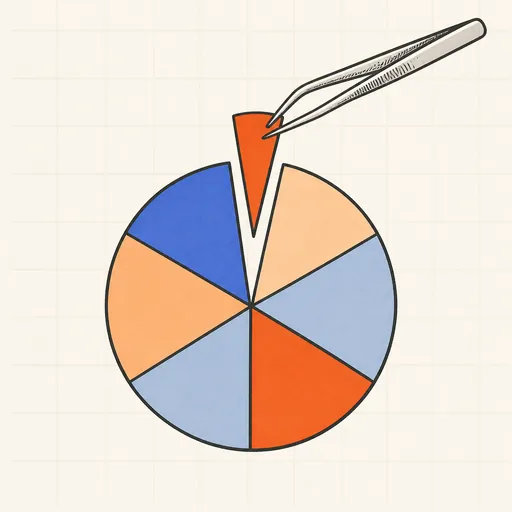
The Odds Converter turns American or fractional prices into the decimal form this calculator needs, plus the implied probability you sum for the book. The Vig Remover shows the margin baked into a single bookmaker's market, which is exactly the quantity that has to vanish across books for an arb to appear.
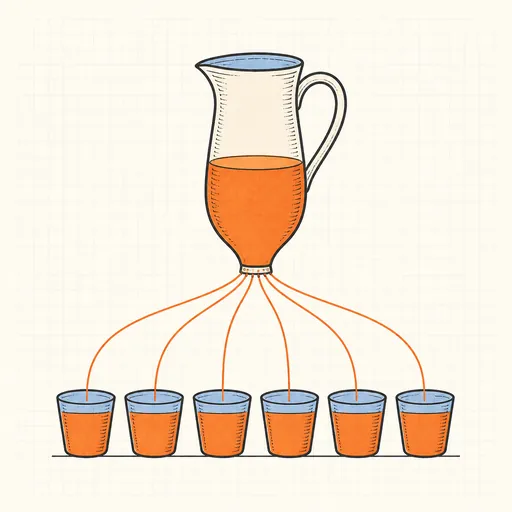
For spreading one stake across several selections at the same book, use the Dutching Calculator, which uses the same equal-return math without the cross-book profit. If you already hold a bet and want to lock a result, the Hedging Calculator handles that case. For single-bet edge and break-even, see the Expected Value Calculator. Multi-leg accumulators go in the Parlay Calculator, and win-or-place structures in the Each-Way Bet Calculator.
Frequently asked questions
How much profit is normal on an arbitrage?
Real cross-book arbs are usually thin, roughly 0.5% to 3% of stake. The demo's 4.50% is on the generous side and reflects a wide gap. On a 2% edge, a 1000 stake returns about 20.
Does the total stake change the percentage profit?
No. Profit scales linearly with stake. A book sum of 95.70% returns 4.50% whether you stake 100 or 100000. Only the absolute figure grows.
Can arbitrage exist with more than two outcomes?
Yes. The formula sums 1/o_i over every outcome. A three-way football market with prices of 2.60, 3.60, and 3.30 has a book sum of 0.3846 + 0.2778 + 0.3030 = 0.9654, so it is an arb worth about 3.58%.
Why are my two returns slightly different?
Rounding. The exact split makes every return equal to T/S. Once you round stakes to whole units, the returns drift by a few cents. Recheck both sides after rounding.
Is arbitrage betting legal?
Placing bets is legal where betting itself is legal, but bookmakers dislike arbitrage and may limit or close accounts that do it. That is a commercial risk, not a mathematical one.
Related tools

Expected Value Calculator
EV, edge and break-even probability for a single bet.

Odds Converter
Decimal, American, fractional, HK, Malay, Indonesian and implied probability.

Parlay Calculator
Combined odds, payout and true probability of accumulators.

Hedging Calculator
Lock in profit on an open bet, or convert a free bet.
Vig Remover
Overround, bookmaker margin and fair odds of a market.
Dutching Calculator
Spread one stake over several selections for equal profit.