Stair Calculator, Explained
After reading this you can divide any floor-to-floor rise into equal, comfortable risers, check them against the classic step-length rule, and read off the total run, angle and stringer length before you cut a single board.
What a stair calculator actually solves
A staircase has to climb a fixed vertical distance in a whole number of steps. That distance, called the total rise, runs from the finished lower floor to the finished upper floor. You do not get to pick the riser height freely. You pick a target, then the geometry forces you to a value nearby, because every riser in one flight must be identical.
Here is the hook. Say your rise is 2700 mm and you want a comfortable 180 mm riser. Divide: 2700 / 180 = 15. That comes out exactly to 15 risers, each exactly 180 mm. Change the rise to 2750 mm and the same target gives 15.28 risers. You cannot build a fraction of a step, so you round to 15 or 16. Fifteen risers of 2750 / 15 = 183.3 mm, or sixteen of 2750 / 16 = 171.9 mm. The tool does this rounding for you and shows both neighbours.
- Riser (R)
- The vertical height of one step.
- Tread depth or going (T)
- The horizontal depth you step onto, measured without the nosing overhang.
- Number of risers (N)
- How many equal steps the rise is divided into.
- Total run
- The horizontal distance the whole flight covers.
- Stringer
- The sloped board that carries the treads.
When to use it, and when not
Use this for a straight single flight where all treads have the same depth. That covers most interior stairs between two floors, deck stairs and basement stairs.
Do not trust a single-flight calculation for winders, spiral stairs or curved flights. On a winder the going changes across the tread width, so one number cannot describe the step. Split-level stairs with an intermediate landing are really two flights: calculate each separately, because the landing resets the geometry. The rule that all risers must be equal still applies across a landing, so the two flights usually share the same riser height.
Measure the rise to the finished floors, not the subfloor. A 40 mm difference in flooring thickness at the top spread over 15 risers changes each riser by about 2.7 mm, which is enough to make the top step feel wrong under your foot.
The formulas and the intuition behind them
Start with the number of risers. You divide the rise by your target and round to a whole number:
Here R_{target} is the riser you would like and N is the whole number of steps you land on. The actual riser is then the exact division:
A flight always has one fewer tread than it has risers, because the top riser lands on the upper floor, which is not a tread. So the total run uses N - 1:
The steepness comes from the ratio of one riser to one going:
The stringer is the hypotenuse of the right triangle whose legs are the rise and the run. Its length per unit of run follows from Pythagoras:
The comfort check is Blondel's rule, which says a natural stride on a slope keeps twice the riser plus the going near the length of a level pace:
The intuition: on a flat floor a comfortable pace is around 630 mm. As the stair gets steeper, each riser eats into that pace twice (once going up, once for the effort), so a tall riser demands a shorter going and a short riser allows a deeper one. Values below 600 feel cramped and mincing; values above 660 make you overreach.
A worked example with the demo numbers
Rise 2700 mm, target riser 180 mm, going 280 mm, tread 40 mm
- Number of risers:
2700 / 180 = 15.0, which rounds toN = 15. - Actual riser:
R = 2700 / 15 = 180.0 mm. It matches the target exactly here, which is why 2700 is a tidy demo rise. - Number of treads:
15 - 1 = 14. - Total run:
14 × 280 = 3920 mm. - Angle: \arctan(180 / 280) = \arctan(0.643) = 32.7^\circ.
- Stringer length: \sqrt{2700^2 + 3920^2} = \sqrt{7\,290\,000 + 15\,366\,400} = \sqrt{22\,656\,400} \approx 4760 \text{ mm}.
- Blondel:
2 × 180 + 280 = 640 mm. That sits inside 600 to 660, so the step feels natural.
The stringer drop matters at the bottom. The lowest tread sits on top of the stringer, so if you cut all risers equal on the notches, the bottom step ends up one tread thickness too tall. You cut the foot of the stringer down by the tread thickness, here 40 mm, so the first riser measures a true 180 mm once the tread is laid.
If your rise is not a round multiple of the target, always compute both neighbours. For a 2750 mm rise the choice is 15 risers at 183.3 mm (steeper, 632 mm Blondel) or 16 risers at 171.9 mm (gentler, 616 mm Blondel). Both pass, so pick by the run you have.
Trading steepness against run
Adding a riser makes each step shorter and the whole flight gentler, but it lengthens the run because you add a tread too. Removing a riser does the opposite. This is the single most useful thing the tool shows, so it is worth seeing as a table.
| Risers N | Riser R (mm) | Run (mm) | Angle | 2R + T (mm) |
|---|---|---|---|---|
| 13 | 207.7 | 3360 | 36.6° | 695 |
| 14 | 192.9 | 3640 | 34.6° | 666 |
| 15 | 180.0 | 3920 | 32.7° | 640 |
| 16 | 168.8 | 4200 | 31.1° | 618 |
| 17 | 158.8 | 4480 | 29.6° | 598 |
Notice how 13 risers gives a Blondel value of 695, well above 660, and a riser of 207.7 mm that exceeds the usual 190 mm limit for private stairs. That option is out on both counts. At 17 risers the value drops to 598, just below the comfort band, and the run has grown to 4480 mm. The 15 and 16 riser rows are the sweet spot.
Reading and interpreting the results
Check the results in this order. First, the actual riser R: it should sit between 150 and 190 mm for a private stair. Below 150 the steps feel shuffling and eat floor space; above 190 they get tiring and, in most codes, illegal for a home.
Second, Blondel's 2R + T. If it lands between 600 and 660 the rhythm feels right. A value of 640 like the demo is close to ideal. Third, the angle. Comfortable domestic stairs run 30 to 37 degrees. Steeper than 42 degrees and people start turning sideways to descend.
Fourth, headroom. Measure the vertical clearance from the nosing line to any ceiling or floor edge above. Most codes want about 2000 mm. Because the stair climbs as it runs, the tightest point is usually where the flight passes under a floor opening.
Finally, the run. If you entered an available run, compare it against the computed run. If the computed run is longer than what you have, you need more risers (shorter steps) or a shallower going, and you should recheck Blondel after each change.
Common mistakes
The most frequent error is counting treads equal to risers. A 15-riser flight has 14 treads, not 15. Using 15 overstates the run by one going, here by 280 mm, and throws off your landing position.
The second is using the target riser directly instead of the exact division. If you build 15 steps at exactly 180 mm from a 2710 mm rise, the last step is only 2710 - 15 × 180 = 10 mm, a guaranteed trip. Always divide the true rise by N.
The third is forgetting the stringer drop, which leaves a bottom step one tread thickness too tall. The fourth is measuring going including the nosing. The nosing overhang, typically 20 to 30 mm, does not add to the run or the going; only the exposed horizontal depth counts.
Related tools on this site
Once the stair geometry is set, you still have to build it. The sloped stringers are a roof-style cut problem, and the Roof Pitch & Rafter Calculator handles plumb and seat cut angles from the same rise-over-run logic. To buy stringer stock in the fewest boards, feed your lengths into the Cut List Optimizer. If you are cutting treads from sheet goods, the Sheet Goods Cut Optimizer nests the rectangles for you.
Frequently asked questions
Why must every riser be the same height?
Because your body learns the step rhythm within the first two treads and then stops looking. A single riser even 5 mm off breaks that expectation and causes trips, most dangerously on the top or bottom step. That is why the calculator divides the exact rise rather than trusting your target.
How many treads for N risers?
Always N - 1. The topmost riser lands you on the upper floor, which is not counted as a tread. So a 16-riser flight has 15 treads.
What riser height is most comfortable?
Around 175 to 180 mm for indoor stairs, paired with a going near 275 to 285 mm. That keeps 2R + T close to 630 to 640, the middle of Blondel's band.
Does the tread thickness change the number of risers?
No. Thickness only affects the stringer drop at the bottom, so the first step ends at the right height once the tread is on. It never changes N or the run.
My rise gives a fractional number of risers. What now?
Round to the nearest whole number and check both neighbours. Take the one whose actual riser stays under 190 mm and whose 2R + T lands in 600 to 660. If both pass, choose by the run you can fit.
Related tools
3D Model Viewer (STL/OBJ)
Preview STL and OBJ files in 3D — orbit, measure and inspect before printing.
3D Print Cost & Time Calculator
Material, time, energy and failure-adjusted print cost.
CNC Feeds & Speeds Calculator
RPM and feed rate for router and mill cutters.
Cut List Optimizer
Fit your parts onto the fewest boards or bars (1D).
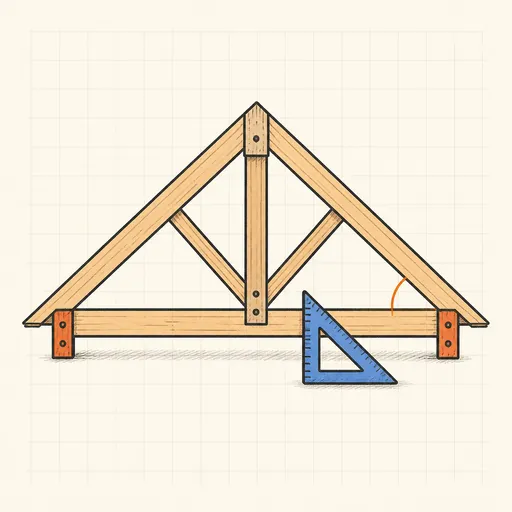
Roof Pitch & Rafter Calculator
Rafter lengths, cut angles and pitch conversions.
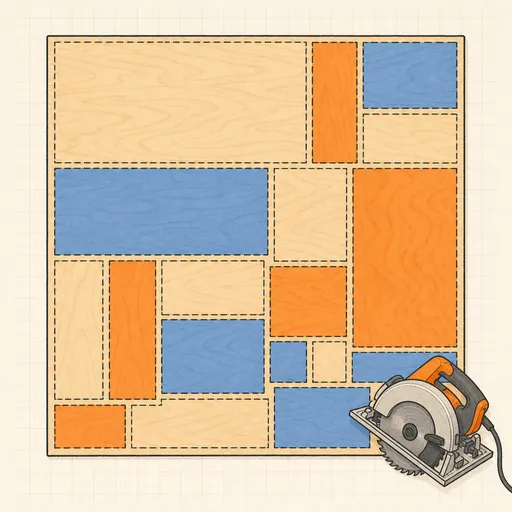
Sheet Goods Cut Optimizer
Nest rectangular parts on plywood or MDF sheets (2D).