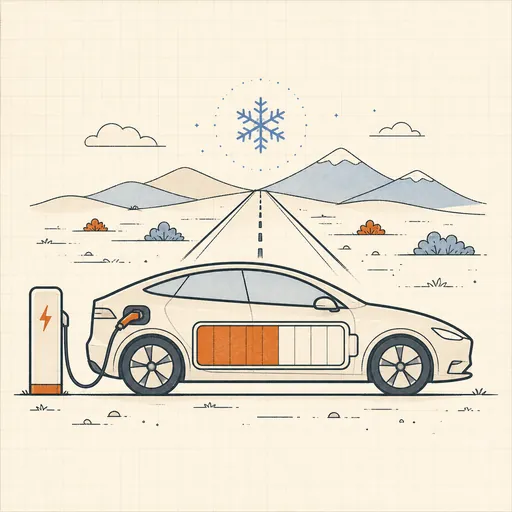
EV Range & Charging Simulator
Turns a battery size and a consumption figure into real-world electric-car range. Aerodynamic drag grows with speed squared, so the model scales your baseline consumption at 90 km/h up to the cruising speed you actually drive; cold weather adds a battery-chemistry penalty, the cabin heater burns a steady ~1.5 kW below 5 °C, and payload adds ~2% per 100 kg. The result is the expected range for your mix of highway and city driving, curves of range versus speed and versus temperature, plus charging answers: AC full-charge time, a DC fast-charge 10→80% estimate with a realistic power taper above 50% state of charge, and how many km a 15-minute splash-and-dash adds.
Read the full guide to this tool
Results
Notes
- Speed model: Wh/km = base × (0.55 + 0.45 × (v/90)²) — the fixed 55% covers rolling resistance and electronics, the rest is aerodynamic and scales with speed squared. This is why highway speed kills EV range while an ICE, wasteful at low load, barely notices.
- Temperature multiplies consumption (~1.35× at −10 °C, 1.15× at 0 °C, flat at 15–25 °C); the winter loss is mostly cabin heating plus reduced battery efficiency, and a heat pump-equipped car loses noticeably less than this resistive-heater model.
- DC charging is modelled flat at peak power to 50% state of charge, then tapering linearly to 20% of peak at 100% — which is why 10→80% is quick and the last 20% is not worth waiting for on a road trip.
- AC charging assumes ~90% charger efficiency; real curves vary by car, battery temperature and preconditioning.
Related tools
Home Heating Cost Simulator
What heating really costs — and whether the night setback pays.
3D Model Viewer (STL/OBJ)
Preview STL and OBJ files in 3D — orbit, measure and inspect before printing.
Aspect Ratio Calculator
Simplify W:H, match common ratios, scale sizes.
Cooking Measurement Converter
Cups ↔ grams with per-ingredient densities.

DPI & Pixel Size Calculator
Screen PPI, and pixels ↔ physical print size.
Fuel Economy Converter
MPG (US/UK) ↔ L/100 km ↔ km/L in one step.