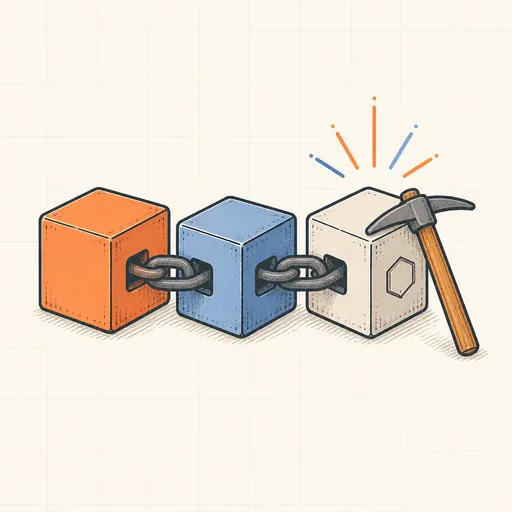
Proof-of-Work Mining Simulator
A hands-on proof-of-work laboratory using real SHA-256. Mine live: edit a block’s transactions, set the difficulty in leading zero bits and watch the miner grind through nonces at thousands of hashes per second until one hash clears the target — then chain the next block onto it. Tamper with a finished 4-block chain and see every later block turn invalid instantly, because each block commits to the previous hash; re-mining them in order shows the cumulative work an attacker must redo. A third panel measures the probability side: expected attempts double with every difficulty bit (2^bits), an empirical histogram of attempts shows the huge geometric spread around that average, and the classic random-walk formula plots an attacker’s chance of catching up from k blocks behind at a given share of the hashrate.
Runs 100% in your browser — simulations are computed locally on your device.
Read the full guide to this tool
Notes
- Mining is a lottery, not a puzzle: each nonce is an independent coin flip with success probability 2^-bits. Attempts follow a geometric distribution — finding a block in 10 hashes or 4× the expected number is perfectly normal, as the histogram shows.
- One more difficulty bit doubles the expected work. Bitcoin’s ~76 leading zero bits mean around 10²² hashes per block — this simulator’s 8–24 bits are the same mechanism at a millionth-of-a-trillionth scale.
- The chain is tamper-evident, not tamper-proof: anyone can rewrite a block, but every descendant must then be re-mined. Honest nodes simply follow the chain with the most cumulative work, so an attacker must outrun the entire network.
- The catch-up probability is a biased random walk: with attacker hashrate share q < ½ it decays like (q/(1−q))^k — exponentially in the deficit k. That is why exchanges wait for confirmations, and why q ≥ ½ (a 51% attack) means certain success.
- Runs 100% in your browser — keys and data never leave your device.
Related tools
AES Encryption
Encrypt and decrypt text with AES-GCM or AES-CBC.
Cryptographic Key Generator
Random keys, IVs, salts and API tokens from a CSPRNG.
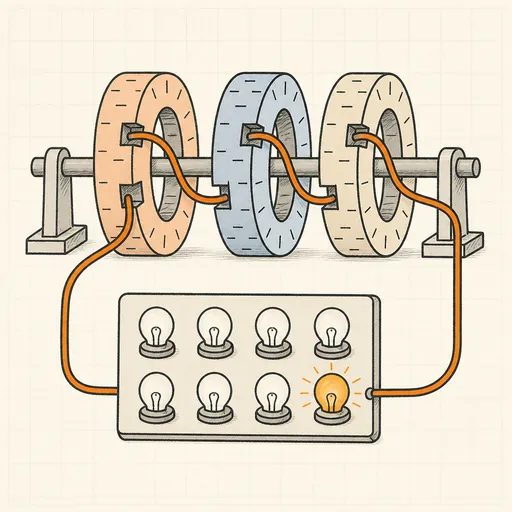
Enigma Machine Simulator
Operate a full Enigma I — rotors, plugboard, lamp board — and watch each letter travel the wiring.
JWT Builder & Signer
Build and sign JSON Web Tokens (HS256/384/512).
RSA Key Pair Generator
Generate 2048/3072/4096-bit RSA keys in PEM format.
TOTP / HOTP Authenticator
Generate 2FA codes and otpauth:// QR strings.