Work and Power, Explained
After reading this you can compute the work a force does over a distance at any angle, convert that work into power when you know the time, and spot the angle and sign errors that trip up most people.
What work means in physics
In everyday speech, holding a heavy box counts as work. In physics it does not. Work happens only when a force moves its point of application through a distance. Stand still holding a 20 kg box and you do zero mechanical work on it, no matter how tired your arms get.
Here is a concrete hook. You push a loaded cart with a steady 100 N force and roll it 5 m along a flat floor, pushing straight ahead. The work you do is 100 × 5 = 500 joules. If instead you push down and forward at 60° from the floor, only part of that force drives the cart along its path, and the work drops to 250 J. The distance and the force are identical. The direction changed everything.
One joule is one newton acting through one metre. That is a small amount: lifting a 100 g apple (weight about 0.98 N) by one metre takes roughly 1 J.
When to use this, and when not
Use the work formula when a constant force acts along a straight path. That covers dragging a crate, lifting a weight at steady speed, or a tow rope at a fixed angle. Give a time as well and you get average power over that interval.
Do not use it blindly when the force changes along the path, such as a stretching spring where force grows with extension. There the true work is the area under the force-versus-distance curve, which needs an integral or an average force. The single-number formula here assumes the force magnitude and angle stay fixed for the whole distance.
Work is a scalar: it has a size and a sign but no direction. Power is also a scalar. Force, by contrast, is a vector. The angle in the formula is exactly what reduces the force vector to the scalar work.
The formula and why the cosine appears
Here W is work in joules (J), F is the force in newtons (N), d is the distance moved in metres (m), and \theta is the angle between the force and the direction of motion.
The cosine is not an arbitrary factor. Split the force into two parts: one along the motion and one perpendicular to it. The component along the motion has size F\cos\theta. The perpendicular component does no work because the object does not move in that direction. Only F\cos\theta survives, and multiplying it by the distance gives the work.
Check the extreme cases. At \theta = 0, \cos 0 = 1 and you get the full F·d. At \theta = 90^\circ, \cos 90^\circ = 0, so a sideways force does no work. This is why the tension in a string that whirls a ball in a circle does zero work: it always points to the centre, at right angles to the motion. At \theta = 180^\circ, \cos 180^\circ = -1, so the work is negative. Friction acting backward on a sliding block does negative work, removing energy.
Power is the rate of doing work:
with P in watts (W) and t the time in seconds. One watt is one joule per second. If you already know the steady speed v = d/t, you can also write P = F v \cos\theta, which gives the same answer.
Worked example: the demo numbers
500 J of work at 50 W
Use the tool defaults: force 100 N, distance 5 m, angle 0°, time 10 s.
- Find the cosine factor. At \theta = 0^\circ, \cos 0 = 1, so the full force acts along the motion.
- Compute work: W = 100 \times 5 \times 1 = 500 J.
- Compute power: P = 500 / 10 = 50 W.
- Sanity check with speed. The cart covers 5 m in 10 s, so v = 0.5 m/s. Then P = F v = 100 \times 0.5 = 50 W. The two routes agree.
Fifty watts is about the power of a person climbing stairs at a gentle pace. In horsepower it is 50 / 745.7 ≈ 0.067 hp.
Now change only the angle to see the cosine bite. The table holds force and distance fixed at 100 N and 5 m, and time at 10 s.
| Angle (°) | cos θ | Work (J) | Power (W) |
|---|---|---|---|
| 0 | 1.000 | 500.0 | 50.00 |
| 30 | 0.8660 | 433.0 | 43.30 |
| 60 | 0.5000 | 250.0 | 25.00 |
| 90 | 0.000 | 0.000 | 0.000 |
| 120 | -0.5000 | -250.0 | -25.00 |
| 180 | -1.000 | -500.0 | -50.00 |
Reading and interpreting the result
Three features of the output carry meaning.
- Sign
- Positive work adds energy to the object (you push it along). Negative work removes energy (friction, braking, or a force opposing the motion). Zero work means the force is perpendicular to the path.
- Magnitude in joules
- By the work-energy theorem, the net work from all forces equals the change in kinetic energy. If 500 J of net work goes into a 4 kg cart starting from rest, its kinetic energy becomes 500 J, so v = \sqrt{2 \times 500 / 4} \approx 15.8 m/s.
- Power in watts
- This is the average power over the time you entered, not the peak. A 50 W average could hide a hard shove followed by coasting. The formula only knows the total work and the total time.
To reach a target power, either do more work or do the same work faster. Halving the time from 10 s to 5 s for the same 500 J doubles the power from 50 W to 100 W.
Common mistakes
The angle is the single largest source of error. It is the angle between the force and the direction of motion, not the angle from the ground or from vertical. If a rope pulls a sled and the rope sits 30° above the horizontal ground while the sled slides horizontally, then \theta = 30^\circ and \cos 30^\circ = 0.866. Read the geometry carefully before you type a number.
A second trap is mixing up force and weight. To lift a 10 kg mass at steady speed you must supply a force equal to its weight, F = mg = 10 \times 9.81 = 98.1 N, not 10 N. Lifting it 2 m takes W = 98.1 \times 2 = 196.2 J. Feeding the mass in as if it were a force gives an answer that is wrong by a factor of about ten.
A third is forgetting the sign of opposing forces. If you compute the work done against friction, that force points backward, so its work is negative. The net work is the sum, and it can be smaller than any single term.
Finally, keep units in SI. Force in newtons, distance in metres, time in seconds. A distance in centimetres or a force in kilograms-force will silently corrupt the result.
Related tools
Work connects tightly to the rest of mechanics. To find the speed that a given work produces, or to check the work-energy theorem, use the Kinetic and potential energy calculator. To get the force in the first place from a mass and acceleration, use the Force calculator. If you need the speed or distance over the interval, the Kinematics calculator solves the SUVAT relations.
When the opposing force is friction on a slope, the Friction and inclined plane calculator gives you the force to plug in here. For rotation rather than straight-line motion, the twist analogue of force times distance is the Torque calculator, which uses \tau = rF\sin\theta. Notice the sine there against the cosine here: torque wants the perpendicular component, work wants the parallel one.
Frequently asked questions
Why is the work zero when I carry a box across a level floor?
The force you apply to hold the box up is vertical, but the motion is horizontal. The angle between them is 90°, and \cos 90^\circ = 0. So the lifting force does no work on the box while you walk. You still burn energy because your muscles cycle, but that is a fact about biology, not about mechanical work on the box.
Can power be negative?
Yes, whenever the work is negative. Braking a car does negative work on it, so the power is negative: energy leaves the car's motion. The calculator will show a negative power for any angle between 90° and 180°.
How do I convert watts to horsepower?
Divide by 745.7. A 50 W output is 50 / 745.7 ≈ 0.067 hp. A 1500 W kettle draws about 2.0 hp of electrical power. Note that horsepower for engines usually means mechanical output power, so the two are not always comparable.
What is the difference between work and energy?
They share the unit, the joule, and that is not a coincidence. Work is a transfer of energy by a force acting through a distance. Doing 500 J of positive work on an object adds 500 J to its energy budget. Energy is the stock; work is one way to change the stock.
Does speed matter for the work done?
No. Work depends only on force, distance and angle, not on how fast you cover the distance. Speed only affects the power. Push a crate 5 m with 100 N and you do 500 J whether it takes 1 second or 1 hour. The fast push just delivers more power.
Related tools
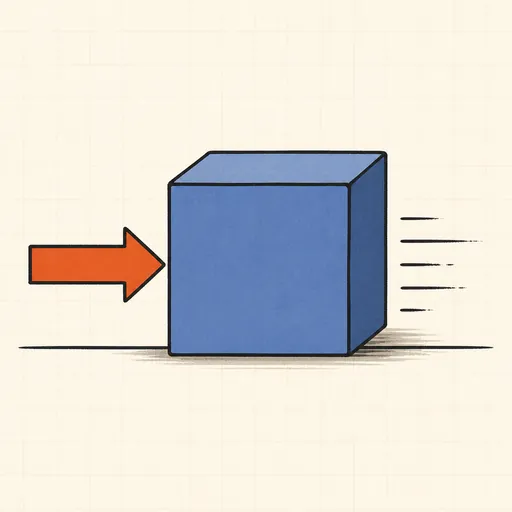
Force Calculator (F = ma)
Solve Newton's second law for force, mass or acceleration.
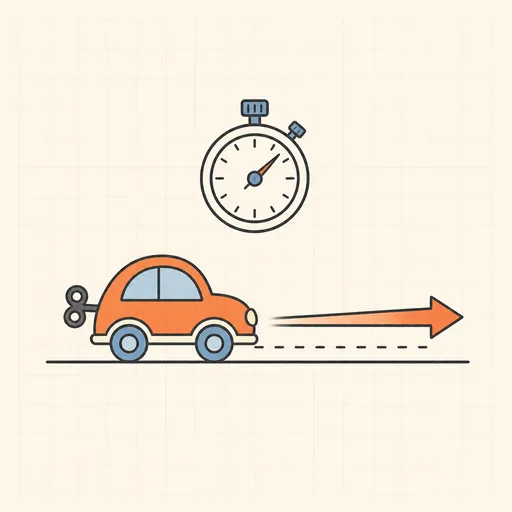
Kinematics Calculator (SUVAT)
Solve motion problems from any three of u, v, a, t, s.
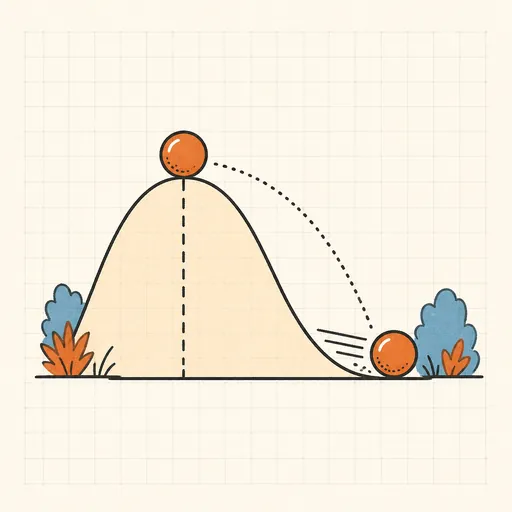
Kinetic & Potential Energy Calculator
KE = ½mv², PE = mgh and total mechanical energy.
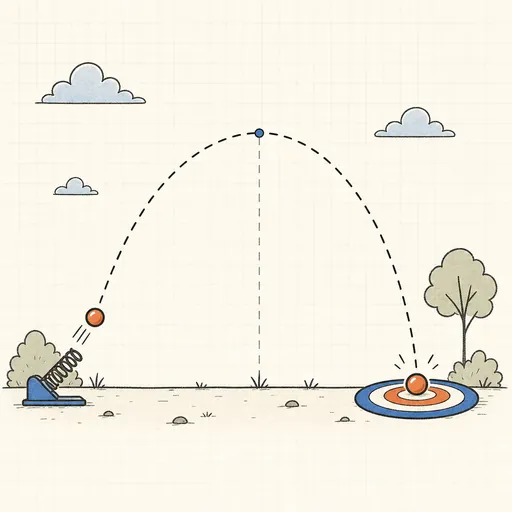
Projectile Motion Calculator
Range, height, flight time and the trajectory curve.
Circular Motion Calculator
Centripetal acceleration, force and angular speed.
Density Calculator (ρ = m/V)
Solve density, mass or volume from the other two.