Torque, Explained
After reading this you can compute the turning effect of a force about a pivot, choose the right lever arm and angle, and spot the errors that make torque calculations go wrong.
What torque is
Torque is the turning effect of a force. Push on a door near its hinge and it barely swings. Push on the same door at the handle, far from the hinge, and it opens easily. The force you apply can be identical in both cases. What changes is the distance from the pivot and, less obviously, the direction of your push.
Torque captures all of that in one number. It depends on three things: how hard you push (the force), how far from the pivot you push (the lever arm), and the angle between the push and the arm. A force of 50 newtons applied 0.3 metres from a bolt, perpendicular to the wrench, produces 15 newton metres of torque. The same force applied along the wrench, pointing straight at the bolt, produces zero.
The unit is the newton metre (\text{N}\cdot\text{m}). It has the same dimensions as energy (a joule is also a newton metre), but torque and energy are different physical quantities, so the newton metre name is kept for torque and the joule name is reserved for energy.
When to use it, and when not
Reach for torque whenever something can rotate about a fixed axis and you want to know how strongly a force tends to spin it. Tightening a bolt, balancing a seesaw, opening a valve, and analysing a beam that is about to tip all involve torque about a pivot.
Torque is not the whole story of rotation. To predict how fast something actually spins up, you need the moment of inertia and the rotational form of Newton's second law, \tau = I\alpha. This tool gives you the torque itself, the input to that equation. If your problem is a body being pushed in a straight line rather than rotated, use the Force Calculator (F = ma) instead.
Torque is always defined about a specific point or axis. The same force gives different torques about different pivots. Before you compute anything, decide where the pivot is.
The formula and the intuition behind it
The magnitude of torque about a pivot is
Here \tau is the torque in newton metres, r is the distance from the pivot to the point where the force is applied (the lever arm length, in metres), F is the force in newtons, and \theta is the angle between the lever arm and the force.
The \sin\theta factor is where the intuition lives. Only the part of the force that acts perpendicular to the arm turns the pivot. Split the force into two pieces: one along the arm (F\cos\theta) and one across it (F\sin\theta). The piece along the arm just pulls or pushes on the pivot and produces no turning. The perpendicular piece F\sin\theta does all the turning, acting at distance r, so the torque is r \cdot F\sin\theta.
Two limits check the sense of this. At \theta = 90^\circ, \sin\theta = 1 and torque is at its maximum, rF. At \theta = 0^\circ or 180^\circ, \sin\theta = 0, so a force pointing straight along the arm turns nothing at all.
A worked example with the demo numbers
Loosening a bolt with a wrench
You pull on a wrench with a force of 50 N. Your hand is 0.3 m from the bolt, and you pull perpendicular to the wrench (\theta = 90^\circ). These are the tool's default values.
- Write the formula: \tau = r \cdot F \cdot \sin\theta.
- Insert the numbers: \tau = 0.3 \times 50 \times \sin 90^\circ.
- Evaluate the sine: \sin 90^\circ = 1.
- Multiply: \tau = 0.3 \times 50 \times 1 = 15 newton metres.
So this pull delivers 15 N·m to the bolt. Now suppose you pull at 45^\circ instead. Then \sin 45^\circ \approx 0.7071, and the torque drops to 0.3 \times 50 \times 0.7071 \approx 10.61 N·m. Same force, same wrench, but almost a third less turning effect because you wasted part of the push pulling along the wrench.
Reading and interpreting the result
The output is a single number in newton metres. Larger means more turning effect. To make the number useful you usually compare it against a target.
Bolts, for instance, have a specified tightening torque. A wheel nut on a car might call for 110 N·m. If your wrench and pull give only 15 N·m, you are far short, and you either pull harder or use a longer bar. This is exactly why breaker bars exist: at fixed force, torque is proportional to r, so a 0.9 m bar triples the torque of a 0.3 m wrench for the same effort, reaching 45 N·m.
| Lever arm (m) | Torque (N·m) |
|---|---|
| 0.15 | 7.5 |
| 0.30 | 15.0 |
| 0.60 | 30.0 |
| 0.90 | 45.0 |
Torque also has a direction (clockwise or counterclockwise), which this calculator does not track. For a single force about one pivot the direction is usually obvious from the geometry. When several torques act at once, assign one sense as positive and the other as negative, then add them. A balanced seesaw has torques summing to zero.
Common mistakes
The angle trips people up most. \theta is the angle between the lever arm and the force, not between the force and some other reference like the ground or the vertical. Draw the arm from pivot to the application point, draw the force from that same point, and measure between them.
A frequent error is entering the angle the force makes with the horizontal when the wrench is not horizontal. If the wrench points up at 30 degrees and the force is vertical, the angle between them is 60 degrees, not 30. Sketch both vectors before you read off \theta.
The second mistake is measuring r to the wrong point. It runs from the pivot to the exact spot where the force is applied, not to the middle of the tool or to some convenient landmark. Measure to your hand.
The third is unit slips. Force must be in newtons and r in metres to get newton metres. A lever arm given in centimetres must be divided by 100 first. Enter 30 cm as 0.3 m, or your torque comes out 100 times too large.
How torque connects to other quantities
Torque sits inside a web of mechanics. When a torque acts through an angle, it does rotational work, and the rate of that work is rotational power. For the straight-line versions of those ideas, see the Work & Power Calculator. A force perpendicular to the radius that keeps something moving in a circle relates to the Circular Motion Calculator, where the same geometry of radius and perpendicular force appears.
If you are building up a full mechanics toolkit, the Kinematics Calculator (SUVAT) handles linear motion, the Kinetic & Potential Energy Calculator handles energy, the Momentum & Collision Calculator handles collisions, and the Friction & Inclined Plane Calculator handles whether things slide. Rotational systems like the Pendulum & Spring Period Calculator depend on restoring torques and forces of exactly this kind.
Frequently asked questions
Why is torque zero when the force points along the arm?
Because such a force only pulls the pivot toward or away from the application point, it produces no turning. Mathematically, \theta = 0^\circ gives \sin\theta = 0, so \tau = 0 regardless of how hard you push.
What is the difference between newton metres and joules?
They have the same base units, \text{kg}\cdot\text{m}^2/\text{s}^2, but describe different things. A joule measures energy or work, a scalar. A newton metre of torque measures a turning effect and has a rotational direction. To avoid confusion, torque keeps the newton metre name and never borrows the joule name.
Does a longer wrench really give more torque?
Yes, in direct proportion. At the same force and angle, doubling the lever arm doubles the torque. A 50 N pull gives 15 N·m at 0.3 m and 30 N·m at 0.6 m. That is the physics behind breaker bars and long-handled tools.
What angle should I enter if I do not know it?
If you apply the force perpendicular to the arm, which is the most effective way and the usual case for tools, enter 90 degrees. That gives the maximum torque, rF. Only reduce the angle if the force genuinely acts at a slant to the arm.
Can torque be negative?
The magnitude from this formula is never negative because \sin\theta \ge 0 for angles from 0 to 180 degrees. Signs come from direction: you choose one rotational sense as positive and label opposing torques negative when you add several together.
Related tools
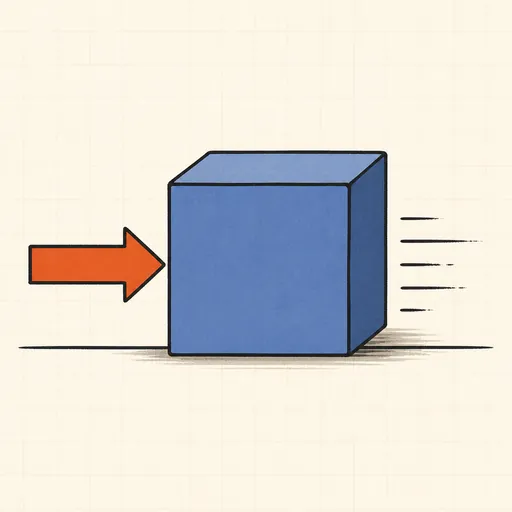
Force Calculator (F = ma)
Solve Newton's second law for force, mass or acceleration.
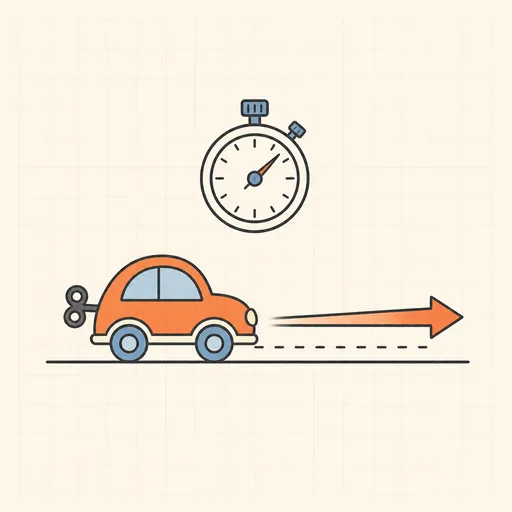
Kinematics Calculator (SUVAT)
Solve motion problems from any three of u, v, a, t, s.
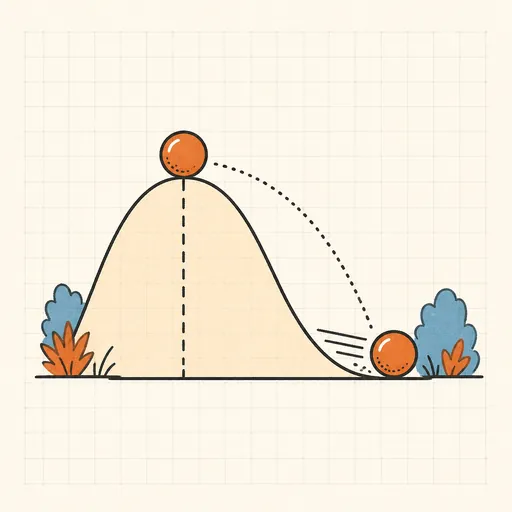
Kinetic & Potential Energy Calculator
KE = ½mv², PE = mgh and total mechanical energy.
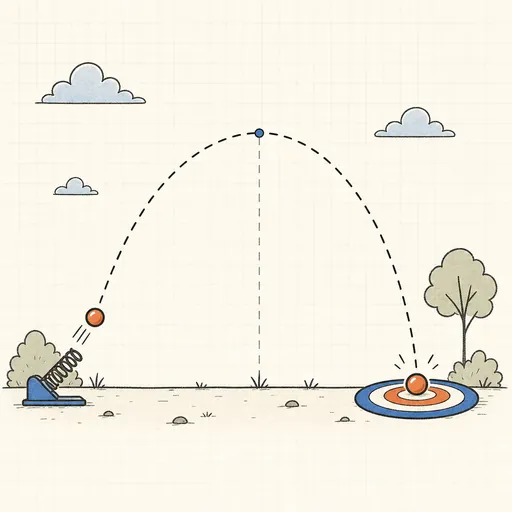
Projectile Motion Calculator
Range, height, flight time and the trajectory curve.
Circular Motion Calculator
Centripetal acceleration, force and angular speed.
Density Calculator (ρ = m/V)
Solve density, mass or volume from the other two.