Pendulum and Spring Period, Explained
After reading this you can predict how long one full swing or bounce takes, convert between period and frequency, and know exactly when the tidy formulas stop being accurate.
What a period is and why it stays the same
Hang a mass from a string and pull it a little to one side. Let go. It swings out, comes back, and passes through the bottom again and again. The period T is the time for one complete cycle: out, back, and returned to the start moving the same way. A grandfather clock keeps time because that period barely changes from swing to swing.
The surprising fact, which Galileo noticed by timing a swinging lamp against his own pulse, is that a pendulum's period does not depend on how heavy the bob is, nor (for small swings) on how far you pull it. A 1 metre pendulum on Earth takes about 2.006 seconds per swing whether the bob is a marble or a cannonball. That independence is what makes both pendulums and springs useful as timekeepers.
This calculator handles two systems that share the same underlying mathematics: a simple pendulum defined by its length, and a mass on a spring defined by the mass and the spring's stiffness.
When these formulas apply, and when they fail
Both formulas describe simple harmonic motion: a restoring force proportional to the displacement from equilibrium. That proportionality is an idealization. It holds well in a narrow range and breaks outside it.
For a pendulum, the restoring force is only proportional to the angle when the angle is small. The honest statement is that the true period grows with amplitude. For a swing amplitude of 20 degrees, the real period is about 0.77% longer than the small-angle formula predicts. At 45 degrees it is roughly 4% longer. Below about 10 degrees the error is under 0.2%, which is why the model is trusted there.
For a spring, the assumption is that the spring obeys Hooke's law, F = -kx, and that the spring itself is massless. Stretch a real spring too far and it deforms permanently or coils bind together, and the linear relationship fails. If the spring's own mass is not negligible compared with the load, the effective mass is larger and the period runs longer.
The small-angle result is an approximation, not a law. If you are timing a pendulum released from 60 degrees and comparing to a stopwatch, expect the real swing to be several percent slower than T = 2\pi\sqrt{L/g} says. Do not blame your measurement.
The two formulas and the intuition behind them
A simple pendulum of length L in a gravitational field g has period:
Here T is the period in seconds, L is the length from pivot to the centre of the bob in metres, and g is the local gravitational acceleration in metres per second squared. Notice what is absent: no mass. A longer pendulum has a longer arc to travel and swings slower, so T rises with \sqrt{L}. Stronger gravity pulls it back faster, so T falls with \sqrt{g}.
A mass m on a spring of stiffness k has period:
Here m is the mass in kilograms and k is the spring constant in newtons per metre. A heavier mass has more inertia and responds sluggishly, so T rises with \sqrt{m}. A stiffer spring pulls harder for the same stretch, so T falls with \sqrt{k}.
Both formulas share the pattern T = 2\pi\sqrt{\text{inertia}/\text{stiffness}}. For the pendulum, gravity supplies an effective stiffness mg/L, and the inertia is m; the mass cancels. That cancellation is why the pendulum period is mass-independent while the spring period is not.
Frequency and angular frequency
The frequency f counts cycles per second, measured in hertz. It is simply the reciprocal of the period:
The angular frequency \omega measures the phase advance in radians per second. One full cycle is 2\pi radians, so:
The calculator reports all three. For a period of 2 seconds, the frequency is 0.5 Hz and the angular frequency is \pi \approx 3.142 rad/s. Angular frequency is the natural quantity in the equation of motion x(t) = A\cos(\omega t), which is why physicists reach for \omega even when everyday speech uses f.
Worked example reproducing the demo
The default 1 metre pendulum
The demo uses the pendulum mode with L = 1 m and g = 9.81 m/s². Follow the arithmetic.
- Form the ratio: L/g = 1 / 9.81 = 0.10194 s².
- Take the square root: \sqrt{0.10194} = 0.31928 s.
- Multiply by 2\pi = 6.2832: T = 6.2832 \times 0.31928 = 2.006 s.
- Frequency: f = 1/2.006 = 0.4985 Hz.
- Angular frequency: \omega = 2\pi \times 0.4985 = 3.132 rad/s.
So a 1 metre pendulum ticks almost exactly once per second on each half swing, which is why the "seconds pendulum" used in old clocks is close to 0.994 m long.
The default spring
Switch to spring mode with the defaults m = 0.5 kg and k = 20 N/m.
- Ratio: m/k = 0.5 / 20 = 0.025 s².
- Square root: \sqrt{0.025} = 0.15811 s.
- Period: T = 6.2832 \times 0.15811 = 0.9935 s.
- Frequency: f = 1/0.9935 = 1.007 Hz.
- Angular frequency: \omega = 6.2832 / 0.9935 = 6.324 rad/s.
The mass bounces roughly once per second, a touch faster than the metre pendulum.
Explore how the parameters push the period
Reading and interpreting the results
The three outputs describe the same motion in different units. Keep straight what each answers.
- Period T
- Seconds for one full cycle. Use it when you care about timing, like a clock's tick or a bridge's sway.
- Frequency f
- Cycles per second, in hertz. Use it when comparing to other oscillations or driving frequencies.
- Angular frequency ω
- Radians per second. Use it inside x(t) = A\cos(\omega t) and in energy expressions.
A resonance check is a common reason to compute these. If a machine vibrates at 1 Hz and your spring-mounted platform has a natural frequency near 1.007 Hz, the platform will amplify that vibration badly. Shift the natural frequency by changing mass or stiffness to avoid the match.
To halve a spring's period you must quadruple the stiffness or quarter the mass, because of the square root. Small tuning tweaks move the period less than you might expect.
Common mistakes
The errors that produce wrong numbers are almost always unit or model errors, not arithmetic.
- Measuring length to the wrong point. For a physical bob, L runs from the pivot to the centre of mass, not to the top of the bob. On a 1 m string with a 5 cm bob, using 1.00 m instead of 1.025 m gives a period 1.2% short.
- Large-amplitude swings. Applying the small-angle formula at 45 degrees underestimates the period by about 4%, as noted above.
- Mixing units. Spring constant in N/cm instead of N/m, or mass in grams instead of kilograms, throws the result off by factors of 10 or more. A k of 20 N/cm is 2000 N/m and gives a period ten times shorter.
- Forgetting the spring's own mass. A rough correction adds one third of the spring's mass to the load. For a 0.5 kg mass on a 0.09 kg spring, use 0.53 kg, which lengthens the period by about 3%.
- Confusing period and frequency. They are reciprocals. A period of 2 s is 0.5 Hz, not 2 Hz.
Related tools on this site
The restoring force that drives these oscillations is a force like any other. To work out that force directly, use the Force Calculator (F = ma). The energy stored in a stretched spring or a raised bob connects to the Kinetic & Potential Energy Calculator, since a pendulum trades height for speed on every swing.
Angular frequency \omega also appears in steady rotation, covered by the Circular Motion Calculator. If you are analysing the straight-line motion of a released bob rather than its oscillation, the Kinematics Calculator (SUVAT) handles constant-acceleration motion.
Frequently asked questions
Does a heavier pendulum bob swing slower?
No. The pendulum period T = 2\pi\sqrt{L/g} has no mass in it. A 1 kg bob and a 10 kg bob on the same 1 m string both swing with a period of 2.006 s, because gravity pulls harder on the heavier bob in exact proportion to its greater inertia.
Why does the spring period depend on mass but the pendulum period does not?
For a spring the restoring stiffness k is fixed by the spring, independent of the load, so heavier masses genuinely oscillate slower. For a pendulum the effective stiffness is mg/L, which itself grows with mass, so the mass cancels in the ratio.
How do I find the period of a pendulum on the Moon?
Change g to the Moon's 1.62 m/s². A 1 m pendulum then has T = 2\pi\sqrt{1/1.62} = 4.937 s, about 2.46 times longer than on Earth because \sqrt{9.81/1.62} = 2.46.
What amplitude counts as a small angle?
Below about 10 degrees the small-angle formula is accurate to within 0.2%. At 15 degrees the error is roughly 0.4%, at 30 degrees about 1.7%, and at 45 degrees about 4%. Choose your tolerance and stay under the matching angle.
Can I combine several springs?
Yes. Springs in parallel add their constants: two 20 N/m springs give k = 40 N/m and a shorter period. Springs in series combine as 1/k = 1/k_1 + 1/k_2, giving 10 N/m for two 20 N/m springs and a longer period. Compute the effective k first, then enter it.
Related tools
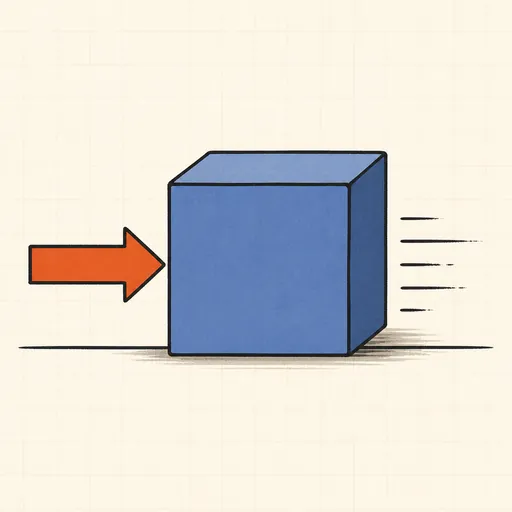
Force Calculator (F = ma)
Solve Newton's second law for force, mass or acceleration.

Kinematics Calculator (SUVAT)
Solve motion problems from any three of u, v, a, t, s.
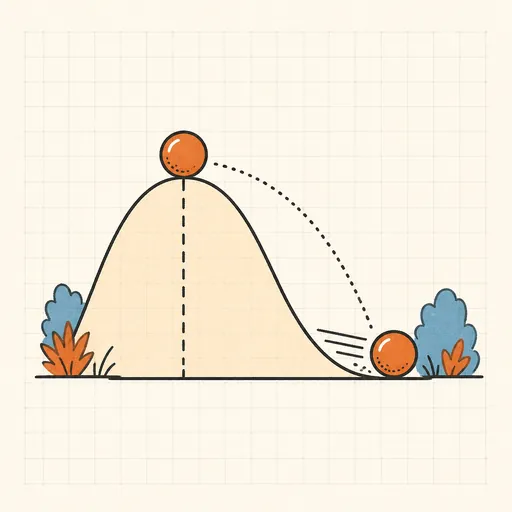
Kinetic & Potential Energy Calculator
KE = ½mv², PE = mgh and total mechanical energy.
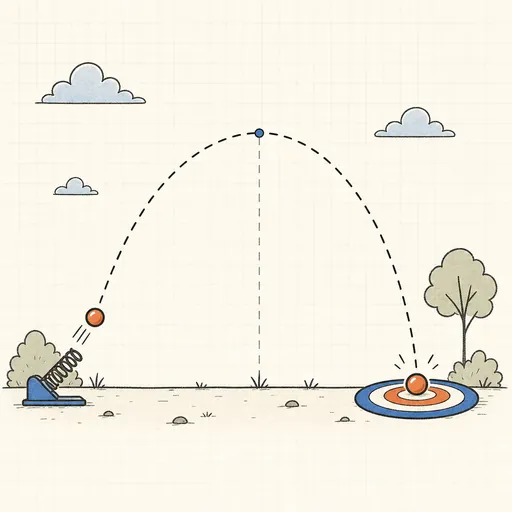
Projectile Motion Calculator
Range, height, flight time and the trajectory curve.
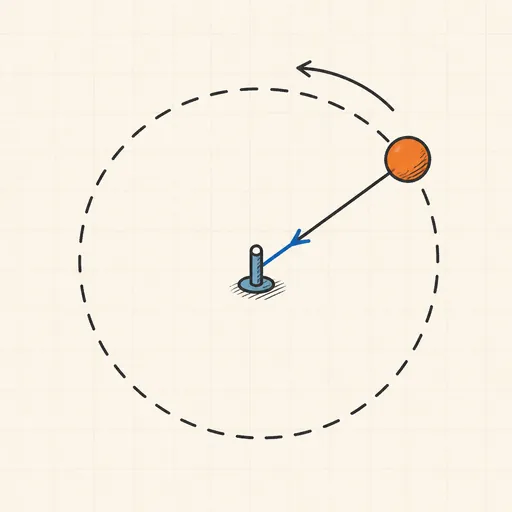
Circular Motion Calculator
Centripetal acceleration, force and angular speed.
Density Calculator (ρ = m/V)
Solve density, mass or volume from the other two.