Newton's Second Law (F = ma), Explained
After reading this you will be able to solve F = ma for force, mass or acceleration, put real units on each quantity, and tell the difference between an object's mass and its weight.
Push an empty shopping cart and it leaps forward. Load it with 40 kg of groceries and the same push barely moves it. That everyday experience is Newton's second law: for a fixed push, the acceleration you get depends on how much mass you are trying to move.
The Force Calculator solves the single equation behind that observation. This guide explains where the equation comes from, how to read its results, and the mistakes that trip people up, especially the confusion between mass and weight.
What the law says
Newton's second law connects the net force on an object, its mass, and the acceleration that results.
Here \vec{F}_{\text{net}} is the sum of all forces acting on the object, measured in newtons (N). The mass m is in kilograms (kg). The acceleration \vec{a} is in metres per second squared (m/s²). One newton is defined as the force that gives 1 kg an acceleration of 1 m/s², so 1\ \text{N} = 1\ \text{kg}\cdot\text{m/s}^2.
The arrows matter. Force and acceleration are vectors: they have direction. The acceleration always points the same way as the net force. If several forces act, you add them as vectors first, then divide by the mass. In one dimension you can drop the arrows and just track signs, which is what this calculator does.
The key word is net. If you pull a box with 30 N and friction resists with 12 N, the net force is 18 N, and that is the number that goes into F = ma. A box moving at steady speed has zero net force even though your hand is clearly pushing.
Where the equation comes from
Newton's first law says an object keeps its velocity unless a force changes it. The second law makes that quantitative. The deeper statement is that force equals the rate of change of momentum p = mv.
If the mass is constant, it comes outside the derivative and you get F = m\,\frac{dv}{dt} = ma, because \frac{dv}{dt} is the acceleration. The familiar F = ma is the constant-mass special case. For a rocket burning fuel the mass changes, and you have to keep the fuller momentum form.
Rearranging gives the two other forms this tool solves. To find mass from a measured force and acceleration, use m = F/a. To find acceleration, use a = F/m. All three are the same statement written three ways.
When to use it, and when not
Use F = ma when you know two of the three quantities and want the third, and the mass stays constant. It is exact for everyday speeds and sizes: cars, balls, carts, people.
It breaks down in three regimes. Near the speed of light (say above 10% of c, about 3\times 10^{7} m/s), you need special relativity, because momentum is no longer simply mv. At atomic scales you need quantum mechanics. And when mass changes rapidly, as with a rocket, you go back to the momentum form above.
If your problem is really about how far something travels or how fast it ends up moving, the force is only the first step. Once you have the acceleration, the Kinematics Calculator takes over to find distance, time and final velocity.
A worked example with the demo numbers
The demo loads a mass of 2 kg and an acceleration of 5 m/s², and solves for force.
Force on a 2 kg mass accelerating at 5 m/s²
- Write the equation for force: F = ma.
- Substitute the numbers: F = 2\ \text{kg} \times 5\ \text{m/s}^2.
- Multiply: F = 10\ \text{kg}\cdot\text{m/s}^2 = 10\ \text{N}.
So a net force of 10 N does the job. Check the other directions. If you instead knew the force was 10 N and the mass 2 kg, then a = 10/2 = 5 m/s². If you knew the force was 10 N and the acceleration 5 m/s², then m = 10/5 = 2 kg. The three answers are consistent because they are the same relationship.
The tool also reports the weight this mass would have on Earth: W = mg = 2 \times 9.81 = 19.62 N. Notice that is nearly double the 10 N you needed to accelerate it. Weight and applied force are different quantities that happen to share the unit newton.
Mass versus weight
This is the single most common source of error, so it deserves its own section.
- Mass
- How much matter an object contains, in kilograms. It does not change if you move the object to the Moon. It measures how hard the object is to accelerate.
- Weight
- The gravitational force on the object, in newtons. It is W = mg, so it changes with the local gravity
g.
On Earth g \approx 9.81 m/s². A 2 kg mass weighs 2 \times 9.81 = 19.62 N. On the Moon g \approx 1.62 m/s², so the same 2 kg weighs only 2 \times 1.62 = 3.24 N. Its mass is still 2 kg in both places, and the force to accelerate it at 5 m/s² is still 10 N in both places.
| Location | g (m/s²) | Mass (kg) | Weight (N) | Force for a = 5 m/s² (N) |
|---|---|---|---|---|
| Earth | 9.81 | 2 | 19.62 | 10 |
| Moon | 1.62 | 2 | 3.24 | 10 |
| Jupiter (cloud tops) | 24.79 | 2 | 49.58 | 10 |
A kitchen scale reading in kilograms is measuring your weight and dividing by 9.81 for you. If you took that scale to the Moon it would read about one sixth as much even though your mass had not changed. Bathroom scales report a force disguised as a mass.
How force reshapes acceleration
Hold the mass fixed and the graph of acceleration against force is a straight line through the origin with slope 1/m. A heavier object gives a shallower line: the same force buys you less acceleration. The chart below shows a 2 kg mass. At 10 N you read off 5 m/s², matching the demo.
Common mistakes
Watch for these five errors. Each has a quick check.
- Using weight where mass belongs. If a problem gives you 20 N and calls it "the object", that is probably a weight. Divide by 9.81 to get the mass in kilograms before you use F = ma.
- Forgetting to net the forces. Add friction, tension and gravity as signed quantities first. Only the total drives the acceleration.
- Mixing units. Grams and centimetres will give nonsense. Convert to kilograms, metres and seconds first. A 500 g mass is 0.5 kg.
- Confusing g with acceleration. The
gin W = mg is the free-fall acceleration, 9.81 m/s². An object sitting on a table is not accelerating even though gravity acts, because the table pushes back with an equal force. - Ignoring direction. A 5 N force left and a 3 N force right give a net 2 N left, not 8 N. Signs are not optional.
Related tools
Force is the entry point to most of mechanics. Once you have it, several other calculators continue the problem:
- Turn a net force into distance and speed with the Kinematics Calculator.
- Find the friction that opposes motion, or whether a block slides on a slope, with the Friction & Inclined Plane Calculator.
- Multiply force by distance to get work, and by time to get power, with the Work & Power Calculator.
- Track momentum before and after a crash with the Momentum & Collision Calculator.
- Handle forces that point toward a centre with the Circular Motion Calculator.
- See the energy a moving mass carries with the Kinetic & Potential Energy Calculator.
- For forces that turn rather than push, use the Torque Calculator.
- To go from mass to volume or the reverse, use the Density Calculator.
- For the restoring forces behind oscillation, see the Pendulum & Spring Period Calculator, and for forces in fluids, the Pressure & Buoyancy Calculator.
Frequently asked questions
Is F = ma the same as force equals mass times gravity?
No. F = ma is the general law for any acceleration. W = mg is one specific case where the force is gravity and the acceleration is g. Weight is a force computed with F = ma, but the law itself is not about gravity.
What is one newton in everyday terms?
About the weight of a small apple, roughly 100 g. That mass weighs 0.1 \times 9.81 = 0.981 N, close to 1 N. Holding a 1 kg bag of sugar means resisting about 9.81 N.
Why does my answer come out with strange units?
You almost certainly mixed units. Force in newtons requires mass in kilograms and acceleration in m/s². If you used grams or centimetres, convert first. A newton is defined as 1\ \text{kg}\cdot\text{m/s}^2, so those units are the only ones that give a clean answer.
Can acceleration be zero if a force is applied?
Yes, whenever the forces cancel. A car cruising at constant 100 km/h has a large engine force, but drag and friction cancel it, so the net force and the acceleration are both zero. Zero acceleration means constant velocity, not necessarily rest.
Does a heavier object fall faster?
No, ignoring air resistance. Gravity pulls harder on more mass (W = mg), but more mass is also harder to accelerate (a = F/m). The two effects cancel exactly, so every object falls at g \approx 9.81 m/s². Air resistance, not mass, is why a feather drifts.
Related tools
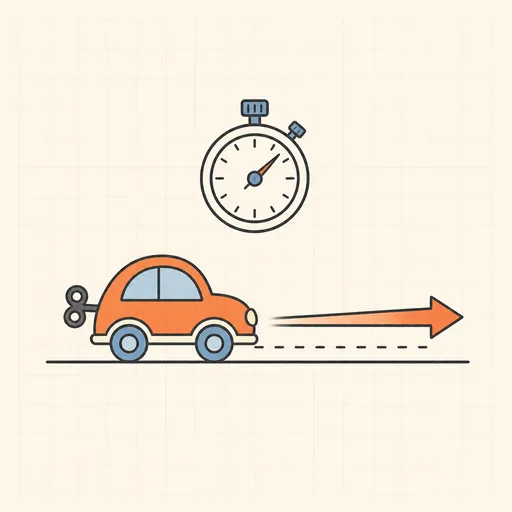
Kinematics Calculator (SUVAT)
Solve motion problems from any three of u, v, a, t, s.
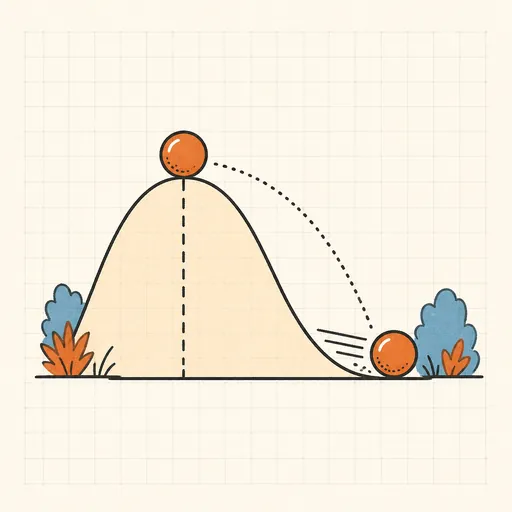
Kinetic & Potential Energy Calculator
KE = ½mv², PE = mgh and total mechanical energy.
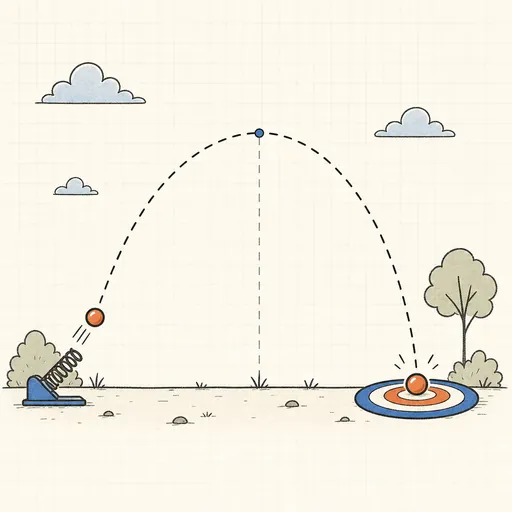
Projectile Motion Calculator
Range, height, flight time and the trajectory curve.
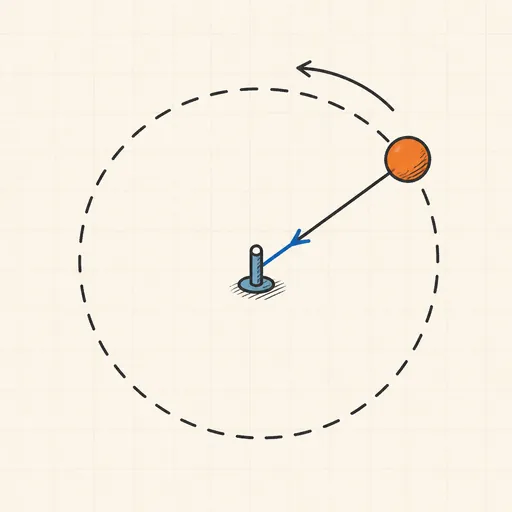
Circular Motion Calculator
Centripetal acceleration, force and angular speed.
Density Calculator (ρ = m/V)
Solve density, mass or volume from the other two.
Free Fall Calculator
Fall time and impact speed from a height, or vice versa.