Momentum and Collisions, Explained
After reading this you will be able to predict the velocities of two bodies after a head-on collision, decide whether kinetic energy survives, and compute exactly how much energy a stick-together crash throws away.
What a collision calculator actually solves
Two objects move along a line. They meet. What happens next depends on one physical law that never fails and one that sometimes does. Momentum is conserved in every collision. Kinetic energy is conserved only when the collision is perfectly elastic.
Consider a 2 kg cart rolling right at 3 m/s that strikes a 1 kg cart moving left at 1 m/s. Before the hit, the total momentum is 2 \times 3 + 1 \times (-1) = 5\ \text{kg}\cdot\text{m/s}. That number is fixed. It will be exactly 5 after the collision too, no matter how the carts bounce, crumple or stick. The calculator uses that anchor plus one more equation to pin down both final velocities.
Sign matters. Pick a positive direction (here, to the right) and keep it. Leftward motion is negative. The whole problem is one-dimensional, so a single sign carries all the direction information you need.
When this model applies and when it does not
The calculator treats a clean head-on impact between two rigid bodies with no outside push during contact. That covers billiard balls, rail carts, and a dropped ball meeting a bat, all good enough for a first estimate.
It does not cover glancing hits where the objects fly off at angles, because those need two-dimensional momentum bookkeeping. It also assumes the collision is fast compared to any friction or gravity acting sideways, so those forces do not change the total momentum during the brief contact. If a puck slides across rough ice for a second before impact, handle that leg with the Kinematics Calculator (SUVAT) first, then feed the impact velocities in here.
Real collisions almost never sit exactly at "perfectly elastic" or "perfectly inelastic". A tennis ball on concrete gives back roughly half its speed, which is partly inelastic. The two options here are the mathematical limits. Reality lives in between, described by a coefficient of restitution between 0 and 1.
The formulas and why they take that shape
Momentum conservation is the same for both collision types. With masses m_1, m_2 and initial velocities u_1, u_2:
Here v_1 and v_2 are the final velocities. That single equation has two unknowns, so you need a second condition.
For a perfectly inelastic collision the bodies stick, so v_1 = v_2 = v. Substituting gives one unknown:
The stuck pair simply carries the total momentum divided by the total mass. That is the same form as a weighted average of the two starting velocities.
For a perfectly elastic collision the second condition is that kinetic energy is also conserved. Solving the two equations together (momentum and energy) gives closed forms:
A useful check hides inside these. Subtract them and you find v_2 - v_1 = u_1 - u_2. The relative speed of approach equals the relative speed of separation. In an elastic collision the objects part exactly as fast as they came together, only reversed. That single fact reproduces the two formulas and is worth remembering as a sanity test.
Worked example: the demo data
Use the tool defaults: m_1 = 2\ \text{kg}, u_1 = 3\ \text{m/s}, m_2 = 1\ \text{kg}, u_2 = -1\ \text{m/s}.
- Total momentum: 2(3) + 1(-1) = 5\ \text{kg}\cdot\text{m/s}.
- Total kinetic energy before: \tfrac12(2)(3^2) + \tfrac12(1)(1^2) = 9 + 0.5 = 9.5\ \text{J}.
- Elastic final velocities. With m_1 + m_2 = 3: v_1 = \tfrac{2-1}{3}(3) + \tfrac{2(1)}{3}(-1) = 1 - 0.667 = 0.333\ \text{m/s}.
- And v_2 = \tfrac{2(2)}{3}(3) + \tfrac{1-2}{3}(-1) = 4 + 0.333 = 4.333\ \text{m/s}.
- Check momentum: 2(0.333) + 1(4.333) = 0.667 + 4.333 = 5. Correct.
- Check energy: \tfrac12(2)(0.333^2) + \tfrac12(1)(4.333^2) = 0.111 + 9.389 = 9.5\ \text{J}. Energy is conserved, as it must be.
- Inelastic outcome: v = 5/3 = 1.667\ \text{m/s} for both. Kinetic energy after: \tfrac12(3)(1.667^2) = 4.167\ \text{J}.
- Energy lost in the stick: 9.5 - 4.167 = 5.333\ \text{J}, which is 56% of the starting kinetic energy.
Reading the results
The calculator returns final velocities and the kinetic energy lost. Read the signs first. In the elastic case above, v_1 = 0.333\ \text{m/s} stays positive, so cart 1 still moves right, just slowly. Cart 2 shoots off at 4.333 m/s, faster than either object started, because it absorbed momentum from the heavier cart.
The energy-lost figure is the headline number for inelastic cases. For elastic collisions it should read zero (up to rounding). If it does not, you have almost certainly selected the wrong collision type. For inelastic collisions the loss is always positive and represents energy that went into heat, sound and permanent deformation. That energy did not vanish from the universe, it simply left the tidy kinetic bucket. To follow where mechanical energy goes in other situations, the Kinetic and Potential Energy Calculator is the companion tool.
A widget for the whole family of collisions
The two options in the tool are endpoints. In between sits every real bounce, tuned by the coefficient of restitution e. It is defined so that the separation speed is e times the approach speed: v_2 - v_1 = e\,(u_1 - u_2). At e = 1 you recover the elastic result; at e = 0 you recover the stick.
Common mistakes
The errors below account for most wrong answers.
- Dropping the sign on an incoming velocity
- If cart 2 moves left, its velocity is negative. Entering
+1instead of-1changes the demo total momentum from5to7and throws off every result. - Expecting energy loss in an elastic collision
- By definition it is zero. If you want a bounce that loses energy, you need the inelastic option or a restitution below 1.
- Assuming the heavier object always moves forward
- A light object hitting a much heavier one can bounce straight back. Set m_1 = 1, m_2 = 100 elastic and cart 1 reverses at nearly its original speed, like a ball off a wall.
- Confusing kinetic energy with momentum
- Momentum uses velocity to the first power and keeps its sign. Kinetic energy uses velocity squared and is never negative. A collision can leave total momentum unchanged while destroying more than half the kinetic energy.
To sanity check any elastic result by hand, verify that the approach speed equals the separation speed. In the demo, approach is 3 - (-1) = 4\ \text{m/s} and separation is 4.333 - 0.333 = 4\ \text{m/s}. Equal, so the answer is consistent.
Two useful limiting cases
Special mass ratios are worth memorizing because they show up constantly.
| Mass ratio | v1 (as fraction of u1) | v2 (as fraction of u1) | What you see |
|---|---|---|---|
| m1 = m2 | 0 | 1 | Cart 1 stops dead, cart 2 leaves at u1 |
| m1 much larger | 1 | 2 | Cart 1 barely slows, cart 2 shot to 2u1 |
| m1 much smaller | -1 | 0 | Cart 1 bounces back, heavy cart hardly moves |
The first row is the classic Newton's cradle behavior: equal masses swap velocities in an elastic hit. These limits fall straight out of the elastic formulas when you set u_2 = 0 and take the mass ratio to its extreme.
Related tools
Collisions connect to the rest of mechanics. The force during contact is the change in momentum divided by the contact time, which you can size up with the Force Calculator. If the objects roll to a stop afterward against friction, the Friction and Inclined Plane Calculator handles that deceleration, and the Work and Power Calculator converts a stopping force over a distance into the energy removed. For objects circling rather than colliding head-on, see the Circular Motion Calculator, and for oscillating systems the Pendulum and Spring Period Calculator. Rotational impacts extend the same momentum idea into the Torque Calculator. Density and buoyancy come up when the colliding bodies float or sink, covered by the Density Calculator and the Pressure and Buoyancy Calculator.
Frequently asked questions
Why is momentum conserved but kinetic energy not?
During contact the two bodies push on each other with equal and opposite forces (Newton's third law). Those internal forces cancel in the total, so total momentum cannot change. Kinetic energy has no such protection: it can convert into heat, sound and deformation, none of which the collision must return.
How much energy does a perfectly inelastic collision lose?
The maximum that momentum conservation permits. For the demo data that is 5.333 J out of 9.5 J, or 56%. The general result is \tfrac12 \tfrac{m_1 m_2}{m_1+m_2}(u_1-u_2)^2, which depends only on the approach speed and the reduced mass.
Can a final velocity exceed both starting velocities?
Yes. In the elastic demo, cart 2 ends at 4.333 m/s, faster than cart 1's initial 3 m/s. A light object struck by a heavier one can be launched faster than either began, as long as momentum and energy both balance.
What if both objects move the same way before impact?
Give them the same sign. A faster cart catching a slower one ahead of it is a valid head-on case in one dimension. The formulas handle it without change; only the faster object can catch the slower one, so check that u_1 \gt u_2 for a rear-end hit.
Is a real bounce elastic or inelastic?
Neither exactly. Measure the coefficient of restitution by dropping the object and comparing rebound height to drop height: e = \sqrt{h_{\text{rebound}}/h_{\text{drop}}}. A superball reaches about 0.9, a lump of clay about 0.
Related tools
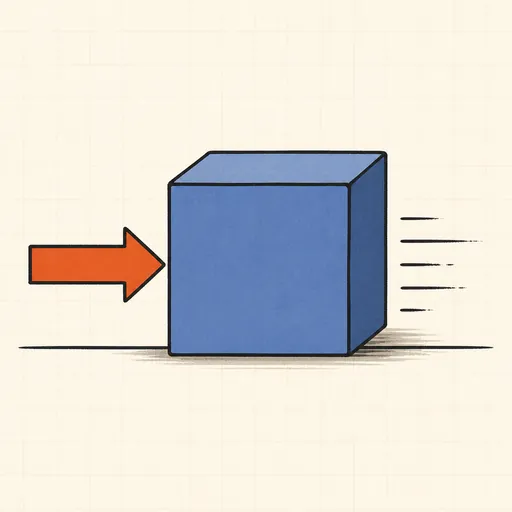
Force Calculator (F = ma)
Solve Newton's second law for force, mass or acceleration.
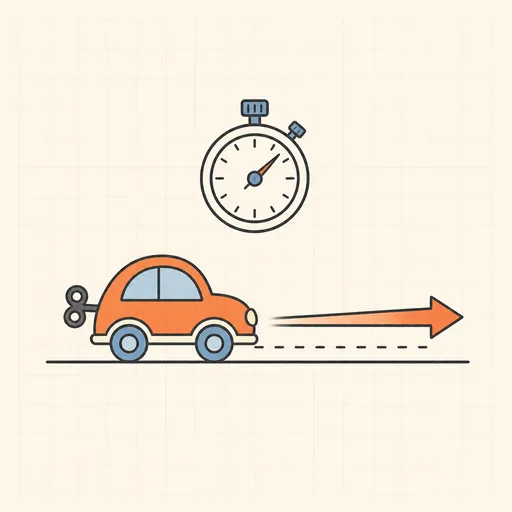
Kinematics Calculator (SUVAT)
Solve motion problems from any three of u, v, a, t, s.
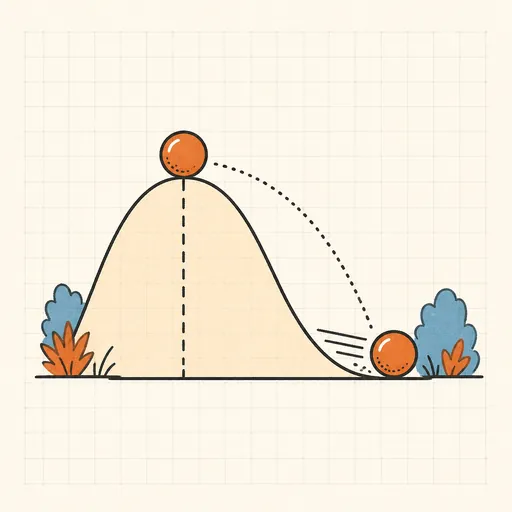
Kinetic & Potential Energy Calculator
KE = ½mv², PE = mgh and total mechanical energy.
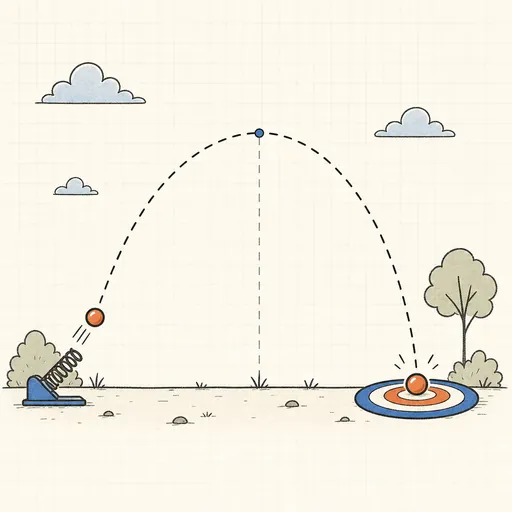
Projectile Motion Calculator
Range, height, flight time and the trajectory curve.
Circular Motion Calculator
Centripetal acceleration, force and angular speed.
Density Calculator (ρ = m/V)
Solve density, mass or volume from the other two.