Kinetic and Potential Energy, Explained
After reading this you can compute an object's kinetic energy from its mass and speed, its gravitational potential energy from its mass and height, and combine them into a total mechanical energy you can track as motion unfolds.
What these energies are
Energy is a bookkeeping quantity. It does not glow or weigh anything; it is a number you compute so you can predict what a system will do next. Two forms dominate simple mechanics problems.
Kinetic energy is the energy an object has because it is moving. A 2 kg book sliding at 10 m/s carries kinetic energy that will do damage if it hits your foot. Stop the book and that energy has to go somewhere: into heat, sound, a dent.
Gravitational potential energy is the energy stored in an object's position within a gravitational field. Lift that same book onto a shelf and you have stored energy. Let go and gravity converts the stored energy back into motion.
Here is the hook. Drop the 2 kg book from a 5 m shelf. At the top it has potential energy and no speed. Just before it lands it has speed and (measured from the floor) no potential energy. The total stays fixed at about 98 joules the whole way down. That constancy is the single most useful fact in this article, and the rest explains how to use it.
When to use this, and when not
The formulas here assume a rigid object moving slowly compared to light, in a uniform gravitational field, with no rotation you need to account for. That covers most everyday problems: falling objects, sliding blocks, swinging weights, projectiles below a few kilometres of altitude.
They break down in three common situations. First, if the object spins, some energy hides in rotation and \tfrac{1}{2}mv^2 undercounts the total. Second, if height changes by hundreds of kilometres, g is no longer constant and mgh fails; you need the full -GMm/r form. Third, near the speed of light the classical \tfrac{1}{2}mv^2 is wrong. None of that matters for a dropped book.
Mechanical energy is conserved only when the forces doing work are conservative (gravity, ideal springs). Friction, air drag and collisions convert mechanical energy into heat, so the total mechanical energy drops. This tool computes the mechanical energy; it does not model the losses.
The formulas and where they come from
Start with kinetic energy. Work is force times distance. Push a mass m with a constant force so it accelerates from rest, and the work you do equals the kinetic energy it gains. Using F = ma and the kinematic relation v^2 = 2as, the work Fs = ma \cdot s = m \cdot \tfrac{v^2}{2}. That gives the standard result.
Here m is mass in kilograms, v is speed in metres per second, and KE is in joules. One joule is one \text{kg} \cdot \text{m}^2/\text{s}^2. Note the square: speed matters far more than mass, a point we return to.
Potential energy comes from the same work idea. To lift a mass a height h against gravity you apply an upward force mg over distance h. The work you do is stored as potential energy.
Here g is the gravitational field strength (about 9.81 m/s² at Earth's surface) and h is height above a reference level you choose. Add the two to get the total mechanical energy.
The reference height deserves emphasis. There is no absolute zero of potential energy. If you put the origin at the floor, the shelf is at h = 5. If you put it at the shelf, the floor is at h = -5. Only differences in PE have physical meaning, and both choices give the same energy change.
A worked example with the demo numbers
A 2 kg object at 10 m/s, 5 m up
These are the tool's default values: mass = 2 kg, velocity = 10 m/s, height = 5 m, gravity = 9.81 m/s².
- Kinetic energy: KE = \tfrac{1}{2}(2)(10)^2 = \tfrac{1}{2}(2)(100) = 100 J.
- Potential energy: PE = (2)(9.81)(5) = 98.1 J.
- Total mechanical energy: E = 100 + 98.1 = 198.1 J.
Read that as follows. The object is moving fast enough to carry 100 J of kinetic energy right now, and it sits high enough to release another 98.1 J if it fell to the floor. If it did fall from rest and no drag acted, it would arrive with all 198.1 J as kinetic energy, giving a landing speed of v = \sqrt{2E/m} = \sqrt{198.1} \approx 14.07 m/s.
Why speed dominates: the square law
Because kinetic energy goes as v^2, small changes in speed cause large changes in energy. Double the speed and you quadruple the kinetic energy. Triple it and you get nine times the energy.
Check with the 2 kg object. At 10 m/s, KE = 100 J. At 20 m/s, KE = \tfrac{1}{2}(2)(400) = 400 J, four times as much. At 30 m/s it is 900 J. This is why a car crash at 60 km/h is far more than twice as violent as one at 30 km/h, and why braking distance grows with the square of speed.
Watching energy trade as an object falls
The clearest demonstration is a free fall. Take the 2 kg object and let it drop from 5 m with no initial speed, so its total energy is E = mgh = 98.1 J throughout. At each height, PE = mgh and KE = E - PE. The two swap while their sum holds fixed.
| Height (m) | Speed (m/s) | PE (J) | KE (J) | Total (J) |
|---|---|---|---|---|
| 5 | 0 | 98.1 | 0 | 98.1 |
| 4 | 4.429 | 78.48 | 19.62 | 98.1 |
| 3 | 6.264 | 58.86 | 39.24 | 98.1 |
| 2 | 7.672 | 39.24 | 58.86 | 98.1 |
| 1 | 8.858 | 19.62 | 78.48 | 98.1 |
| 0 | 9.905 | 0 | 98.1 | 98.1 |
Notice the total column never moves. That is conservation of mechanical energy in action. The speed at each height comes from v = \sqrt{2 \cdot KE / m}, and at the floor it reaches 9.905 m/s, matching the free-fall result you would get from the Kinematics Calculator (SUVAT).
Reading and interpreting the results
The tool returns three numbers: kinetic energy, potential energy and their sum. Treat them as follows.
- Kinetic energy
- The energy available right now from motion. Divide by a stopping distance to estimate the average force needed to stop the object: 100 J stopped over 0.5 m needs about 200 N.
- Potential energy
- Energy that can be released if the object descends to your reference level. It is only meaningful relative to that level.
- Total mechanical energy
- The conserved quantity in a frictionless, non-rotating problem. Compute it once and you can find the speed at any height without tracking the motion step by step.
A worked interpretation: if the total is 198.1 J and you want the speed when the object reaches the floor (PE = 0), set KE = 198.1 J and solve v = \sqrt{2(198.1)/2} = \sqrt{198.1} \approx 14.07 m/s.
Common mistakes
Do not forget the square in kinetic energy. Writing KE = \tfrac{1}{2}mv instead of \tfrac{1}{2}mv^2 gives 10 J instead of 100 J for the demo object, off by a factor of the speed.
Three more traps catch people often. First, mixing units: speed must be in m/s, not km/h. A speed of 36 km/h is 10 m/s, and using 36 directly inflates KE by a factor of 3.6^2 \approx 13. Second, using weight (in newtons) where mass (in kilograms) belongs; mgh already contains g, so do not multiply by g twice. Third, expecting conservation when friction is present. If a block slides to a stop, its mechanical energy did not vanish; it became heat, and the tool's total energy will not match the block's later state.
One subtler point: kinetic energy depends on the reference frame. A passenger at rest in a moving train has zero kinetic energy relative to the train but a large value relative to the ground. Pick a frame and stay in it.
Related tools
Energy connects to most of mechanics, so several nearby tools extend what you can do here. Use the Work & Power Calculator to find the force and time behind an energy change, since work equals the change in kinetic energy. The Force Calculator (F = ma) supplies the forces that do that work. For collisions where energy may or may not be conserved, turn to the Momentum & Collision Calculator. When motion follows a curve, the Circular Motion Calculator handles the centripetal side, and the Pendulum & Spring Period Calculator covers the repeating energy trade in oscillators. If your object slides on a slope, the Friction & Inclined Plane Calculator tells you how much energy friction removes.
Frequently asked questions
What units does energy come out in?
Joules, provided you enter mass in kilograms, speed in metres per second, height in metres and gravity in m/s². One joule is one \text{kg} \cdot \text{m}^2/\text{s}^2. For the demo values you get 100 J of kinetic energy and 98.1 J of potential energy.
Why does potential energy depend on where I set zero?
Because only differences in potential energy affect motion. Setting the zero at the floor or the ceiling shifts every PE value by a constant, but the change between two heights (and therefore the physics) is identical. Choose the reference that makes your problem simplest, usually the lowest point the object reaches.
Can kinetic energy be negative?
No. Since v^2 is never negative and mass is positive, \tfrac{1}{2}mv^2 \ge 0 always. Potential energy can be negative if the object sits below your chosen reference level, but kinetic energy cannot.
What value of g should I use?
At Earth's surface, 9.81 m/s² is accurate to about a part in a thousand across most locations. Use 9.83 near the poles or 9.78 near the equator if you need that precision. On the Moon use 1.62 m/s², which cuts the demo object's potential energy to (2)(1.62)(5) = 16.2 J.
How do I get the landing speed from the total energy?
Set all the energy to kinetic at the landing point and solve v = \sqrt{2E/m}. For a total of 198.1 J and a 2 kg object, v = \sqrt{198.1} \approx 14.07 m/s. This assumes no energy is lost to drag.
Related tools
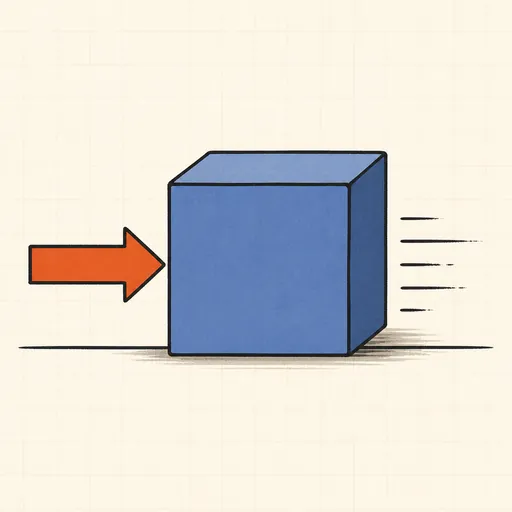
Force Calculator (F = ma)
Solve Newton's second law for force, mass or acceleration.
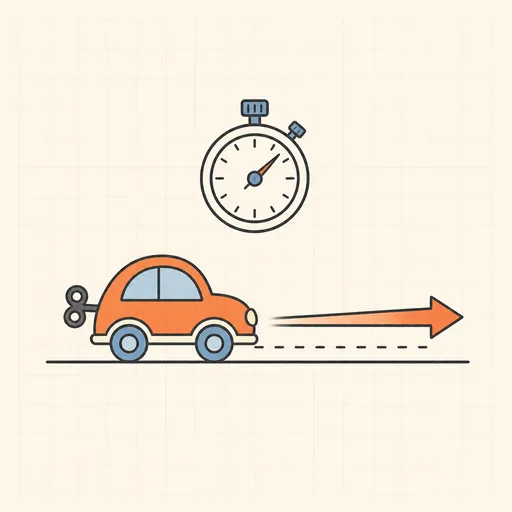
Kinematics Calculator (SUVAT)
Solve motion problems from any three of u, v, a, t, s.
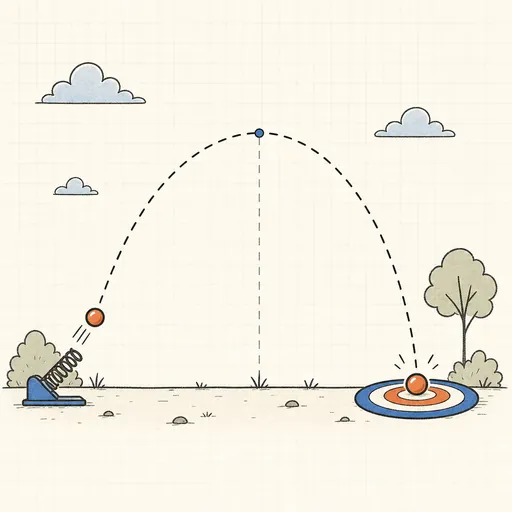
Projectile Motion Calculator
Range, height, flight time and the trajectory curve.
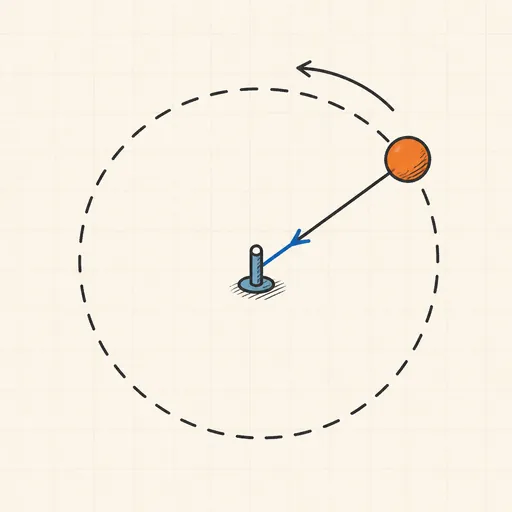
Circular Motion Calculator
Centripetal acceleration, force and angular speed.
Density Calculator (ρ = m/V)
Solve density, mass or volume from the other two.
Free Fall Calculator
Fall time and impact speed from a height, or vice versa.