Friction and Inclined Planes, Explained
After reading this you can find the normal force on a block resting on a slope, decide whether it will slide, and compute its acceleration if it does, all from the geometry and two friction coefficients.
What the calculator answers
Put a wooden crate on a ramp. Tip the ramp up slowly. For a while nothing happens: friction holds the crate in place. Past a certain angle it breaks loose and slides. The Friction and Inclined Plane Calculator models exactly this situation for a single block on a flat slope.
It reports four things. The normal force pressing the surfaces together, the gravity component along the slope trying to pull the block down, the maximum static friction resisting that pull, and a verdict: does the block stay put or slide? If it slides, you also get its acceleration down the ramp.
Everything follows from resolving the weight into two directions: one perpendicular to the slope and one parallel to it. Get those two components right and the rest is arithmetic.
When to use this model, and when not
This is the classic rigid-block-on-a-plane problem. It fits a box on a loading ramp, a coin on a tilted book, a car parked on a hill (treated as a point mass), or a ski resting on packed snow. It assumes a single flat inclined surface, one contact patch, gravity pulling straight down, and dry friction described by two constant coefficients.
It does not fit rolling objects (a rolling ball or wheel obeys torque equations, not sliding friction), objects on curved surfaces, cases where air drag matters, or situations with an extra applied force such as a rope pulling the block. For a pull-along-the-slope problem you combine this analysis with Newton's second law by hand. If the block does slide and you want to know how fast it moves after some distance, feed the acceleration here into the Kinematics Calculator.
Friction coefficients are not fundamental constants. Textbook values for wood on wood span roughly 0.2 to 0.6 depending on grain, moisture and polish. Treat any single value as an estimate good to maybe one significant figure, and do not report a "slides or not" verdict as certain when your angle sits within a degree or two of the threshold.
The formula and the intuition behind it
Set up axes along and across the slope, not horizontal and vertical. The weight of the block is mg, pointing straight down. Split it into a piece pressing into the slope and a piece sliding along it.
Here N is the normal force, m the mass, g the gravitational field strength, and \theta the slope angle. On flat ground (\theta = 0) the cosine is 1 and the surface carries the full weight. On a steeper slope the cosine shrinks, so less of the weight presses into the surface.
This is the part of the weight pulling the block down the slope. At \theta = 0 it is zero (nothing to slide down), and it grows as the slope steepens.
F_{\text{s,max}} is the largest static friction force the contact can supply, and \mu_s is the static friction coefficient. Static friction is not a fixed force. It adjusts itself to match whatever is trying to move the block, up to this ceiling. The block stays put as long as the pull stays below the ceiling.
Divide both sides by mg\cos\theta and the mass cancels completely. What remains is a statement about the angle alone.
The block slides once \tan\theta \gt \mu_s. The threshold angle is \theta_c = \arctan\mu_s, and it does not depend on the mass. A heavy crate and a light one on the same surface let go at the same tilt. That is the single most useful fact on this page.
If the block does slide, kinetic friction takes over, using the kinetic coefficient \mu_k, which is usually smaller than \mu_s. The net force down the slope divided by the mass gives the acceleration.
Again the mass cancels. Every block on that surface accelerates at the same rate, just as Galileo argued for free fall.
A worked example with the demo numbers
A 5 kg block on a 30 degree slope
Use the demo values: m = 5\ \text{kg}, \theta = 30^\circ, \mu_s = 0.5, \mu_k = 0.3, g = 9.81\ \text{m/s}^2.
- Weight: mg = 5 \times 9.81 = 49.05\ \text{N}.
- Normal force: N = 49.05 \times \cos 30^\circ = 49.05 \times 0.8660 = 42.48\ \text{N}.
- Gravity pull down the slope: F_{\text{gravity}} = 49.05 \times \sin 30^\circ = 49.05 \times 0.5 = 24.53\ \text{N}.
- Maximum static friction: F_{\text{s,max}} = 0.5 \times 42.48 = 21.24\ \text{N}.
- Compare: the pull (24.53 N) exceeds the friction ceiling (21.24 N), so the block slides.
- Acceleration: a = 9.81\,(\sin 30^\circ - 0.3\cos 30^\circ) = 9.81\,(0.5 - 0.2598) = 9.81 \times 0.2402 = 2.357\ \text{m/s}^2.
Check the verdict against the shortcut: \tan 30^\circ = 0.5774, which is greater than \mu_s = 0.5. Same conclusion, no forces needed. The threshold angle is \arctan 0.5 = 26.57^\circ, so 30 degrees is a few degrees past the tipping point.
To reproduce these numbers, open the tool and press the demo button, which loads exactly these values, then Calculate. Change only \mu_s to 0.6 and the block holds: \tan 30^\circ = 0.5774 \lt 0.6.
Watching the forces cross over
The whole story is a race between two curves as the angle changes. The gravity pull mg\sin\theta rises from zero. The friction ceiling \mu_s mg\cos\theta starts high and falls. Where they cross is the threshold angle.
Because the mass canceled in the threshold condition, this crossover angle is the same whether the block is 0.5 kg or 500 kg. The vertical scale of both forces changes with mass, but the crossing point does not move.
Reading and interpreting the results
- Normal force N
- The push of the surface on the block, perpendicular to the slope. It sets the friction ceiling. On a 30 degree slope it is already 13 percent below the block's full weight.
- Gravity component down the slope
- The driving force. Compare it to the friction ceiling to decide the verdict.
- Maximum static friction
- An upper limit, not the actual friction. When the block stays put, the real static friction equals the pull exactly, which is less than or equal to this ceiling.
- Acceleration
- Reported only when the block slides. A positive value means it accelerates down the slope. If your inputs give a negative number, kinetic friction alone exceeds the pull, which means a moving block would decelerate, not that a resting block starts moving.
One subtlety worth stating plainly: static and kinetic friction describe different phases. Static decides whether motion starts. Kinetic governs the acceleration once it has. Because \mu_k \lt \mu_s in most materials, a block can sit at the very edge of sliding, then accelerate briskly the instant it lets go, which is why heavy objects on ramps can lurch suddenly.
Common mistakes
Using the wrong trig function. The normal force uses cosine, the slope pull uses sine. A quick sanity check: on flat ground the normal force must equal the full weight, and cosine of 0 is 1, so N = mg. If your formula gives zero there, you swapped them.
Expecting mass to matter for the verdict. It does not. The threshold is \tan\theta = \mu_s for every mass. Mass changes the size of the forces, not whether the block slides.
Treating maximum static friction as the actual friction on a resting block. A 5 kg block held on a 10 degree slope feels a pull of 49.05 \times \sin 10^\circ = 8.518\ \text{N}, and static friction supplies exactly 8.518 N to balance it, well below the 48.31 N ceiling. Friction only reaches its ceiling at the point of slipping.
Using kinetic friction to decide if motion starts. That is the job of the static coefficient. Kinetic friction only enters the acceleration formula.
Forgetting that real surfaces are messy. Coefficients drift with dust, moisture and load. A verdict from inputs one degree above threshold is not trustworthy.
Related tools
Once you have the acceleration, the Kinematics Calculator gives speed and distance over time. To reason about the net force directly, use the Force Calculator. Energy questions (how fast at the bottom, how much heat friction dissipates) suit the Kinetic and Potential Energy Calculator and the Work and Power Calculator. If your problem involves a collision at the bottom of the ramp, see the Momentum and Collision Calculator. For rotating or orbiting objects rather than sliding ones, the Circular Motion Calculator, Torque Calculator and Pendulum and Spring Period Calculator apply. Material properties that feed friction problems connect to the Density Calculator and the Pressure and Buoyancy Calculator.
Frequently asked questions
Why does the mass cancel out?
Both the driving pull and the friction ceiling are proportional to mg. When you compare them, mg divides out, leaving \tan\theta against \mu_s. So a 1 kg block and a 100 kg block on the same slope both slide at the same angle and accelerate at the same rate.
What angle makes the block start to slide?
The critical angle is \theta_c = \arctan\mu_s. For \mu_s = 0.5 that is 26.57 degrees. For \mu_s = 0.7 it is 34.99 degrees. Below the critical angle the block holds, above it the block slides.
Why is my acceleration negative?
If \mu_k\cos\theta \gt \sin\theta, the formula returns a negative value. That means kinetic friction alone would beat the slope pull, so an already moving block would slow down. It does not mean a resting block starts moving. Check the static verdict first.
Can I use this for a block being pushed up the slope?
Not directly. This tool assumes gravity is the only along-slope force. An external push adds a term to the balance. Compute the extra force separately and combine it with the gravity and friction values from here.
Does the contact area affect the friction?
In this idealized dry-friction model, no. Friction depends on the normal force and the coefficient, not the contact area, because a larger area spreads the same load over more contact points. Real surfaces deviate from this at extremes, but for everyday blocks the area-independent model works well.
Related tools
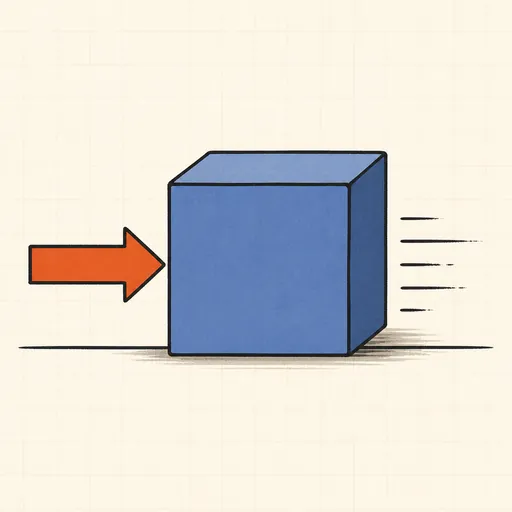
Force Calculator (F = ma)
Solve Newton's second law for force, mass or acceleration.

Kinematics Calculator (SUVAT)
Solve motion problems from any three of u, v, a, t, s.
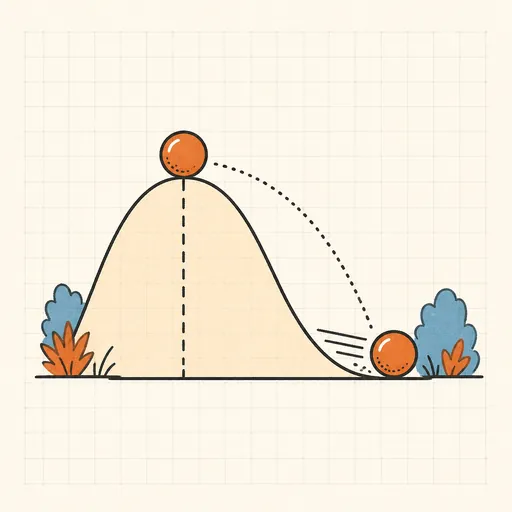
Kinetic & Potential Energy Calculator
KE = ½mv², PE = mgh and total mechanical energy.
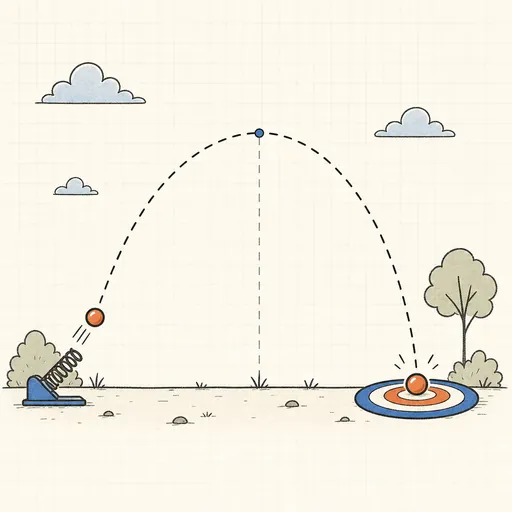
Projectile Motion Calculator
Range, height, flight time and the trajectory curve.
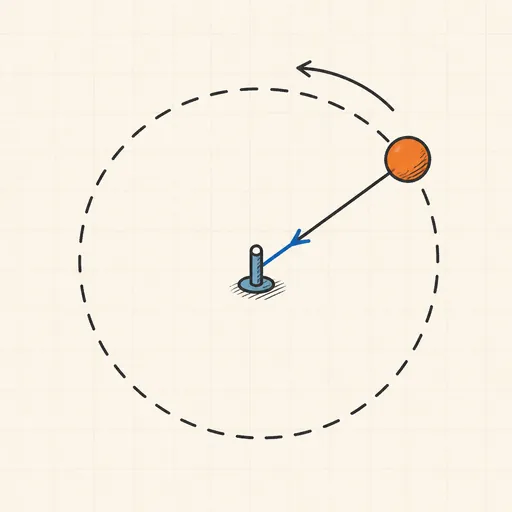
Circular Motion Calculator
Centripetal acceleration, force and angular speed.
Density Calculator (ρ = m/V)
Solve density, mass or volume from the other two.