Density, Explained
After reading this you can solve \rho = m/V for density, mass or volume, convert between the common units, and predict whether an object floats on water.
What density measures
Density is how much mass sits inside a given volume. Two objects can be the same size but very different in mass. A liter of water has a mass of 1 kilogram. A liter of lead has a mass of about 11.3 kilograms. The lead is not bigger, it is denser: its atoms are heavier and packed more tightly.
The symbol for density is the Greek letter rho, written \rho. The relation is a simple ratio.
Here m is mass, V is volume, and \rho is the mass per unit volume. Pick a substance and its density is (for a given temperature and pressure) a fixed property. Copper is 8.96 g/cm³ whether you hold a coin or a cannonball.
The hook that makes density worth calculating: it tells you what floats. Ice is about 0.917 g/cm³, water is 1.00 g/cm³, so ice floats with roughly 8 percent of its volume above the surface. That is the physics behind an iceberg.
When to use this, and when not
Use \rho = m/V when a material is uniform (the same throughout) and you know two of the three quantities. Weigh a metal block, measure its volume, and the ratio identifies the metal. Or take a known density from a table and use it to find the mass of a tank of fuel from its volume.
The formula assumes constant density across the object. It breaks down in three common cases. First, mixtures and porous objects: a loaf of bread has a low average density because of trapped air, not because the dough is light. Second, materials that change with temperature: water is densest near 4 °C at 1.000 g/cm³ and slightly less dense when warmer. Third, gases, whose density depends strongly on pressure. Air at sea level is about 0.00122 g/cm³, roughly 800 times less dense than water.
Density is an intensive property. It does not depend on how much you have. Cut a copper bar in half and each half still has density 8.96 g/cm³, even though the mass and volume both halved.
The formula and its rearrangements
The single relation gives you three formulas depending on what you want. Solve for mass by multiplying both sides by V.
Solve for volume by dividing mass by density.
Every symbol keeps its meaning: m is mass, V is volume, \rho is density. The tool picks the right form from your Solve for choice, but knowing all three by hand lets you check the answer.
The intuition is a rate, like speed. Speed is distance per time; density is mass per volume. If you know a car covers 60 km in 1 hour, you can find distance in any time by multiplying. In the same way, if a substance has 8.96 grams in every cubic centimeter, you get total mass by multiplying that rate by the number of cubic centimeters.
A worked example with the demo numbers
Density from 100 g in 100 cm³
The demo button loads mass 100 g and volume 100 cm³, solving for density. Work it through.
- Write the formula: \rho = m/V.
- Substitute the numbers: \rho = 100 \, \text{g} / 100 \, \text{cm}^3.
- Divide: \rho = 1.00 g/cm³.
The answer is exactly water's density, 1.00 g/cm³. So this material sits right at the floating boundary. In practice it would be neutrally buoyant, neither rising nor sinking.
Now reverse the problem. Suppose you had density 1.00 g/cm³ and wanted the mass of 250 cm³. Use m = \rho \cdot V = 1.00 \times 250 = 250 g. And the volume of 500 g of the same material is V = m/\rho = 500 / 1.00 = 500 cm³. The three forms agree because they are the same equation.
Floating: comparing to water
An object floats on a fluid when its average density is less than the fluid's. Water is the reference at 1.00 g/cm³ (equivalently 1000 kg/m³). So the float test is a single comparison.
When an object floats, the fraction of its volume submerged equals the ratio of its density to the fluid's. Ice at 0.917 g/cm³ floats with 0.917 / 1.00 = 0.917, so 91.7 percent is underwater and 8.3 percent shows. Oak at about 0.75 g/cm³ sits with three quarters submerged. Aluminum at 2.70 g/cm³ has a ratio above 1, so it sinks outright.
The table lists common materials so you can sanity-check any result.
| Material | Density (g/cm³) | Floats on water? |
|---|---|---|
| Cork | 0.24 | Yes |
| Oak wood | 0.75 | Yes |
| Ice | 0.917 | Yes |
| Water | 1.00 | Boundary |
| Aluminum | 2.70 | No |
| Lead | 11.34 | No |
A steel ship floats even though steel is 7.85 g/cm³. What matters is the average density of the whole hull including the enclosed air. Shape the steel into a shell around a large air space and the average drops below 1.00.
See how submersion depends on density
The chart below plots the submerged fraction against object density for anything floating on water. Below 1.00 g/cm³ the fraction rises linearly to 1. At and above 1.00 the object is fully underwater and sinks.
Common mistakes
The errors below account for most wrong answers.
- Mixing units
- Density in g/cm³ needs mass in grams and volume in cm³. If your mass is in kilograms, convert first:
2kg is2000g. A mass in kg divided by a volume in cm³ gives a number 1000 times too big. - Confusing cm³ and mL
- These are equal:
1cm³ =1mL. But a liter is1000cm³, not100. A 2 L bottle is2000cm³. - Forgetting the kg/m³ conversion
1g/cm³ equals1000kg/m³. Water is1000kg/m³ in SI units. Reading a table in kg/m³ and treating it as g/cm³ inflates the answer by 1000.- Using outer volume for a hollow object
- The float test needs average density, mass divided by the total volume displaced. A sealed hollow ball displaces its full outer volume even though much of it is air.
- Weight versus mass
- Density uses mass, not weight. On the Moon a rock weighs less but its density is unchanged, because both its mass and volume are the same.
Related tools
Density feeds directly into fluid problems. Once you know density, the Pressure & Buoyancy Calculator gives the upward force on a submerged object using Archimedes' principle and the pressure at a given depth.
Mass, the numerator here, is also the input to motion problems. Use the Force Calculator to turn a mass into a force from F = ma, the Kinetic & Potential Energy Calculator for KE = \tfrac{1}{2}mv^2, and the Momentum & Collision Calculator when that mass collides with another.
Frequently asked questions
What is the density of water in different units?
Water at room temperature is 1.00 g/cm³, which equals 1.00 g/mL, 1000 kg/m³, and 1.00 kg/L. All four describe the same substance.
How do I find volume if I only have mass and density?
Rearrange to V = m/\rho. For 200 g of aluminum at 2.70 g/cm³, the volume is 200 / 2.70 = 74.07 cm³.
Why does ice float when solid water should be denser?
Water is unusual. When it freezes, the molecules lock into an open crystal structure that takes more space, so ice at 0.917 g/cm³ is less dense than liquid water at 1.00 g/cm³. That is why ice floats and why pipes burst when water freezes inside them.
Does temperature change density?
Yes, but usually by a small amount for solids and liquids. Water drops from 1.000 g/cm³ near 4 °C to about 0.958 g/cm³ at 100 °C, a change of roughly 4 percent. Gases change far more because they expand freely.
How do I know if something floats without measuring it?
Compare its density to the fluid. On water, anything below 1.00 g/cm³ floats and anything above sinks. On mercury at 13.6 g/cm³, even iron and lead float.
Related tools
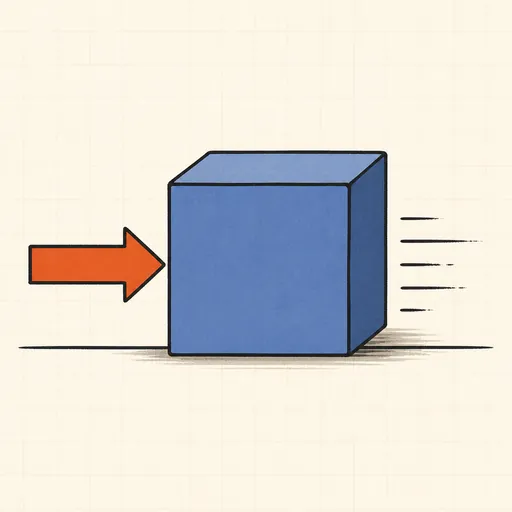
Force Calculator (F = ma)
Solve Newton's second law for force, mass or acceleration.
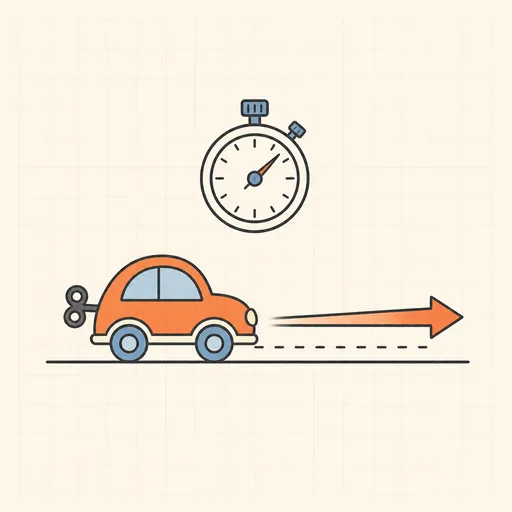
Kinematics Calculator (SUVAT)
Solve motion problems from any three of u, v, a, t, s.
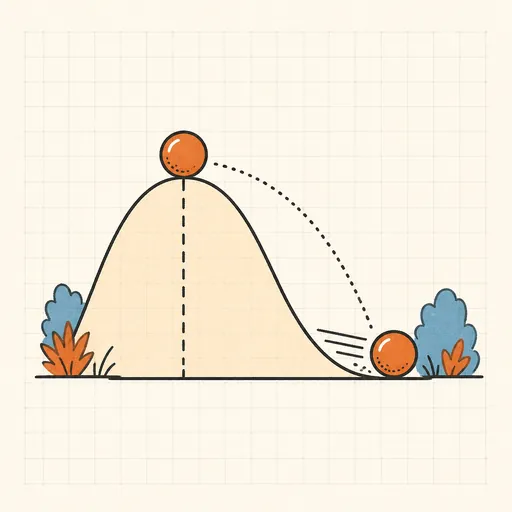
Kinetic & Potential Energy Calculator
KE = ½mv², PE = mgh and total mechanical energy.
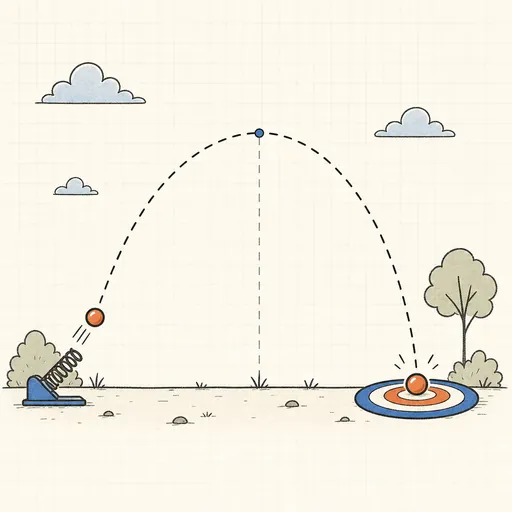
Projectile Motion Calculator
Range, height, flight time and the trajectory curve.
Circular Motion Calculator
Centripetal acceleration, force and angular speed.
Free Fall Calculator
Fall time and impact speed from a height, or vice versa.