Scientific Notation and Significant Figures
After reading this you can write any number in scientific, E or engineering notation, count its significant figures, and round it to a chosen precision without introducing errors.
What scientific notation is
Scientific notation writes a number as a coefficient between 1 and 10 multiplied by a power of ten. The speed of light in a vacuum is 299792458 metres per second. In scientific notation that is 2.99792458 \times 10^{8}. The coefficient 2.99792458 carries the digits, and the exponent 8 records the scale.
The point of the format is that scale and digits live in separate places. You read the exponent to know how big the number is, and you read the coefficient to know its value. A number like 0.0000000000667 (the gravitational constant, roughly) becomes 6.67 \times 10^{-11}, which is far easier to compare and manipulate.
Two close cousins share the same idea. E notation replaces \times 10^{8} with E8, so the speed of light is 2.99792458E8. That is what calculators and programming languages print. Engineering notation forces the exponent to a multiple of 3, matching the SI prefixes. The speed of light becomes 299.792458 \times 10^{6}, or about 299.8 mega (M).
When to use it, and when not to
Reach for scientific notation when numbers span many orders of magnitude or carry long strings of leading or trailing zeros. Distances in astronomy, masses in chemistry, and tolerances in engineering all fit this description. Writing 6.022 \times 10^{23} beats writing 602200000000000000000000, and it makes the precision explicit: four figures, not twenty-four.
Skip it for ordinary values in everyday range. A price of 19.99, a count of 42 apples, or a temperature of 98.6 degrees reads better in plain decimal. Scientific notation on such numbers adds friction without adding clarity.
Engineering notation pairs directly with unit prefixes. An exponent of -6 is micro, -3 is milli, 3 is kilo, 6 is mega, 9 is giga. If you read a data sheet in prefixes, engineering notation is the format that matches it digit for digit.
The conversion, step by step
To convert a positive number to scientific notation, shift the decimal point until exactly one nonzero digit sits to its left, then count how far you moved it.
Here x is the original number, c is the coefficient, and n is the exponent. If you moved the decimal point left by n places, the exponent is +n. If you moved it right, the exponent is -n. For 299792458 the decimal point starts after the final 8. Moving it left to sit after the first 2 takes 8 places, so n = 8 and the coefficient is 2.99792458.
For engineering notation, keep sliding by whole steps of 3 until the exponent is a multiple of 3. Since 8 is not a multiple of 3, drop to 6 and move two extra digits into the coefficient: 299.792458 \times 10^{6}. The coefficient of engineering notation can range from 1 up to just below 1000.
Significant figures
Significant figures are the digits in a number that carry real information about its precision. The rules are worth stating plainly, because the edge cases trip people up.
- Nonzero digits
- Always significant.
3.14has three. - Zeros between nonzero digits
- Always significant.
1002has four. - Leading zeros
- Never significant. They only place the decimal.
0.0025has two significant figures. - Trailing zeros with a decimal point
- Significant.
2.50has three;0.004500has four. - Trailing zeros with no decimal point
- Ambiguous.
4500could have two, three or four. Scientific notation removes the doubt.
That last row is the strongest argument for the notation. Write 4.5 \times 10^{3} for two figures, 4.50 \times 10^{3} for three, or 4.500 \times 10^{3} for four. The coefficient shows exactly how many digits you trust.
Rounding to a chosen number of figures
To round a number to n significant figures, find the first n significant digits, then look at the digit immediately after them. If that next digit is 5 or more, round the last kept digit up; otherwise leave it. Fill any remaining integer places with zeros and drop the rest.
Take 299792458 rounded to 3 significant figures. The first three significant digits are 2, 9, 9. The next digit is 7, which is 5 or more, so the third digit rounds up from 9 to 10, carrying into the second: 299 becomes 300. The result is 300000000, or 3.00 \times 10^{8}. Note the two trailing zeros in the coefficient: they say the precision is three figures, not one.
Rounding once is not the same as rounding repeatedly. Rounding 2.449 to two figures directly gives 2.4, because the digit after the 4 is another 4. If you first round to three figures (2.45) and then to two, you get 2.5. Always round from the original value in a single step.
Reproducing the demo: 299792458 to scientific notation
Set Mode to To scientific notation and enter 299792458, which is the demo data.
- Locate the decimal point. It sits at the far right:
299792458. - Move it left until one nonzero digit remains on the left. That lands between the first
2and the first9, after 8 moves. - The exponent equals the number of moves: n = 8.
- The coefficient is the shifted digits:
2.99792458. - Assemble the result: 2.99792458 \times 10^{8}, printed as
2.99792458E8.
For engineering notation, back the exponent down to the nearest lower multiple of 3, which is 6, and move two digits into the coefficient: 299.792458 \times 10^{6}, or about 299.8 M. The value has 9 significant figures throughout.
Reading the results and the sign traps
When you read a converted value, check three things: the sign of the coefficient, the size of the exponent, and its sign. A negative number keeps its sign on the coefficient, so -0.0042 becomes -4.2 \times 10^{-3}. The exponent is negative because the number is smaller than 1, and the coefficient is negative because the value is below zero. The two signs are independent.
Zero has no scientific-notation form with a coefficient in the standard range, so it is written as 0. Very small positive numbers get negative exponents: 0.00667 is 6.67 \times 10^{-3}. A common slip is reading the count of decimal places instead of the shift distance. For 0.00667 the first nonzero digit is in the third decimal place, so the exponent is -3, and the coefficient is 6.67.
Common mistakes
The frequent errors are small and mechanical. Watch for these.
- Coefficient out of range. 29.98 \times 10^{7} is a valid number but not standard scientific notation, because the coefficient must satisfy 1 \le |c| \lt 10. The correct form is 2.998 \times 10^{8}.
- Losing trailing zeros when rounding. Rounding
299792458to three figures gives3.00 \times 10^8, not3 \times 10^8. Dropping the zeros throws away the precision claim. - Confusing engineering notation with fixed prefixes. Engineering notation permits coefficients up to
999.999..., so470 000ohms is 470 \times 10^{3}, that is 470 kilo, not0.47mega, even though both describe the same resistance. - Miscounting the shift for numbers below 1. Move the decimal to just after the first nonzero digit and count every place, including the zero before the decimal point.
Related tools
If you need exact arithmetic on numbers with hundreds or thousands of digits rather than a rounded coefficient, use the Big Number Calculator. To write a value in binary, octal or hexadecimal instead of base ten, see the Number Base Converter. For turning a decimal into an exact fraction or continued fraction, the Fraction, Decimal and Continued Fraction converter does that directly. And to break an integer into primes or find a GCD, try Prime Factorization and Number Theory.
Frequently asked questions
How many significant figures does 4500 have?
Without more context it is ambiguous: anywhere from two to four. Trailing zeros in an integer with no decimal point could be placeholders or measured digits. Write it in scientific notation to fix the count: 4.5 \times 10^{3} for two, 4.500 \times 10^{3} for four.
What is the difference between E notation and scientific notation?
They express the same value. E notation replaces \times 10^{n} with the letter E followed by the exponent, so 6.022 \times 10^{23} becomes 6.022E23. It exists because calculators and text formats cannot show a raised exponent.
Why does engineering notation force exponents to multiples of 3?
Because the SI prefixes step in factors of 1000: milli (-3), micro (-6), kilo (3), mega (6). Keeping the exponent a multiple of 3 lets you read the prefix straight off it. 2.2 \times 10^{-5} farads becomes 22 \times 10^{-6}, that is 22 microfarads.
Does rounding change the number of significant figures?
Yes, that is its purpose. Rounding 2.99792458 to three significant figures gives 3.00, a value with exactly three trusted digits. The trailing zeros are kept to show the precision you chose.
How do I round a number that ends in exactly 5?
The common rule rounds the last kept digit up. So 2.45 to two figures gives 2.5. Some fields use "round half to even" to avoid bias, which would give 2.4 here because 4 is even. State which rule you use when it matters.
Related tools
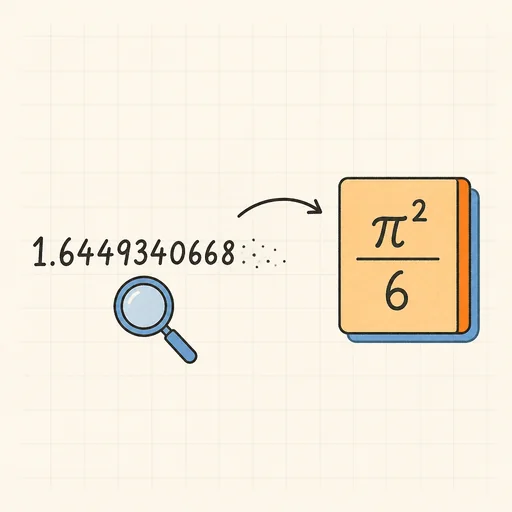
Inverse Symbolic Calculator
Paste a decimal, get its closed form: 1.6449340668 → π²/6. Also names integer sequences.
Number Base Converter
Binary, octal, decimal, hex and any base from 2 to 36.
Prime Factorization & Number Theory
Prime factors, divisors, GCD/LCM and modular arithmetic.
Big Number Calculator
Exact arithmetic with thousands of digits: +, −, ×, ÷, ^, fact().
Fraction ↔ Decimal ↔ Continued Fraction
Exact conversions with repeating decimals and convergents.

Roman Numeral Converter
Numbers to Roman numerals and back, with validation.