Derivatives and Integrals, Explained
After reading this you will know how to differentiate and integrate an expression symbolically, how to read the exact answers, and where the calculator will hand you an antiderivative that no elementary formula can produce.
What this calculator does
A derivative measures how fast a function changes. An integral adds up its accumulated value. This calculator does both symbolically, meaning it returns exact formulas rather than decimal approximations.
Take the demo expression f(x) = x^2 \sin(x). Its derivative is
Every symbol in that answer comes from a rule you can check by hand. The point of a symbolic engine is that it applies those rules perfectly, even when the expression is long enough that doing it by hand invites sign errors.
The calculator supports three modes: the derivative of any order, the indefinite integral (an antiderivative plus a constant), and the definite integral (an exact number or symbol over bounds you choose).
When to use it, and when not to
Use the symbolic mode when you want an exact expression: a derivative to find slopes and extrema, or an antiderivative you plan to reuse. Exact means \int_0^{\pi} \sin(x)\, dx = 2, not 1.9999.
Do not use it when the integrand has no closed-form antiderivative. The classic example is e^{-x^2}. There is no combination of elementary functions whose derivative equals it. For those, switch to the Numerical Integrator, which computes the definite integral by adaptive quadrature.
A definite integral can be a finite number even when the antiderivative is not elementary. \int_{-\infty}^{\infty} e^{-x^2}\, dx = \sqrt{\pi} \approx 1.7725. The symbolic engine knows this special case, but many others require numerical work.
The rules behind the answers
Differentiation rests on a few rules applied repeatedly. The product rule handles a product of two functions:
Here u and v are the two factors, u' and v' their derivatives. For x^2 \sin(x), set u = x^2 and v = \sin(x), so u' = 2x and v' = \cos(x). Substituting gives the derivative shown above.
Integration reverses differentiation. The fundamental theorem of calculus ties the two together:
F is any antiderivative of f. The constant of integration cancels in the subtraction, which is why definite integrals give a single clean value while indefinite integrals always carry a + C.
A worked example with the demo data
Differentiating x^2 sin(x)
Set Mode to Derivative, Expression to x^2 * sin(x), Variable to x, and Derivative order to 1. Press Calculate.
- Identify the factors: u = x^2 and v = \sin(x).
- Differentiate each: u' = 2x and v' = \cos(x).
- Apply the product rule: u'v + uv' = 2x\sin(x) + x^2\cos(x).
Check one point. At x = \pi/2 \approx 1.5708, \sin(\pi/2) = 1 and \cos(\pi/2) = 0, so the derivative is 2 \cdot 1.5708 \cdot 1 + 0 = 3.1416. The function is climbing at a slope of about 3.14 there.
Higher orders and the definite case
Set the order to 2 and the calculator differentiates twice. For x^2 \sin(x) the second derivative is
Higher derivatives feed extrema and inflection tests. If you want that analysis packaged, the Function Analyzer & Grapher reports zeros, extrema and inflection points directly.
For a definite integral, choose the Definite integral mode and enter bounds. The bounds accept symbols. Type pi for \pi and oo for infinity. Integrating \sin(x) from 0 to pi gives
How to read the results
- Indefinite integral
- An antiderivative. It always leaves out an additive constant. The calculator may return
-cos(x)where you expected-cos(x) + C. Both are correct; the family differs only by a constant. - Equivalent forms
- A symbolic answer can look different from your hand result yet still be equal. For example \sin^2(x) and \tfrac{1}{2}(1 - \cos(2x)) match at every point. Plug in a test value to confirm.
- Exact symbols
- Answers keep \pi, e and roots intact. \int_0^1 x^2\, dx = \tfrac{1}{3} stays as one third, not
0.3333.
Common mistakes
Watch the multiplication sign. Writing x^2 sin(x) without the * can be misread. Use x^2 * sin(x). Likewise 2x should be 2*x.
Match the variable. If your expression uses t but the variable field says x, the calculator treats t as a constant, so its derivative comes out zero. Set the variable to the letter you actually vary.
An improper integral can diverge. \int_1^{\infty} \tfrac{1}{x}\, dx grows without bound, so the answer is infinite. But \int_1^{\infty} \tfrac{1}{x^2}\, dx = 1 converges. The exponent decides: powers steeper than 1/x settle to a finite area.
Do not confuse ln and log. In this calculator ln(x) is the natural logarithm. Its derivative is 1/x, and \int \tfrac{1}{x}\, dx = \ln|x|. The absolute value matters for negative x.
Related tools
Once you have a derivative, several nearby calculators build on it. The Taylor & Maclaurin Series tool uses successive derivatives to expand a function into a polynomial around a point. The Limit Calculator handles the limits that define derivatives and that decide whether an improper integral converges.
For functions of several variables, the Gradient & Hessian Calculator extends the derivative to the gradient vector and second-derivative matrix. If your problem involves derivatives set equal to a function, the Differential Equation Solver finds symbolic solutions. To see how a numerical integral is assembled from rectangles, the Riemann Sum Calculator compares left, right and midpoint sums against the exact value. And the Interpolation Calculator fits a smooth function through data points before you differentiate or integrate it.
Frequently asked questions
Why does my indefinite integral not include + C?
The engine returns one antiderivative. Every valid answer differs from it only by a constant, so add + C yourself when you need the general form. For definite integrals the constant cancels and never appears.
Why did the calculator give no closed-form answer?
Some integrands, like e^{-x^2}, \tfrac{\sin(x)}{x} and \sqrt{1 + x^3}, have no antiderivative expressible with elementary functions. Use the numerical integrator to get a decimal value over specific bounds.
How do I enter infinity as a bound?
Type oo (two lowercase letter o's) for positive infinity and -oo for negative infinity. The calculator then evaluates the improper integral as a limit and tells you whether it converges.
My answer looks different from the textbook. Is it wrong?
Probably not. Trigonometric and logarithmic identities produce many equal forms. Pick a test value, say x = 1, and evaluate both expressions. If they agree there and at a second point, they are the same function.
Can I differentiate with respect to a variable other than x?
Yes. Set the variable field to that letter. Any other letters in the expression are held constant, so their derivative contribution is zero.
Related tools
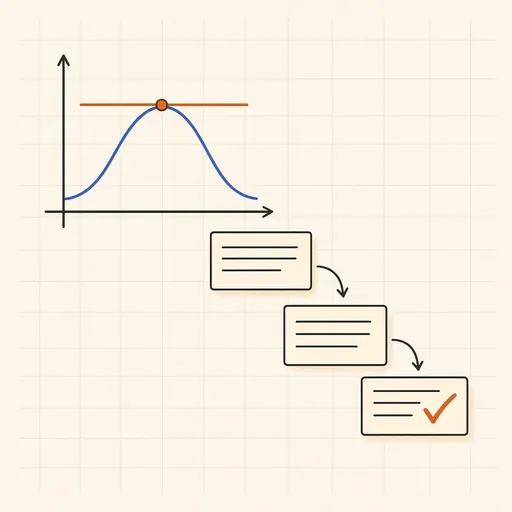
Derivative Calculator with Steps
Differentiate any function with every rule shown: power, product, quotient and chain rule, step by step.
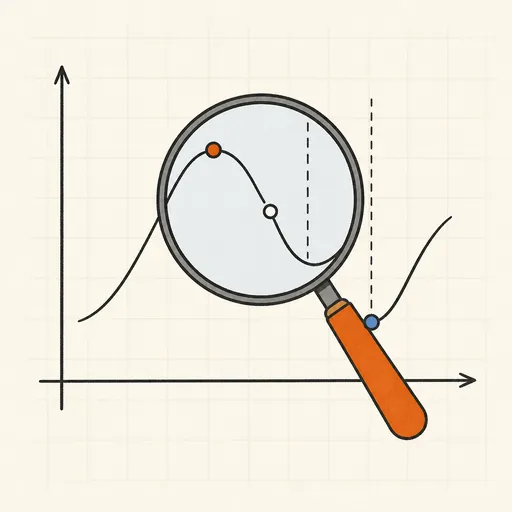
Function Analyzer & Grapher
Zeros, extrema, inflection points and asymptotes, with graphs.
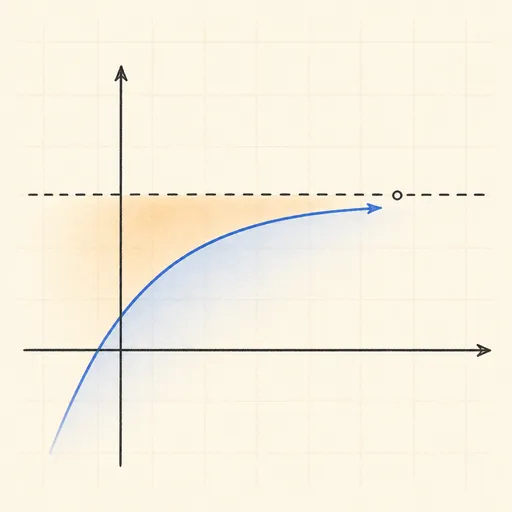
Limit Calculator
Limits at a point or infinity, one-sided or two-sided.
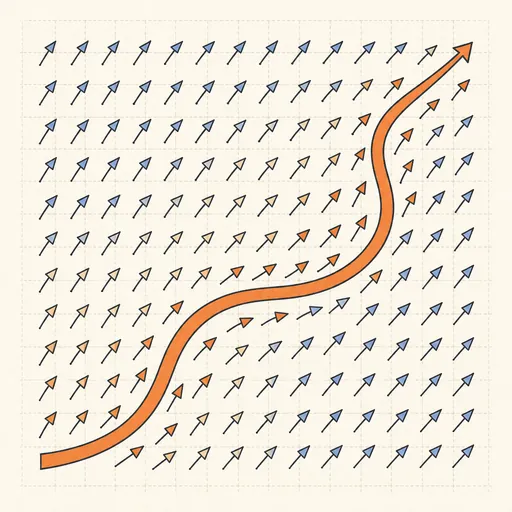
Differential Equation Solver
Symbolic solutions of first and second order ODEs.

Interpolation Calculator
Linear or cubic-spline interpolation through data points.
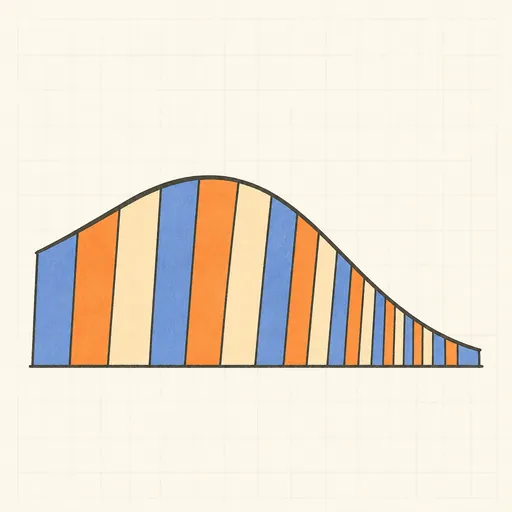
Numerical Integrator
∫f(x)dx on [a, b] by adaptive quadrature, Simpson or trapezoid.