The Step-by-Step Algebra Solver, Explained
Read this to understand what "show every step" really means: which rule fires at each line, why extraneous roots appear, and how to check any answer yourself by substitution.
The Step-by-Step Algebra Solver takes an equation, a system or an expression and writes out the work the way a teacher writes it on a board. Type 3(x - 2) = 2x + 7 and you get a chain of lines that ends at x = 13, with each line justified by one operation. The value is not the final answer alone. It is seeing which move you would have made and why.
This guide explains the concepts behind the steps: inverse operations, the zero-product property, the quadratic formula, and the domain restrictions that create extraneous roots. Once you know those, the output reads like a proof you could have written.
What the solver does and when to use it
Give it an equals sign and it solves. Leave the equals sign out and it rewrites: expand, factor or simplify. The equation types it handles cover most of a first and second algebra course.
- Linear
- One variable to the first power, for example
3(x - 2) = 2x + 7. Exactly one solution unless the variable cancels. - Quadratic
- Highest power 2, solved by factoring, the quadratic formula or completing the square.
- Higher-degree polynomial
- Degree 3 and up, attacked with the rational root theorem, then factoring or numeric approximation.
- Rational, radical, absolute-value
- Equations with variables in a denominator, under a root, or inside
|...|. Each carries a domain restriction that must be checked. - Exponential and logarithmic
- Solved by taking logs or exponentiating, for example 2^x = 40.
- Systems
- Two or more equations solved together by substitution or Gaussian elimination.
Use it when you want the reasoning, not just the number. If you only need a root, a determinant or a decomposition, a specialized tool is faster: the Quadratic solver for discriminant and vertex, the Equation solver for polynomial roots and A \cdot x = b, and the Matrix calculator for RREF and eigenvalues.
Trigonometric equations and other unusual forms fall back to the computer algebra system, so you get the answer without a textbook walkthrough. Everything in the list above gets the full line-by-line treatment.
The rules behind each step
Every step is one legal move. There are only a handful, and each equation type leans on a specific one.
Inverse operations on both sides. To isolate a variable you undo what surrounds it, applying the same operation to both sides. Subtract 5, divide by 3, take a square root. This is the whole of linear solving.
The zero-product property. If a product equals zero, at least one factor is zero. Written as a formula:
Here a and b are the factors of the expression. This is why factoring solves quadratics: once (x-3)(x+2) = 0, the roots are 3 and -2.
The quadratic formula. When a quadratic will not factor over the rationals, this always works for ax^2 + bx + c = 0:
The quantity b^2 - 4ac is the discriminant. If it is positive you get two real roots, if zero one repeated root, if negative two complex roots. For x^2 - 4x + 1 = 0 the discriminant is 16 - 4 = 12, so the roots are 2 \pm \sqrt{3}, about 3.732 and 0.268.
Worked example: 3(x - 2) = 2x + 7
Reproducing the demo
This is the sample the demo button loads. Set the mode to auto: the solver sees the equals sign and solves.
- Start:
3(x - 2) = 2x + 7. - Distribute the 3 on the left:
3x - 6 = 2x + 7. - Subtract
2xfrom both sides:x - 6 = 7. - Add 6 to both sides:
x = 13. - Check by substitution: left side
3(13 - 2) = 3 · 11 = 33, right side2 · 13 + 7 = 33. Both equal 33, sox = 13is confirmed.
The check in step 5 is not decoration. It is how the solver certifies every answer, and for radical and rational equations it is where wrong candidates get thrown out.
Why extraneous roots appear
Some operations are not reversible. Squaring both sides and clearing a denominator can invent solutions that do not satisfy the original equation. The solver keeps them, tests them, and rejects the ones that fail.
Take \sqrt{x + 6} = x. Squaring gives x + 6 = x^2, so x^2 - x - 6 = 0, which factors as (x-3)(x+2) = 0. The candidates are 3 and -2.
- Check
x = 3: \sqrt{9} = 3. True. - Check
x = -2: \sqrt{4} = 2, but the right side is-2.2 ≠ -2, so-2is extraneous.
Squaring turned -2 into a false positive because it erased the sign. The same thing happens with logs, where any candidate that makes an argument zero or negative is rejected, and with rational equations, where a candidate that zeros a denominator is thrown out.
Never skip the substitution check on radical, rational, log or absolute-value equations. Roughly one candidate in these families can be extraneous. Skipping the check is the single most common way to hand in a wrong answer that "looked solved".
Systems and the two solving strategies
Two linear equations are solved by substitution: isolate one variable, put it into the other equation, back-substitute. Larger systems use Gaussian elimination on the augmented matrix, row-reducing until the solution reads off directly. A linear plus non-linear pair (a line and a circle, say) is solved by substitution.
Consider the system x + y = 5 and 2x - y = 1. Add the two equations to cancel y: 3x = 6, so x = 2, and then y = 3. Substituting back, 2 + 3 = 5 and 4 - 3 = 1. Both hold.
Geometrically each linear equation is a line, and the solution is where they cross. Parallel lines never cross (no solution), identical lines cross everywhere (infinitely many solutions). Gaussian elimination detects both cases as a row that reduces to 0 = 1 or 0 = 0.
Interpreting the output
The number of solutions tells you the shape of the problem. A linear equation gives one solution, or none if the variable cancels to a false statement like 0 = 4, or all reals if it cancels to 0 = 0. A quadratic gives up to two, a cubic up to three.
Switch the number domain to complex and a negative discriminant produces two conjugate roots instead of none. For x^2 + 1 = 0 the real domain returns "no real solution", while the complex domain returns x = \pm i. Choose the domain that matches your course.
Common mistakes
Dividing by a variable. Solving x^2 = 3x by dividing both sides by x gives x = 3 and silently loses the root x = 0. Move everything to one side instead: x^2 - 3x = 0, factor to x(x - 3) = 0, roots 0 and 3.
Distributing a square. (x + 3)^2 is not x^2 + 9. It is x^2 + 6x + 9. Set the mode to expand and the solver shows the FOIL product term by term.
Sign errors in the quadratic formula. The numerator is -b, so for x^2 - 5x + 6 you use -(-5) = 5, not -5. The roots are 2 and 3, which you can confirm because 2 · 3 = 6 and 2 + 3 = 5.
Forgetting the base convention. On this site log(x) and ln(x) both mean the natural logarithm. Write log10(x) or log2(x) for other bases.
Related tools
When you want a specific rewrite rather than a solution, reach for the focused tool. The Polynomial toolkit factors, expands and divides with remainder. Partial fraction decomposition splits a rational expression for integration. The Inequality solver returns interval notation for \lt and \gt problems. For roots and powers, use the Exponent and logarithm calculator and the Radical simplifier. When answers are complex, the Complex number calculator handles polar form and nth roots. For advanced matrix work behind large systems, see Matrix decompositions, the Vector calculator and the Sequence calculator.
Frequently asked questions
Why did the solver reject a root it just found?
That root is extraneous. It came from squaring both sides or clearing a denominator, steps that can create false candidates. When substituted into the original equation it fails, so it is rejected. The example \sqrt{x+6} = x rejects -2 for exactly this reason.
How do I choose the quadratic method?
Leave it on auto and the solver factors when the roots are rational, otherwise it uses the quadratic formula. Force completing the square when you want to see the vertex form, or force the formula when you want the discriminant spelled out.
Can it solve for a specific variable in a formula?
Yes. Put the variable name in the solve-for field. For A = P(1 + r*t) solving for t gives t = \frac{A - P}{Pr}, with each isolation step shown.
What happens with a cubic that has no rational roots?
The solver tries the rational root theorem first. If no rational root exists, it factors over the rationals where possible and approximates the real roots numerically to 10 digits.
Does simplify mode reduce fractions too?
Yes. Without an equals sign, simplify mode combines and reduces rational expressions and shows each rewrite. For example \frac{x^2 - 1}{x - 1} simplifies to x + 1 with the difference-of-squares factoring shown first.
Related tools

Equation Solver
Polynomial roots and linear systems A·x = b.
Exponent & Logarithm Calculator
Logarithms to any base, exponential equations and nth roots.
Matrix Calculator
Determinant, inverse, rank, RREF and eigenvalues.

Quadratic Equation Solver
Exact roots, discriminant, vertex and factored form.
RREF Calculator with Steps
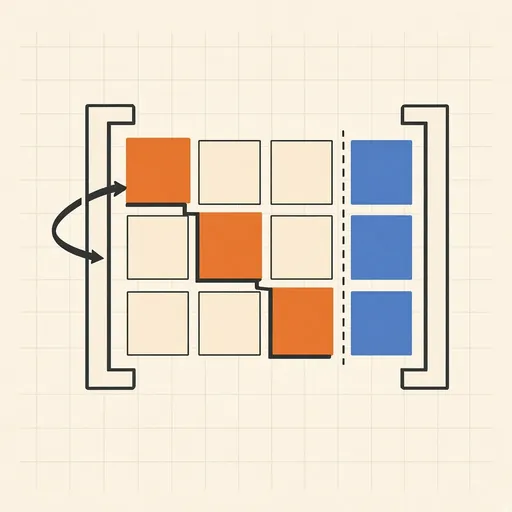
Row-reduce any matrix with every row operation shown: RREF, row echelon form, the inverse and the determinant.

Sequence Calculator
Arithmetic, geometric and Fibonacci: nth term and sums.