Down Payment and LTV, Explained
After reading this you can move between three numbers (down payment percent, down payment amount, and loan-to-value ratio) starting from whichever one you already know, and read what each says about your mortgage.
What this calculator does
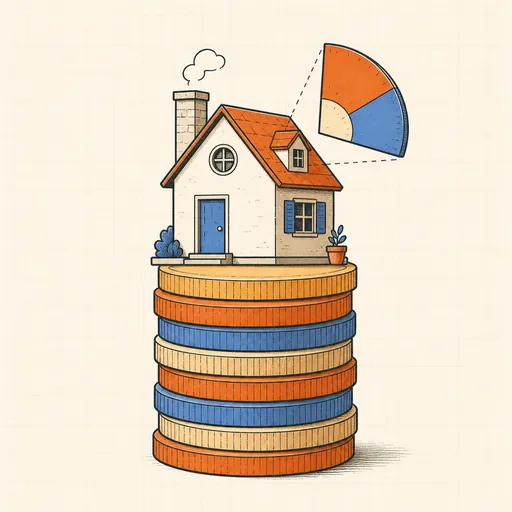
Three numbers describe the cash side of a home purchase: the price, the down payment (in dollars or as a percent of price), and the loan amount. Fix the price and any one of the others, and the rest are forced. That is the down-payment triangle.
The loan-to-value ratio, or LTV, ties them together. It is the loan divided by the price. On a 300000 home with 60000 down, the loan is 240000 and the LTV is 240000 / 300000 = 0.80, so 80%. Lenders watch LTV closely because it measures how much of the risk sits with them rather than with you.
The tool solves in three directions. You can start from a percent, from a saved cash amount, or from a target LTV and a known loan. Each path lands on the same triangle from a different corner.
When to use it, and when not
Use it early, while you are still saving and comparing homes. If you know you can put aside 45000, the tool tells you that on a 300000 home that is 15% down and a 85% LTV loan of 255000. That single fact shapes which rate tier you qualify for and whether mortgage insurance applies.
Do not treat the output as your full cash requirement. The down payment is one line in the closing budget. Closing costs, prepaid taxes, insurance, and moving all sit outside this triangle. This calculator answers "how do price, down payment, and loan relate," not "how much cash do I need on closing day."
LTV and down-payment percent are two views of the same split. On a purchase they add to 100%: 20% down means 80% LTV, 10% down means 90% LTV. They diverge later, because as you repay principal the loan shrinks while the original price stays fixed, so LTV drops below 100% - down payment %.
The formulas and the intuition
Start with the definition of LTV:
Here loan is the amount you borrow and price is the purchase price. LTV is a fraction, usually shown as a percent. A higher LTV means you borrowed more relative to the home's value, so the lender's cushion is thinner.
The down payment is simply the part of the price you cover in cash:
Divide both sides by price and the two views line up:
So the down-payment percent and LTV must sum to 100% at purchase. If you know the target LTV and the loan, recover the price by rearranging the first formula:
With a loan of 240000 and a target LTV of 0.80, the price is 240000 / 0.80 = 300000, and the down payment is 300000 - 240000 = 60000. Every path closes on the same three numbers.
Worked example: the demo numbers
The demo uses a 300000 price with 20% down. Follow the percent path.
- Down payment amount:
300000 × 0.20 = 60000. - Loan amount:
300000 - 60000 = 240000. - LTV:
240000 / 300000 = 0.80, so 80%.
Now start from the saved amount instead. You have 60000:
- Percent of price:
60000 / 300000 = 0.20, so 20%. - Loan:
300000 - 60000 = 240000. - LTV:
0.80, unchanged.
Finally start from the LTV path with loan 240000 and target LTV 80%:
- Price:
240000 / 0.80 = 300000. - Down payment:
300000 - 240000 = 60000, which is 20%.
All three corners return the identical triangle. That is the check: the numbers must agree no matter where you enter.
How the pieces move together
Hold the price at 300000 and watch what a bigger down payment does. Every extra dollar down is a dollar less borrowed, so the loan falls one for one and LTV falls with it.
| Down % | Down amount | Loan | LTV |
|---|---|---|---|
| 5% | 15000 | 285000 | 95% |
| 10% | 30000 | 270000 | 90% |
| 15% | 45000 | 255000 | 85% |
| 20% | 60000 | 240000 | 80% |
| 25% | 75000 | 225000 | 75% |
The relationship is a straight line: for a fixed price, LTV is 1 minus the down-payment fraction. There is nothing curved or surprising about it. What matters is where the thresholds fall, and 80% is the classic one in many markets.
Reading and interpreting the result
The LTV number is the one lenders react to, so read it first. Thresholds tend to cluster. Crossing below 80% often moves you into a better rate tier and, in many markets, removes the requirement for mortgage insurance on the loan. Sitting at 80.5% is expensive in a way that 79.5% is not, even though the down payments differ by only half a percent of price.
Read the loan amount second, because it drives the monthly payment. On the demo, the 240000 loan is what you feed into a Mortgage Calculator to see the payment, interest, and amortization. The down payment amount is the cash figure to line up against your savings.
If your saved amount lands just above a threshold, check both sides. Suppose you have 63000 for a 300000 home. That is 21% down and 79% LTV, already under the 80% line. Putting in more than the threshold requires buys no rate benefit here; the extra 3000 might work harder in your closing-cost budget or emergency fund.
Common mistakes
The first mistake is confusing LTV with the down-payment percent later in the loan. They match only at purchase. After you pay down principal, LTV is measured against the original price (or a new appraisal), not against your down payment, so it keeps falling as the balance drops. See how fast the balance falls with a Mortgage Extra Payment Calculator.
The second mistake is solving the LTV path against the wrong denominator. LTV uses price, not the loan. Dividing by the loan gives a number always equal to 1, which is meaningless. If you enter a loan of 240000 and a target LTV of 80%, the price the tool returns is 300000, not 240000.
The third mistake is treating the down payment as your total cash need. It is not. Closing costs commonly run a few percent of price on top. Budget them separately, and use a Home Affordability Calculator to check that the payment fits your income before you commit the cash.
Related tools
Once you have the loan amount, the Mortgage Calculator turns it into a monthly payment. If you are still deciding whether to buy at all, the Rent vs Buy Calculator compares long-run costs, and the Rent Affordability Calculator checks the rental side against income. When a purchase is underway, the Mortgage Refinance Calculator and the Biweekly Mortgage Calculator handle later decisions. For comparing two properties on floor area, use the Price per Square Meter Calculator, and for a partial first month, the Prorated Rent Calculator.
Frequently asked questions
Is a 20% down payment required?
No. Many loans allow far less, sometimes 5% or 3%. The 20% figure matters because it puts LTV at 80%, the level that in many markets removes mortgage insurance and leads to better rates. Putting less down is possible; it usually costs more per month.
What is a good LTV?
Lower is cheaper for you, since the lender carries less risk. Below 80% is the common target. There is no single correct number; it depends on your rate tiers and how much cash you want to keep in reserve.
Does the down payment reduce my interest rate?
Indirectly. A larger down payment lowers LTV, and lenders often price lower LTV loans at lower rates. The rate follows the LTV tier, not the raw dollar amount, so crossing a threshold like 80% is what matters.
Why does the LTV path ask for the loan instead of the price?
That path exists for when you know how much you want to borrow and a target LTV, but not the price. Dividing the loan by the LTV gives the price: 240000 / 0.80 = 300000. The other two paths start from price instead.
Do the down payment percent and LTV always add to 100%?
At the moment of purchase, yes: 15% down means 85% LTV. Afterward they drift apart, because principal payments shrink the loan while the purchase price stays fixed, so LTV keeps dropping.
Related tools
Home Affordability Calculator
Maximum home price your income supports.
Mortgage Calculator
Payment, interest, LTV and full amortization.
Rent vs Buy Calculator
Long-run cost of renting against buying.

Mortgage Extra Payment Calculator
Years and interest cut by overpaying the mortgage.
Mortgage Refinance Calculator
Current loan vs a refinance offer, with break-even.
Rent Affordability Calculator
30% rule and the 3x-rent rule, both directions.