Deposit / CD Calculator, Explained
After reading this you can compute the maturity value of a fixed-term deposit by hand, check what your bank tells you, and understand why two deposits with the same headline rate can pay different amounts.
What a certificate of deposit is
A certificate of deposit (CD) is a deposit you agree to leave with a bank for a fixed term at a fixed rate. In exchange for locking the money away, the bank pays a rate it will not change during the term. A fixed-term bank deposit works the same way.
Here is the hook. You put in 10000 at 4.5% for 12 months, compounded monthly. At the end you have 10459.40, so you earned 459.40. If the same rate compounded only once a year, you would earn 450.00 instead. The extra 9.40 comes entirely from compounding more often. That gap is the whole reason compounding frequency matters, and it grows with the rate and the term.
When to use this and when not
Use this calculator when the rate is fixed for the whole term and you plan to leave the money untouched until maturity. That describes most CDs and term deposits.
Do not use it for these cases:
- A savings account with a rate the bank can change. The number here assumes the rate holds.
- A deposit where you add money over time. For a lump sum plus regular contributions, use the Compound Interest Calculator.
- Anything where you might withdraw early. Early withdrawal usually forfeits some interest, and this figure assumes you hold to maturity.
The maturity value assumes you do not touch the deposit before the term ends. If you break a CD early, most banks claw back several months of interest, so your real return can fall well below the number shown here.
The formula and why it looks that way
Compound interest applies the rate to the growing balance, not just the original deposit. Split the year into m periods. Each period the balance grows by the periodic rate r/m, where r is the annual rate as a decimal. Over the full term this multiplies together once per period.
Here A is the maturity value, P is the deposit, r is the annual rate as a decimal (so 4.5% is 0.045), m is the number of compounding periods per year, and t is the term in years. A term of 12 months means t = 1; 18 months means t = 1.5.
The intuition: each period you multiply by (1 + r/m), a number just above 1. You do that m \cdot t times. Because each period earns interest on the previous period's interest, the result beats simple interest, which would just add P \cdot r \cdot t once.
The interest earned is simply A - P.
APY: comparing deposits fairly
Two deposits can quote the same nominal rate but pay different amounts because they compound at different frequencies. The annual percentage yield (APY) folds compounding into one honest number: the effective rate you actually earn over a year.
All symbols match the earlier formula. At 4.5% compounded monthly, \text{APY} = (1 + 0.045/12)^{12} - 1 = 0.045940, or 4.594%. That is the single number to compare across banks, since it already accounts for how often each one compounds. To convert nominal and effective rates at any frequency, use the APY / Effective Rate Calculator.
Reproducing the demo: 10000 at 4.5% for 12 months, monthly
- Convert the rate: r = 4.5/100 = 0.045.
- Periodic rate: r/m = 0.045/12 = 0.00375.
- Number of periods: m \cdot t = 12 \times 1 = 12.
- Growth factor: (1.00375)^{12} = 1.045940.
- Maturity value: A = 10000 \times 1.045940 = 10459.40.
- Interest earned: 10459.40 - 10000 = 459.40.
Press Calculate on the tool with the default values and you get the same 10459.40, interest 459.40, and APY 4.594%.
How frequency changes the result
Hold the deposit, rate, and term fixed at 10000, 4.5%, and 12 months. Only the compounding frequency changes. The table shows how the maturity value creeps up as you compound more often.
| Frequency | m | Maturity value | Interest | APY |
|---|---|---|---|---|
| Annually | 1 | 10450.00 | 450.00 | 4.500% |
| Semi-annually | 2 | 10455.06 | 455.06 | 4.551% |
| Quarterly | 4 | 10457.65 | 457.65 | 4.577% |
| Monthly | 12 | 10459.40 | 459.40 | 4.594% |
| Daily | 365 | 10460.25 | 460.25 | 4.602% |
Notice the jumps shrink. Going from annual to monthly adds 9.40, but going from monthly to daily adds only 0.85. The gains flatten out because they approach a ceiling, continuous compounding, worth 460.28 here. See the Continuous Compounding Calculator for that limit.
Reading and interpreting the result
The tool gives you three numbers. Read them together.
- Maturity value
- The total in the account at the end of the term, principal plus interest. This is what the bank credits you.
- Interest earned
- Maturity value minus your deposit. This is your gross return before any tax.
- APY
- The effective annual yield. Use it, not the nominal rate, when comparing offers.
One caution on term versus APY. APY always describes a one-year yield. If your term is 18 months, the 4.594% APY does not mean you earn 4.594% total; you earn it per year, so roughly 1.5 times as much interest over the full term. Read the maturity value for the actual total.
Common mistakes
These trip people up most often.
- Entering the rate as a decimal. The field expects a percent. Type
4.5, not0.045. Entering0.045gives a rate of 0.045%, which is almost nothing. - Confusing nominal rate with APY. A bank may advertise the APY as the "rate". If you enter an APY into the nominal rate field and also pick a compounding frequency, you double count compounding and overstate the result.
- Ignoring tax. Interest is often taxable in the year it is credited. The interest earned here is gross. Your after-tax return is lower.
- Forgetting early withdrawal penalties. The maturity value only applies if you hold to term.
To sanity check any CD result fast, use the Rule of 72: at 4.5%, money doubles in about 72 / 4.5 = 16 years. If a tool ever tells you a one-year deposit doubled, something is wrong with your inputs.
Related tools
These pair naturally with fixed-term deposits:
- Simple Interest Calculator: see how much compounding adds versus plain interest.
- Savings Goal Calculator: find the monthly saving needed to reach a target by a date.
- Time Value of Money Solver: solve for rate or term when you know the other values.
- Savings Withdrawal Calculator: see how long a matured balance lasts under monthly withdrawals.
- Savings Milestone Calculator: estimate the time until savings reach a chosen milestone.
- Rule of 72 Calculator: compare the quick doubling estimate with the exact answer.
Frequently asked questions
Does more frequent compounding always pay more?
Yes, but only slightly once you are past monthly. At 4.5% on 10000 for a year, daily compounding earns 460.25 against monthly's 459.40, a difference of 0.85. Compare the APY across offers instead of chasing frequency.
What rate should I enter, the nominal rate or the APY?
Enter the nominal (stated) annual rate and set the matching compounding frequency. If the bank only gives you an APY, set the frequency to Annually and enter the APY as the rate; that reproduces the same yearly result without double counting.
How do I handle a term that is not a whole year?
Enter the term in months directly. The formula converts it to years as t = \text{months}/12. A 30-month deposit uses t = 2.5.
Is the interest figure before or after tax?
Before tax. Interest on deposits is usually taxable when credited. Subtract your marginal tax rate to estimate what you keep.
Why does my bank's number differ from this by a few cents?
Banks may use exact day counts, round each period, or credit interest on set dates rather than smooth monthly steps. Those conventions shift the last few cents. The math here is the standard textbook model.
Related tools
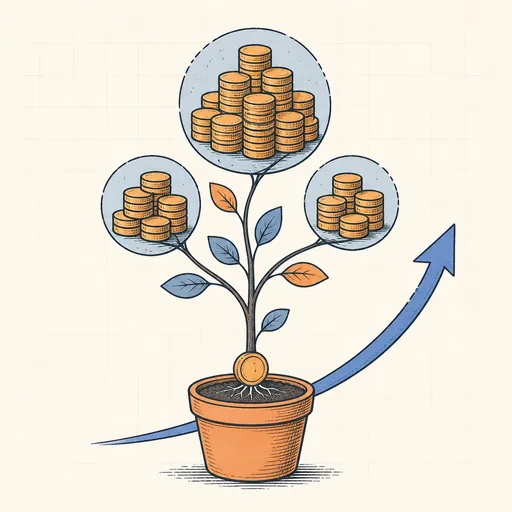
Compound Interest Calculator
Growth of a lump sum plus monthly contributions.
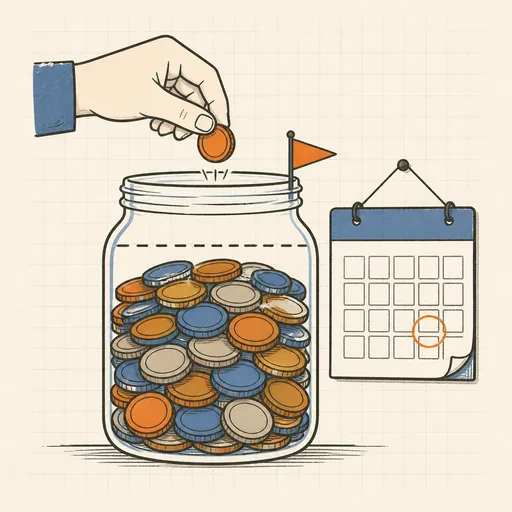
Savings Goal Calculator
Monthly saving needed to hit a target by a date.

APY / Effective Rate Calculator
Nominal ↔ effective annual rate at any compounding.
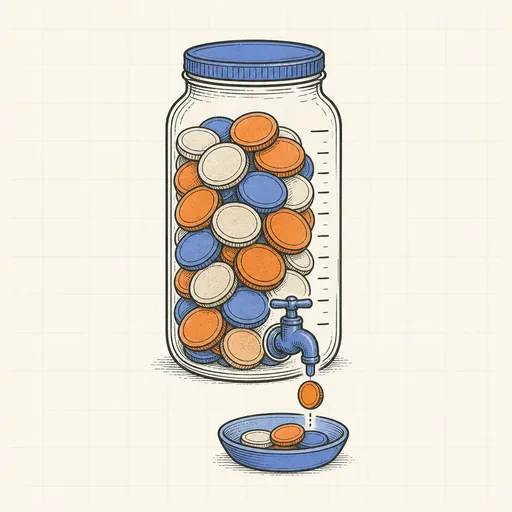
Savings Withdrawal Calculator
How long a balance lasts under monthly withdrawals.

Simple Interest Calculator
Interest without compounding, vs the compound result.
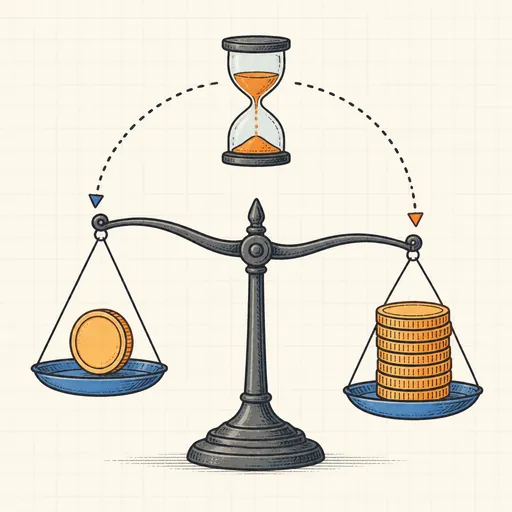
Time Value of Money Solver
Solve any of PV, FV, payment, rate or term.