E-Series Resistor Solver, Explained
After reading this you can pick the standard resistor closest to any value, build a two-resistor series or parallel combination that beats a single part, and choose a divider pair that hits a target Vout/Vin with the smallest error.
What the E-series is and why you cannot buy 3456 Ω
Resistors are not sold in every value. They come in a fixed set of preferred numbers called the E-series. The idea is old and practical: space the values on a logarithmic grid so that a fixed percentage tolerance covers the gaps with no holes and no wasteful overlap.
Each series carries a number that tells you how many values fill one decade. E12 has 12 values from 10 to 100, E24 has 24, E48 has 48, and E96 has 96. So E24 gives you 10, 11, 12, 13, 15, 16, 18, 20, 22, 24, 27, 30, 33, 36, 39, 43, 47, 51, 56, 62, 68, 75, 82, 91, then repeats: 100, 110, 120, and so on up every decade.
Suppose you want 3456 Ω. That value is not in any E-series. In E24 the two nearest neighbors are 3300 and 3600. Neither is close. The solver's job is to tell you exactly how close each option gets, and whether stacking two parts does better.
When to reach for the solver, and when not to
Use it when the exact value matters and a single standard part misses. Feedback networks, gain-setting resistors, timing pairs, and precision dividers all care. Use it also when you want to hit an odd value using parts you already stock, by combining two of them.
Do not over-engineer the everyday cases. A pull-up resistor, a decoupling bleed, or a current limiter for an indicator LED does not need a hand-picked combination. For an LED dropper, the nearest larger standard value is fine, and the LED Series Resistor Calculator handles that directly. If you only need current, voltage, or power from Ohm's law, the Ohm's Law Calculator is the shorter path.
A clever combination can look perfect on paper and still be wrong in the drawer. Two 5% resistors combined to 0.1% nominal error still drift by roughly 5% in the real part. If the ratio matters, buy tighter parts (E96 at 1%), not more parts.
The math behind the grid and the error
The E-series values follow a geometric progression. For a series with n values per decade, the ideal steps are
Here n is 12, 24, 48, or 96, and k is the position in the decade. The step ratio between neighbors is 10^{1/n}. For E24 that is 10^{1/24} \approx 1.1006, a step of about 10.06%. For E96 it is 10^{1/96} \approx 1.0243, about 2.43%. The published tables round these to two or three digits, which is why E24 lists 4.64 as 4.7 and 4.22 as 4.3.
Relative error is the honest way to judge a fit, because the grid is logarithmic. For a candidate value R against a target T:
The worst case for a single part sits halfway between two grid points on the log scale. That half-step is 10^{1/(2n)} - 1. For E24 that is about 4.9%, so any target in an E24 decade is within roughly 5% of some stocked value. For E96 the worst single-part miss is about 1.2%.
Series and parallel combinations
Two resistors extend the reachable grid. In series they add:
In parallel they combine by reciprocals:
The solver scans every pair of standard values across the sensible decades, computes both combinations, and ranks them by e. Series is best when you need a value between two grid points; parallel is best when you need a value below a stocked part or a fine trim.
Worked example: hitting 3456 Ω in E24
Reproducing the demo
Set the mode to a target resistance, enter 3456, choose E24, and solve. Follow the arithmetic.
- Find the nearest single E24 value. The neighbors are
3300and3600. Errors: (3300-3456)/3456 = -4.51\% and (3600-3456)/3456 = +4.17\%. Best single part:3600at +4.17%. - Try a series pair.
3300 + 150 = 3450, error (3450-3456)/3456 = -0.17\%. Both 3300 and 150 are E24 values. - Check an even closer series pair.
3300 + 160 = 3460, error +0.12\%. Also both E24. - Try parallel for comparison.
5100in parallel with11000gives \frac{5100 \times 11000}{16100} = 3484 Ω, error +0.82\%. Worse than the series pair here.
The best result is the series pair 3300 + 160 at 0.12%, a 35-fold improvement over the 4.17% single part. Note the ranking depends on tolerance: with 5% parts, 3450 and 3460 are indistinguishable in practice.
Solving voltage-divider ratios
A divider drops an input voltage by the ratio of its lower resistor to the total. With R1 on top (to the supply) and R2 on the bottom (to ground), the output taken from their junction is
What matters is the ratio, not the absolute values. Scale both resistors by the same factor of ten and the ratio is unchanged. That freedom lets you pick a decade for your current budget: smaller resistors draw more current and stay quieter, larger ones save power but pick up more noise. The Voltage Divider Calculator works the other direction when you already know the parts.
For a target ratio of 0.3333 (a divide-by-three), one clean E24 answer is R_1 = 20\,\text{k} and R_2 = 10\,\text{k}: the ratio is 10/30 = 0.3333, error under 0.01%. The solver ranks pairs by ratio error so you can trade an exact match against parts you actually stock.
Because the divider output feeds into a load, the load resistance sits in parallel with R2 and pulls the ratio down. Keep the divider stiff: make R1 and R2 at least 10 times smaller than the load, or buffer the output with an op-amp.
Explore how tolerance swallows precision
Common mistakes
Chasing nominal error past the tolerance grade is the big one. Ranking a 0.02% pair above a 0.15% pair is pointless with 5% parts. The two are the same resistor once you account for spread.
Confusing series and parallel behavior is next. Series always gives a value larger than either part; parallel always gives a value smaller than the smaller part. If you need something below your smallest stocked resistor, only parallel helps.
Forgetting power dissipation trips people on dividers and loads. A resistor's error rating means nothing if it overheats. Compute P = I^2 R and derate. A pair that shares dissipation runs cooler than one part doing all the work.
Finally, ignoring temperature coefficient. Two resistors in a ratio drift apart if their tempcos differ. For a divider that must hold accuracy over temperature, use a matched pair or a resistor network, not two loose parts.
Related tools
Once you have the value, decode or encode the bands with the Resistor Color Code Calculator. If your resistors feed an RC network, the Capacitor Charge Calculator gives the time constant and stored energy. And when the resistors set corner frequencies in an active filter, the Active Filter Designer turns a Butterworth or Bessel response into component values you can round to the E-series.
Frequently asked questions
Why is 3456 not a standard resistor value?
Standard values sit on a logarithmic grid. E24 spaces values about 10% apart, so between the neighbors 3300 and 3600 there is nothing. To hit 3456 exactly you combine two parts or accept the nearest single value's 4.2% error.
Series or parallel: which gives a closer match?
Neither always wins. Series reaches values above your largest part and fills gaps between grid points; parallel reaches below your smallest part and gives fine downward trims. The solver computes both and ranks them by error so you take whichever is closer for your target.
Does E96 always beat E24 for accuracy?
For a single part, yes: E96's worst-case miss is about 1.2% versus about 4.9% for E24. For combinations the gap narrows, because two E24 parts already reach most values to a fraction of a percent nominally. What E96 buys you is the tighter 1% tolerance, and that is what actually limits real accuracy.
Can I scale a divider pair to any resistance?
Yes. Multiply both resistors by the same power of ten and the ratio is unchanged, since R_2/(R_1+R_2) is dimensionless. A 10k/20k pair and a 100k/200k pair both divide by three. Pick the decade that balances current draw against noise.
Why does my measured divider output differ from the calculation?
The load draws current through the tap point, placing itself in parallel with R2 and lowering the ratio. Keep the divider resistances at least ten times below the load impedance, or use an op-amp buffer to isolate the tap.
Related tools
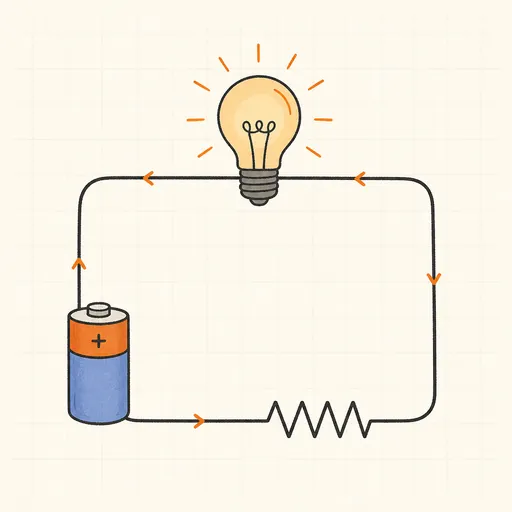
Ohm's Law Calculator
Any two of V, I, R, P — get all four.
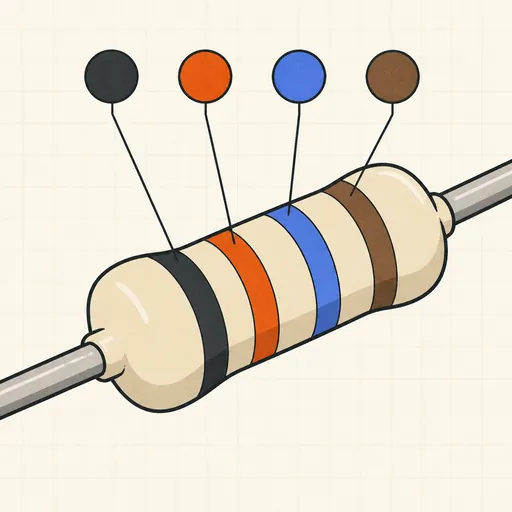
Resistor Color Code Calculator
4- and 5-band colors → value, or value → colors.
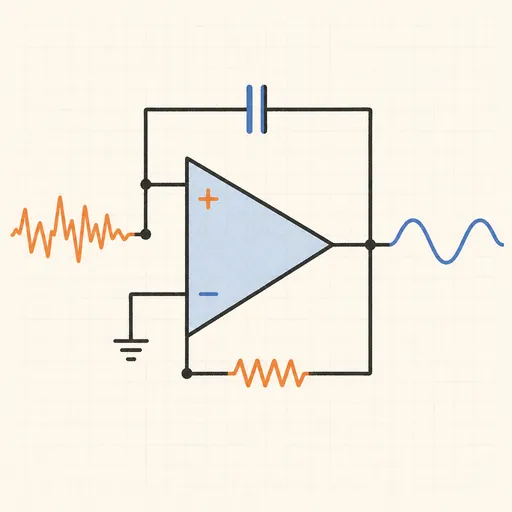
Active Filter Designer (Sallen-Key)
Butterworth, Chebyshev or Bessel — component values and Bode plot.
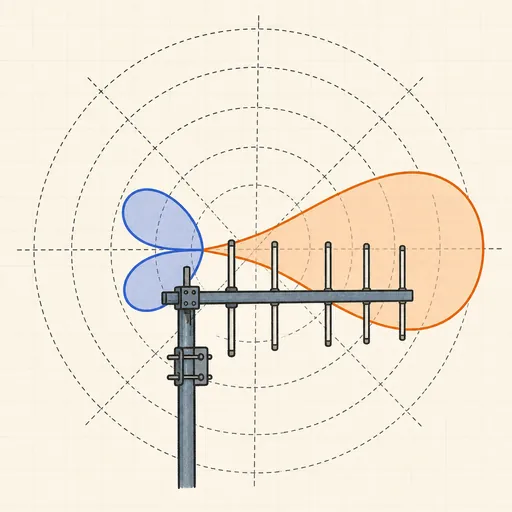
Antenna Radiation Pattern Explorer
Polar plots of dipoles, Yagis and phased pairs — see why more elements mean a narrower beam.
Capacitor Charge Calculator
RC time constant, charge curve and stored energy.
LED Series Resistor Calculator
The right resistor for any LED and supply voltage.